Home AboutArchivesBest Of Subscribe

Various Cutaways of Rat

TV Comedy

(You’ll need to have read this piece on the Fawlty Towers episode “Basil the Rat” and its two-day recording schedule, along with this short follow-up, in order to get anything out of this post. Also, fair warning: we get deep into the weeds with this one.)

Somebody recently emailed me with a reasonable enough question: where do I get all the old television scripts I use in my writing here on Dirty Feed?

You may perhaps expect me to be hanging around various libraries and archives, but for boring practical reasons, that isn’t usually the case.1 Instead, I have various other sources. Some of them are already published in books, like the Absolutely Fabulous pilot.2 Some of them are just sitting online if you know where to search, such as the pilot for Mary Tyler Moore. Some of them I simply get sent by friendly people every now and again. (Yes, I will write about that Love Thy Neighbour script one day, promise.)

Then there’s auction houses. And while I occasionally buy scripts from eBay and the like, I can’t afford to do that too often.3 But just occasionally, you get lucky. As I was when it came to Fawlty Towers, and – you’ve guessed it – “Basil the Rat”, or just “Rat”.

[Read more →]


  1. Oh, you want a longer explanation? Fine. I believe I’m very careful here on Dirty Feed when it comes to copyright and fair dealing. I only use extracts of copyrighted works for the purposes of criticism or review – and the stuff I do here definitely counts as that.

    However, archives are generally a bit stricter than this when you’re actually quoting material they hold, and demand that you get permission from the copyright holder. It’s a) a faff, b) you might not get permission, and c) I seriously want to make sure I don’t upset anyone and make myself persona non grata by disobeying the rules. So with a lot of my stuff, it’s ironically easier to avoid official avenues. 

  2. Though you have to be careful to figure out you’re not working from transcripts, or scripts which have been edited to take all the fun stuff out of them. 

  3. I recently had to stop myself from buying the script for an episode of long-lost Bob Monkhouse sitcom The Big Noise. I still slightly regret controlling myself. 

Read more about...

Basil the Rat Redux

TV Comedy

Last time, we talked about how “Basil the Rat” was unique among Fawlty Towers episodes, in that it had two days in the studio. But there is another thing which makes it unique: the episode was also shot in front of two separate studio audiences.

Both of these audience sessions were on the second day of recording: the 20th May 1979. A matinee, followed by the evening performance. Bob Spiers gives full details on the DVD commentary:

“I think we were able to actually get it together by something like 4 o’clock on the second day, and consequently we showed this I think to two audiences, which gave the actors to really play two separate performances, which they were delighted to do. So I think mainly this is the second performance, but again we used bits of both performances.

I don’t think any actor would turn that down. They know the first performance is like a proper dress rehearsal with an audience, so they can sense the timing and can sense where the laughs are coming.”

Note that the above is different to the famous example of dinnerladies, which was also recorded in front of two separate audiences. But dinnerladies had one audience recording on the first day in the studio, and then the other audience recording on the second day, which gave Victoria Wood a chance to rewrite parts of the script based on the audience reaction of the first recording. “Basil the Rat” did both one after the other. Well, with a dinner break in-between.

It’s a point which is worth hammering home: “Basil the Rat” having two days in the studio had many advantages, rather than simply being useful for recording live rodents. The gang got both extra time for rehearsing the main show, and two bites of the cherry into the bargain.

*   *   *

Bob states above that while most of the episode was taken from the second recording, a few moments were taken from the first. The obvious question is: which ones?

Oh, how I’d love to write that article. I’m sorry to disappoint you. Details of that are lost to the mists of time, and I doubt even the darkest depths of Caversham could shed light on it. If I had a time machine, I’d spend most of my life going through Bob Spiers’ bins.

Also lost to the mists of time are the studio tapes of both performances. Very little unbroadcast footage of Fawlty Towers is known to exist; the bloopers ripped from the Christmas tapes are about your lot. Sure, in an ideal world, the BBC would have been aware that they were making something so special, that they should save every last scrap of material recorded for the series for posterity. But my brain is corrupted by years of DVD extras, and it’s unreasonable to expect the Beeb in 1979 to share my stupid brain. They were too busy making the next piece of great television.

But just imagine. “Basil the Rat” is one of the best half-hours of sitcom ever made. And for an indeterminate period of time, there existed two complete versions of the episode… just played in a slightly different way. All the same lines, all the same beats. Like a version of the episode which slipped in through a wormhole from a parallel universe. I’m imagining the DVD menu. “Basil the Rat: Alternative Version”.

Tell you what, though: considering the raw footage dragged up for the Gold documentary in 2018, I bet you could do it for dinnerladies. And that would have the added interest of seeing all of Victoria’s rewrites. Someone commission me, quick.

Read more about...

TC8, 19th May 1979

TV Comedy

What is special about the Fawlty Towers episode known variously as “Rat”, “Rats”, and nowadays as “Basil the Rat”?1

Most obviously: the episode was delayed due to strike action at the BBC. Originally intended for broadcast on the 26th March 1979, it finally made it to air on the 25th October 1979, billed in the Radio Times as a “Fawlty Towers Special”. This is all an interesting topic in its own right, and something I’ll write about properly at some point.

Today’s subject matter is slightly more oblique. The delay the strike caused in recording the episode was much appreciated by director Bob Spiers, for a very particular reason. He talks about it on the DVD commentary for the show; I will quote it at length, because it’s all relevant.2

“As it turned out, it worked brilliantly to our advantage. because after we had read through, and I’d analysed just what was involved in this episode in terms of special effects and rats running around all over the place and just the number of scenes we had to do, it had finally become in my opinion totally and completely impossible to do this show with one day in the studio.

So I think we had to finally say the game was up, this was just too complex to achieve in one hit, and we needed to pre-record certain bits with the rat, and with other bits and pieces. Just given the amount of work that we had to do camera-rehearsing the show in general. It just would never, ever have worked.

So luckily at the last minute, with this little delay, I went cap in hand to the powers that be, and just finally had to admit defeat, really, and just say: listen, boys, this just ain’t gonna be possible. So very grudgingly, they agreed to allow me two days in the studio, and some pre-record time to do the special effects pieces. So this is an episode that had two days in the studio.

In other words: while every single other episode of Fawlty Towers had one day in the studio, “Basil the Rat” had two.3 A few years later, certain complicated sitcoms such as The Young Ones would have two days in the studio as a matter of course. But in 1979, it was not a common occurrence.

Those two recording days for “Basil the Rat” were the 19th and 20th May 19794, in Studio 8 at Television Centre. On the 19th, they pre-recorded various scenes without an audience; on the 20th the rest of the episode was recorded with an audience present. Of course, the inserts recorded on the 19th would also be played into the audience sessions on the 20th5, in order for the audience to follow the story, and to record their reaction to the pre-recorded scenes.

So far, so good, and the story usually ends there. But, to quote a particularly troublesome guest at the hotel: “I’m not satisfied.” It’s all very well to hand-wave the pre-recorded sections as “certain bits with the rat, and with other bits and pieces”. I want to know exactly which bits they deemed complicated enough to need pre-recording. Of course, we can make some guesses from watching the episode, but that’s not good enough, is it?

What is good enough, is – waves vaguely – a scrap of paper I have here, which lists every single section of the show pre-recorded on the 19th May. And while it doesn’t give time codes for each pre-recorded section, it does list the actors involved, and the exact duration of each insert, which makes it all relatively easy to work out. And some scenes which turn out to have been pre-recorded are ones you really wouldn’t expect… at least, at first glance.

Let’s take a look. For each pre-recorded section, I’ve made a video which labels exactly when the audience recording transitions into the pre-recorded section, and then back to the audience material.

[Read more →]


  1. The history of Fawlty Towers episode titles is too complex to go into here. Suffice to say that the episode titles as we now know them are not the ones used when the series was in production. 

  2. Many people don’t like the Bob Spiers Fawlty Towers commentary, because he talks about boring things such as a pillar being removed from the upstairs landing set. I really enjoy the Bob Spiers Fawlty Towers commentary, because he talks about boring things such as a pillar being removed from the upstairs landing set. 

  3. Not including reshoots made to the pilot, which is a special case, and not the kind of thing we’re talking about here. 

  4. As per Andrew Pixley’s article on Series 2 of Fawlty Towers in TV Zone #152, and confirmed by an independent look at the production paperwork for the series. 

  5. There were two audience sessions on the 20th, not one, but that’s a different article. 

Read more about...

,

“There Are Herrings on the Roof Again!”

TV Comedy

Doing a parody of Fawlty Towers would, at first glance, seem a most inadvisable thing. Parodies of comedy are always a tricky proposition; parodies of one of the funniest comedies ever made is even more so.

This hasn’t stopped many of the great and the good attempting it over the decades. So to celebrate 50 years of Basil and the gang, let’s take a look at all the different take-offs of Fawlty Towers over the years. The good, the bad, and The Laughter Show.1

The Mike Yarwood Christmas Show

TX: 27th December 1976 • BBC1

Mike Yarwood went through a spate of Basil Fawlty impressions, but this sketch from his 1976 Christmas show is the one to focus on. Partly because it’s so early; just a year after Series 1 of Fawlty Towers first aired, it’s by far the earliest parody of the show I could find.

Oh, and partly because the sketch clearly uses parts of the actual Fawlty Towers set, albeit rejigged to take less space in the studio:

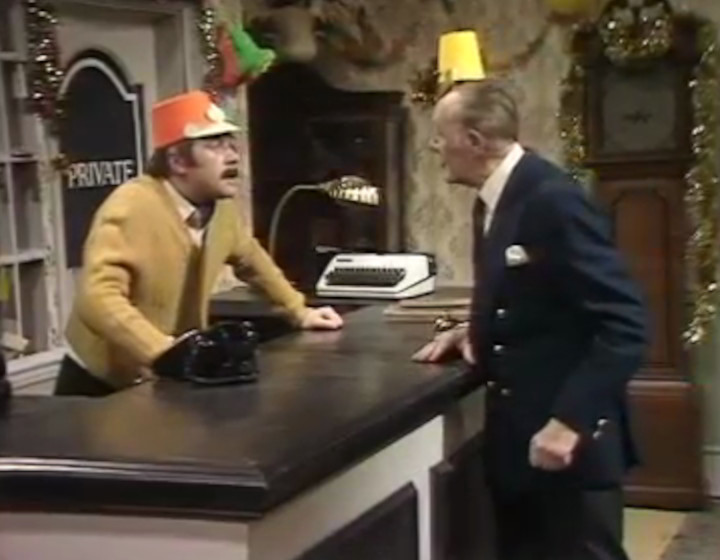
The Mike Yawood Show: Yarwood as Basil, with Ballard Berkely as the Major

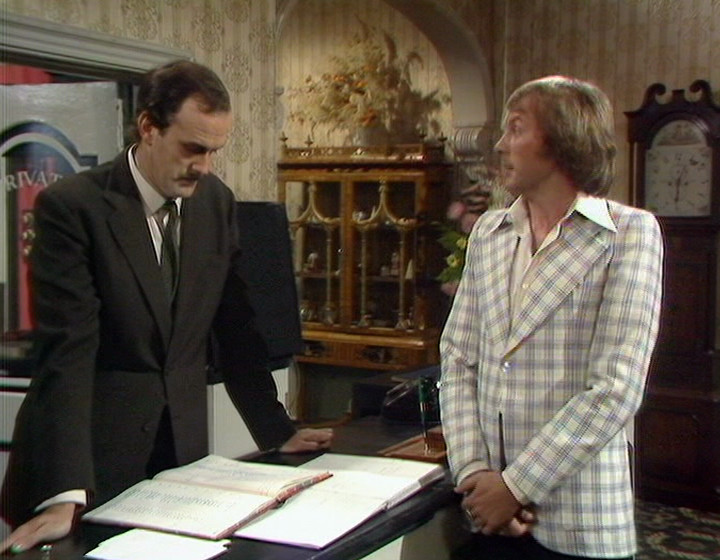
Fawlty Towers: John Cleese as Basil, and Trevor Adams as Alan. Although the main point here is that the set in both pictures is extremely similar.

Note that in the above, the window in the door to the office has been blanked out, so you can’t see that they haven’t erected the office set. And saving space in the studio is the clear rationale behind combining the lobby and the dining room, which gives a peculiar sense of visiting Fawlty Towers in an alternate universe:

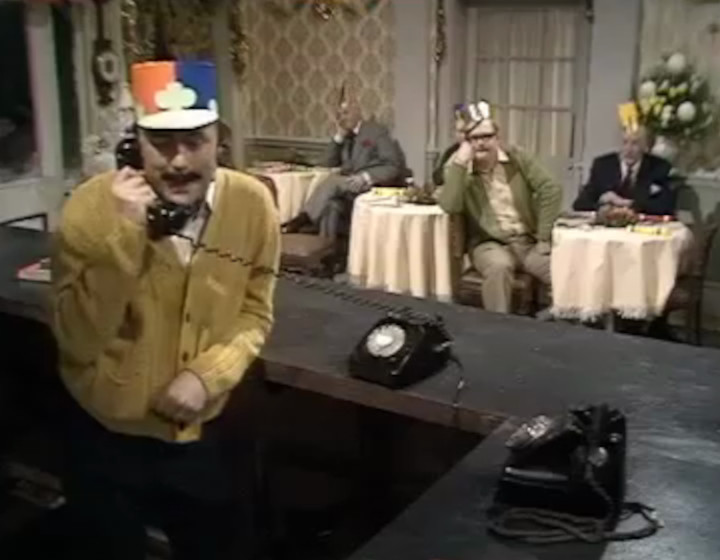
The Mike Yawood Show: Yarwood as Basil, with various guests sitting along the wall to the dining room

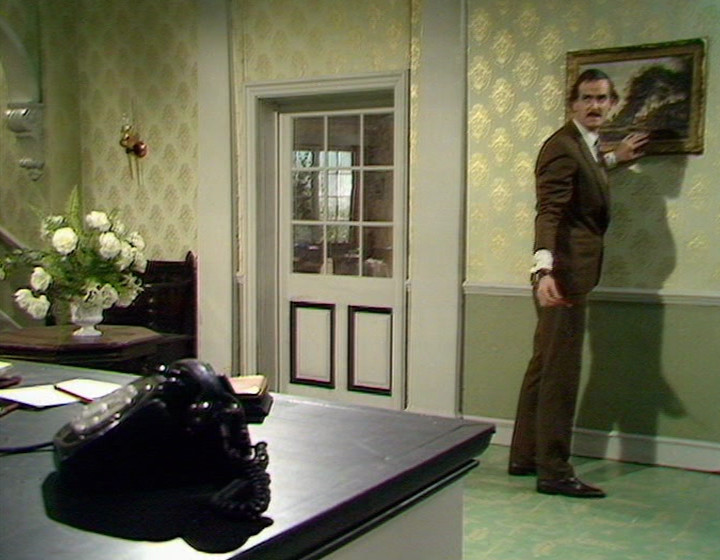
Fawlty Towers: John Cleese as Basil, and of course nobody sitting in the lobby, because that's not how the show worked

Sadly, all the set nonsense above is pretty much the most interesting thing about the sketch, which is one of the the least effective parts of Yarwood’s 1976 show. I guess the ventriloquist stuff is making the point that Cleese occasionally talks through clenched teeth? Precious little of it is anything like Fawlty Towers at all; rather, it’s just an excuse for Yarwood to do his own material in a slightly different setting.

Nice to see Ballard Berkeley and Renee Roberts, though.2

[Read more →]


  1. Look, I allow myself one cheap shot per year on this site. 

  2. Speaking of Ballard Berkeley, I saw him in The Playbirds the other day. Sadly, he didn’t get to have sex with Mary Millington. Pity, it would have livened the film up a bit. 

Read more about...

, ,

“Lucky Old Bin, I Say”

TV Comedy

What is the most famous ending to an episode of Fawlty Towers? Surely “Gourmet Night” has to be up there, first broadcast on the 17th October 1975.

“Duck’s off, sorry.”

Great stuff, yes? Well, one of the delights with Fawlty Towers is hearing John Cleese endlessly tear apart classic moments of the show on his DVD commentary. It always bugged me that Basil doesn’t quite put the lid of the dish down correctly in the above scene, and Cleese concurs:

“When I put the dish down I should have cleanly covered the trifle. Then I should have waited longer before I leaned down and peeped…”

On the famous “Duck’s off, sorry” line, he’s happier:

“And that’s all you need at that moment – it’s almost a dying fall ending, there’s not a big laugh, but it rounds it off nicely.”

Yet there’s a mystery about this particular ending, which I first touched on a couple of years ago. And Cleese unfortunately doesn’t tackle it in the DVD commentary at all. Sitting on Getty Images is this intriguing photo, taken by Don Smith for the Radio Times, during the afternoon dress rehearsal of the episode.1

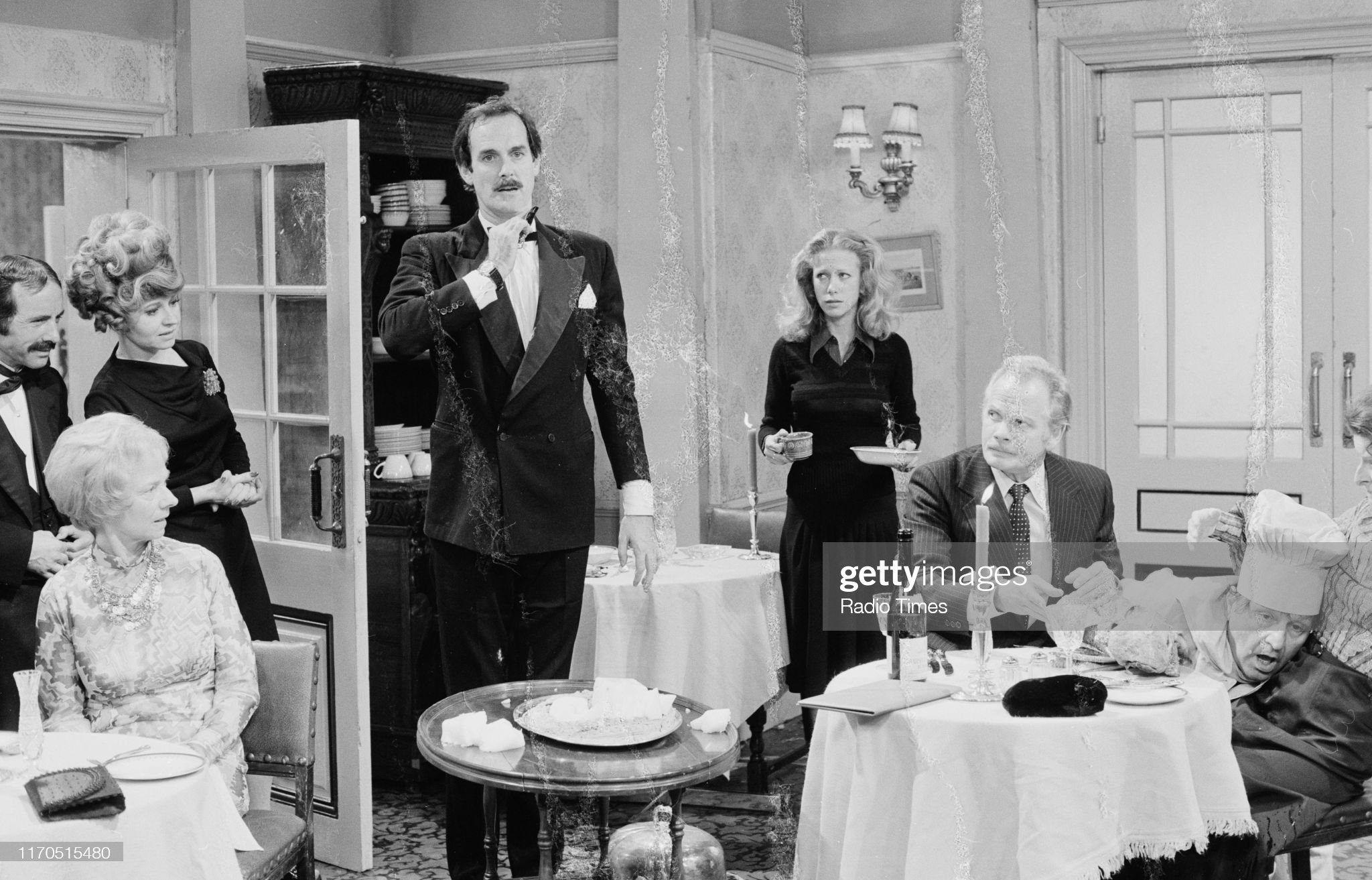
Actors (L-R) Andrew Sachs, Betty Huntley-Wright, Prunella Scales, John Cleese, Connie Booth, Allan Cuthbertson and Steve Plytas in a scene from episode 'Gourmet Night' of the BBC television sitcom 'Fawlty Towers', September 6th 1975. (Photo by Don Smith/Radio Times via Getty Images)

What the bloody hell is our drunken chef Kurt doing there on the right, in Mrs Hall’s lap? At no point in the broadcast episode does he appear in that final scene. What’s going on?

[Read more →]


  1. Note that they clearly didn’t want to waste a real trifle during the dress rehearsal. 

Read more about...

,

Unsolved Fawlty Towers Mystery #1834793

TV Comedy

What’s the most oft-told tale of a Fawlty Towers recording session going a little wrong?

The answer is surely the famous anecdote concerning “The Builders”.1 John Cleese has told the tale many times, with varying levels of insults directed at Icelanders. Let’s go for the version in the interview on the original 2001 DVD release:

“The second show that we did, which was about the builders, was performed almost entirely to complete silence, and it was not a very comfortable experience. Afterwards, I was a bit disturbed, and people said “No no, it was a funny show.” Actually, I think it’s the least good of the twelve shows, but they said “No, it was fine, it was funny”. I said “What about the audience?”, and they said “We don’t know…”

We found out later that a large number of people from the Icelandic Broadcasting Corporation had visited the BBC that day, and the BBC were always helpful to shows like mine. And they thought wouldn’t it be nice if they put all 70 of them in the front row. And they sat there being very pleasant and charming and Icelandic, and not laughing at all. Just this faint whiff of cod coming from the front row… which had we recognised, might have given us the explanation. And I’ve got to say it was a pretty tough recording, and it needed quite a lot of editing to tighten it up.”

The audience reaction to “The Builders” isn’t quite as bad as Cleese paints above, but it is fairly muted. As this was the first episode recorded after the pilot a few months previously, it’s understandable that Cleese would be particularly worried by the audience reaction here. He must have been wondering whether the show as a whole actually worked or not.

Regardless of all that, the above is a nice, safe tale to tell. The only people who come across badly are the BBC tickets unit, a safe target who can’t really answer back. And who cares if you’re mildly racist about the Icelandic? None of it is as dangerous as, say, slagging off one of your fellow actors.

John Cleese knows this. Because when he did such a thing, many years ago, he deliberately omitted the name of the person he was slagging off. Take a look at this interview in the Sunday Sun, on the 13th May 1979, about a month and a half after Series 2 of Fawlty Towers had come to a premature halt.2 While discussing the process of making the show:

The tension can affect everybody: one actor, says John, suddenly changed his performance at the filming stage. “I was tired and started fluffing… and, oh, the whole show was less good than it should have been.”

Sadly, Cleese gives no more details. I’m also not aware of him ever mentioning this again; not even on his absurdly detailed DVD commentaries from 2009. Who was it who screwed Cleese over by changing their performance during a recording?

I have no idea. Anyone?


  1. Episode recorded 3rd August 1975, and transmitted on the 26th September 1975

  2. Due to strike action, “Basil the Rat” missed its recording window, and ended up being shown months after the rest of the series. I’ll be writing more about this at some point. 

Read more about...

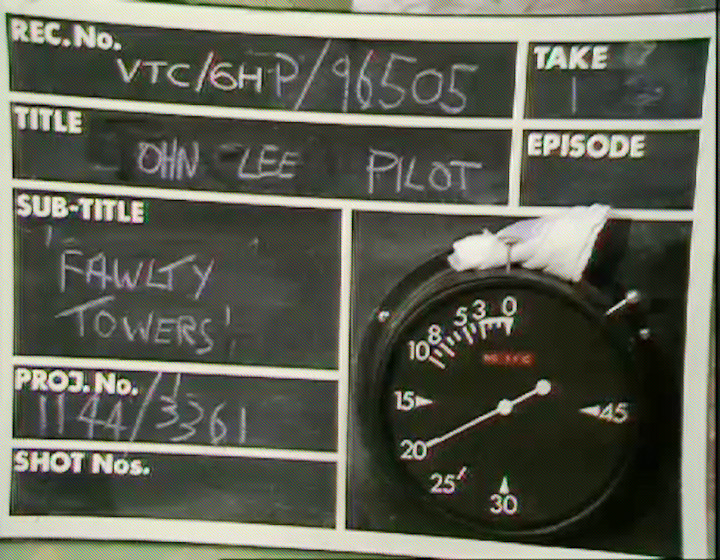
Project No: 1144/3361

TV Comedy

Fawlty Towers VT clock for the pilot

If there’s one thing you should know about me by now, it’s that I will accept any excuse to write about Fawlty Towers. Already this year, we’ve taken a look at cut material from “Gourmet Night”, a superb stage direction from the pilot, and the real truth behind Polly becoming a philosophy student.

Those latter two pieces were written with the aid of a camera script of that pilot: the actual script they took into the studio on the 23rd December 1974. And of course, there are numerous other revelations in that script, which I just have to share with you. Including one moment which I desperately wish had made it to the screen.

Let’s take a step through the episode as broadcast, and see what fun stuff we can dig out. I haven’t mentioned every single tiny change in dialogue, because you would want to kill me, but that still leaves plenty to take a look at. Material present in the script but cut or changed for transmission is rendered like this.

[Read more →]

Read more about...

,

BBC100: Fawlty Towers (1975-79)

TV Comedy

For more on this BBC100 series of posts, read this introduction.
BBC 100 logo, with Basil, Sybil and the health inspector

I admit it. When writing about old television, there is often the desire to pick out something obscure nobody has heard of in decades. It’s not an attempt to be clever. (Well, not always, at least.) It’s just that sometimes, you really want to highlight a programme which you feel deserves more attention than it’s been getting lately.

Not today, though. Fawlty Towers, John Cleese and Connie Booth’s masterwork, is as obvious a choice as you can get, if your task is “pick something brilliant that the BBC made in the 1970s”. What is perhaps more surprising is how many lessons the show has for the kind of comedy we could make today. But we’ll get to that in all good time.

The genesis of Fawlty Towers is oft-told, but worth revisiting. Let’s take a short trip back to Torquay, May 1970. The Monty Python team are busy shooting location material for their second series. Unfortunately – or perhaps fortunately for Cleese – they have booked into the Gleneagles hotel, run by a certain Donald Sinclair. He proceeded to be rude to pretty much everybody: insulting Terry Gilliam’s eating habits (“We don’t eat like that in this country!”), staring bemusedly at Michael Palin when being asked for a wake-up call, and most memorably, hiding Eric Idle’s bag behind a wall in case it contained a bomb. “We’ve had a lot of staff problems lately”, stated Sinclair, in an attempted explanation of the latter.

While most of the team moved to a different hotel in the morning, John Cleese stayed… and Connie Booth, his then-wife, joined him a few days later. They sat and watched. And little by little over the years, elements of Sinclair started appearing in John Cleese’s work. In 1971, he wrote an episode of LWT’s Doctor at Large set in a hotel, featuring a proto-Fawlty character called Mr. Clifford. It went down rather well. The character was clearly destined for his own sitcom.

That sitcom was Fawlty Towers. And it’s an incredibly simple series on the face of it, with only four main characters. There’s Basil and Sybil Fawlty, who are uneasily married. There’s Polly the waitress, usually the voice of sanity, and Manuel the waiter, who isn’t. Together they run a hotel, or in Basil’s case, use running a hotel as an excuse to bully the guests. That, in a nutshell, is it.

And yet it isn’t. Fawlty Towers is many things. It’s an exquisitely-written farce. (The camera scripts were twice the size of a typical BBC sitcom of the time.) It’s a character study, particularly of Basil. But it’s also a sitcom where the “sit” is actually important, rather than just a place to put your characters. This is one thing which isn’t appreciated enough: the show is partly a satire of the service industry, where (as Cleese is fond of saying in interviews) hotels are often run for the convenience of the staff instead of the guests. It’s not a topic which sounds immediately entertaining at first glance, but that’s the joy of comedy: it makes the driest of subjects fun. This point was not lost on Cleese, who three years earlier had set up Video Arts, a company which used comedians to make training materials based on that exact principle. Fawlty Towers can genuinely be viewed as a 12-part hotel management training course, if you desire.

Then there’s the true heart of the show: Basil Fawlty, a desperately appalling man. Stuck between strata of the class system, looking down at the “riff-raff”, and desperately fawning upwards at lords or doctors, we laugh at him because most terrible things that happen to him are his own fault. Basil’s problem isn’t just that he is ludicrously uncomfortable in his own skin; it’s that he inflicts the results of that uncomfortableness on everybody else. If he got on with running a hotel instead of sitting in judgement over everybody who walked through the door, his life would be rather more satisfying. But his neuroses are his – and everybody else’s – downfall.

As was standard for sitcoms at the time, Fawlty Towers was shot in front of a live studio audience. (A real studio audience too – no canned laughter here.) It’s a style of programme which has rather fallen out of fashion in the UK these days; only a few stragglers like Not Going Out and Kate & Koji remain. I will admit to being an unashamed ambassador for what a studio audience can bring to comedy. For a start, an audience forces your sitcom to actually be funny; you can’t get away with inducing a wry, silent smile. It also helps the timing of the performances – actors can react to the room, rather than a vacuum. Obviously you don’t want every TV show to have an audience; different material suits different production methods. But for certain kinds of comedy, nothing quite matches the atmosphere of an audience sitcom. It brings the whole thing alive.

I don’t think there’s anything particularly controversial in the above. But to some people, it really seems to be. And it’s when you hear the arguments against doing any sitcom in front of an audience that I begin to get infuriated. One persistent canard is the idea that “I don’t need to be told when to laugh”. Which is not in any way the point of a show having a studio audience, and starts to reveal the said person’s own neuroses in a manner which would make Basil Fawlty proud. To decry the presence of audience laughter in a sitcom under any circumstances seems to me to be a profoundly anti-creative thing to do. It’s the same as criticising all musicals because “people don’t just suddenly start singing in real life”. To demand some petty interpretation of realism just because a viewer has no imagination doesn’t seem to me to be the best way of creating good television.

Fawlty Towers demands an audience for all kinds of reasons, not least because there are huge laugh lines which utterly demand a reaction. But here’s one big reason why I feel a studio audience is so important to the show: because humiliating Basil is so much more satisfying when it’s done in public. The sound of hundreds of people laughing at his ludicrousness is important. We can understand Basil, we even can feel sorry for Basil, but crucially: it’s important to laugh at Basil too. After all, do you want to end up like him? The studio audience is a vital part of his ritual humiliation.

That’s why Fawlty Towers stands as a template of how to do a mainstream sitcom today. People often focus on the show’s ludicrously complicated plots, and yes, they’re fantastic, immaculately constructed things. But a large part of the joy of the show is poking a character who deserves to be poked, over and over again, while he continues to embarrass himself. That was valid comedy in 1975, and it’s equally as valid in 2022. Giving a kicking to one of the less attractive parts of being British is surely what our comedy is designed for.

People are obsessed with the idea that old comedy easily becomes “dated”. I usually find this to be at best an overstated phenomenon. Humans don’t change that quickly, and some things are eternal. Fawlty Towers is essentially about an incompetent, angry sycophant. It’s not like that breed of human has disappeared in the last few decades.

And they still need to be made fun of. Perhaps more than ever.

Read more about...

,

The Unexamined Sitcom Is Not Worth Watching

TV Comedy

Sometimes, a sitcom mystery you’ve wondered about for years suddenly gets resolved. And for Dirty Feed, this one is the motherlode. After all, with the pilot episode of Fawlty Towers, you’re talking about something as close as you can get to a sacred text around here.

Strap yourself in. This is a good one. Let’s start from the beginning.

One of the most important things to understand production-wise about the pilot of Fawlty Towers – usually known these days as “A Touch of Class” – is that it really was a genuine pilot, made eight months before the rest of the series. The majority of the studio scenes in the episode were shot in front of an audience on the 23rd December 1974, for eventual broadcast on BBC2 on the 19th September 1975. In comparison, the rest of Series 1 was shot in August/September 1975, less than two months before transmission.

[Read more →]

Read more about...

, ,

“Instead of Murdering Him”

TV Comedy

Take a look at the below scene from the pilot of Fawlty Towers, recorded in Studio 8 at Television Centre on the 23rd December 1974, and broadcast on the 19th September 1975.

I always think the knocking of the tray, expertly executed by Cleese and Booth, doesn’t get nearly enough of an audience reaction. Come on, it should get roars. But slagging off TV Centre audiences from 1974 isn’t our topic for today.

[Read more →]

Read more about...

,