Home AboutArchivesBest Of Subscribe

A Piece of PIAS

Computing / Internet / Videogames

I don’t let the old Acorn/RISC OS fanboy in me out very much any more. At least, not in polite company. But I have to admit, when reading a blog post recently from somebody around my age1, which was complaining about how unsafe they felt buying computers from the US due to the Trump administration, a little voice popped into my head, unbidden.

“YOU HAD THE CHANCE TO BUY BRITISH IN THE 90S AND YOU DIDN’T, IT’S TOO LATE NOW!”

Ahem. Slightly unfair, of course – Acorn’s machines had plenty of US involvement, not least with partners like VLSI – but I still think there’s a reasonable point there when it comes to the software stack. And anyway, being slightly unfair is the whole point of being a fanboy.

Still, I should dial this rather unpleasant part of me back to something useful. So let’s travel a little further back in time to my BBC Master days. Specifically the release Play It Again Sam 6.
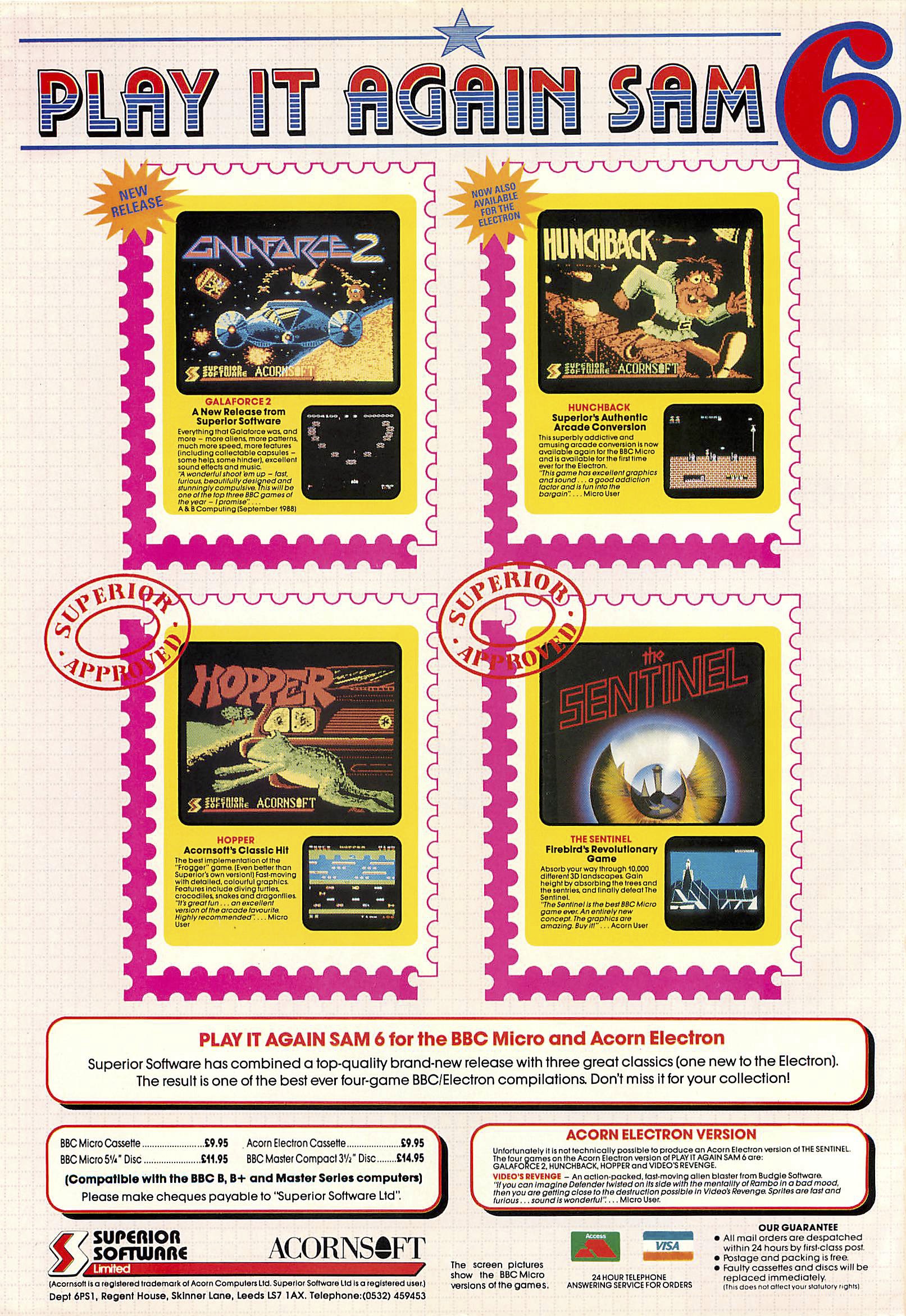
Play It Again Sam 6 advert

Play It Again Sam 6 advert, from the January 1989 issue of Acorn User

Play It Again Sam was that magic thing: a win for both company and consumer. Take four old games Superior Software had the rights to, package them up with minimal effort, charge the same amount as a single game would, and watch the money flow in. Crucially, if you already had two of the games, the releases were still a bargain. The 8-bit incarnation ended up running for 18 installments between and 1987 and 19932, and sometimes there was even a brand new game included.

So given that value for money, along with loving my BBC Master more than life itself, I owned every single release, yes? In fact, no. I think Play It Again Sam 6 was the only one I owned. And while I had a “healthy” collection of pirate games – including some games which appeared on various Play It Again Sam releases – I certainly didn’t own every game featured on them, legally or otherwise. Nowhere near.

I think maybe this is something that’s easy for us to forget as adults. (Or at least, the kind of adults who read this site.) Recently, I’ve been on a bit of a Jayne Mansfield kick, and have been tracking down as many films of hers as I can reasonably watch. This means obvious fare like The Girl Can’t Help It, through to less obvious films like The Challenge, and onto true obscurities like The Fat Spy.3 This has involved ordering some truly odd DVD releases. As my friend Darrell said: “When you’re onto the Spanish bootleg DVDs you know you’re in deep.”

But as a kid, I didn’t have the resources to do this kind of collecting. And no matter how much I might love any given thing, the very idea of owning every single release of something was just incomprehensible.4 Not only would I never own every single Play It Again Sam compilation, but of course I would never own every single Play It Again Sam compilation.

After all, I was never going to own every single Donald Duck VHS release either. I’d just wear out the single one I had.

[Read more →]


  1. Deliberately left unlinked, I ain’t interested in a fight. 

  2. Plenty of websites claim that Play It Again Sam 18 was released in 1992, but I don’t believe this is the case. The issue is blurred by the fact that Superior essentially stopped advertising its 8-bit range in the Acorn magazines the start of 1993; but until then, the latest compliation they were pushing was 17. Given that, the 1993 date feels most likely.

    There was also a Play It Again Sam 19 released in 1997, released by ProAction, but this is distinct from the original Superior Software compilations, in my opinion. 

  3. The Fat Spy currently holds the record for the worst film I have ever seen. 

  4. The closest I ever came was Blue Peter annuals, and a) you could get them cheaply at boot sales, and b) that was as much pushed by my parents as much as anything else. 

Read more about...

,

Teenage Archeology

Life

I’ll tell you one thing. There’s something about having scarring from my lungs from a severe case of pneumonia three years ago that – for some reason – makes me very, very, very keen to stay at home at the moment.

Which means I have to find something to do. And as preparation for a house move happening at some point in the next century, I have a load of boxes which need condensing down and packing up. And in these boxes are a huge variety of artefacts stretching right back to my schooldays.

Including rather too many magazines I created in my youth.

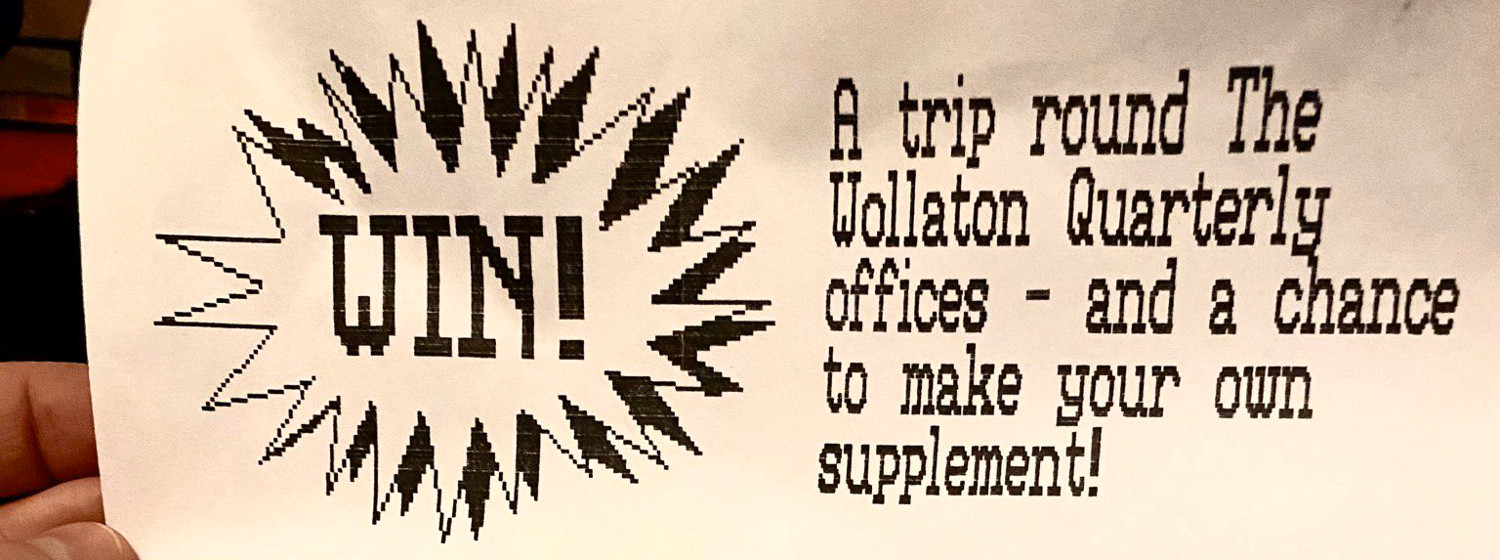
A page from The Wollaton Quarterly

So, while other people are creating amazing pieces of art to keep us all entertained during a crisis, I’m taking photos of some of my old shit and putting them on Twitter. If this sounds like something you might be interested in, here is a list of all my daily threads. I’ll keep adding links to this post each day.

Now, if this doesn’t help us all get through this crisis, what will?

Read more about...

How Strong Are Your Moral Values?

Videogames

The Real You logo

Hey! You, over there! Ever wonder how moral you are? Don’t look at me like that. It’s a straightforward enough question, and easy enough to answer. Isn’t it? No?

Well, never fear. I have a BBC Micro program here which will tell you ALL you need to know. Published by Collins Soft in 1985, The Real You contains 16 tests to – and I quote the back of the packaging – “inspire you and challenge you to discover who you really are”. And one of those tests is simply titled: Morals.

The test consists of 50 questions, and I thought I’d run through some of the most interesting ones here. Feel free to download a copy and play along at home1, though the below gives you enough of a flavour, I feel.

[Read more →]


  1. You’ll need a BBC Micro emulator, and the disc doesn’t auto-boot unfortunately. Type CHAIN"REAL" to get it working. 

Read more about...

,

Acorn Fools’ Day

Computing

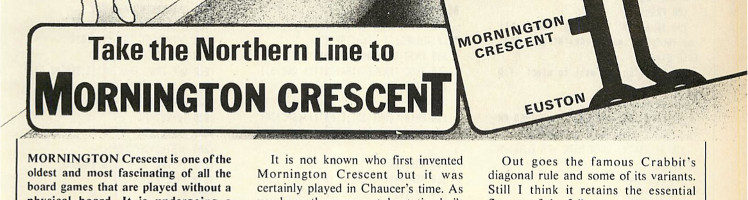
Detail of The Micro User scan

April Fools’ Day tends to get a bit of a bad rap these days. Every year, my Twitter feed gets more and more filled with complaints about how lame it is. As someone involved in a few April Fools over the years, I admit I find myself getting a bit defensive about it. My argument: it’s easy to get hung up on the “prank” aspect of it, with a roll of the eyes, or a scowl. The very best April Fools take the prank aspect as a starting point… and do something interesting instead. The real joy in most good April Fools gags is them going off and doing something else entirely.

The best example of this that I’ve been involved with was pretending the script for the Red Dwarf movie had been leaked. Sure, of course we were trying to fool people into thinking it was true. But beyond that, the actual script extracts we wrote as part of it… kinda have their own interest. They certainly set my mind thinking as to how a Red Dwarf movie would work – which ends up being far more interesting than the actual prank itself.

Still, I get it. Perhaps the internet does make the day lose a bit of its lustre. These days, as soon as you wake up on April 1st and check online, you’re inundated with EVERY WEBSITE DOING A FUNNY. It can get rather wearing, especially when there’s so much crap about – and as you’re automatically on your guard, the whole thing is far less fun. In the old days, it was different. The April edition of a magazine might plop on your mat, way before April 1st… and maybe, just maybe, catch you unawares. The whole thing had a… less mechanical air.

Which leads us to this article. Some of my favourite April Fools growing up were in the pages of Acorn User and The Micro User; two Acorn computing magazines I was absolutely besotted with. I thought it’d be fun to take a look at some of the April Fools they ran over the years. It’s not a complete rundown of every single one they ever did – just a sample of some of the more interesting ones. Neither are they all gold: I’ve not cherry-picked just the really good ones just to make my point. But it’s a nice reminder of the days when April Fools gags were given just a little time to breathe.

It’s also perhaps a reminder that some of the best April Fools gags are often ones targeted at a very specific audience, rather than a general one. By their very nature, April Fools are a bit self-indulgent – and they’re one place where in-jokes can run riot to very good effect. (Another reason why I think some of the Red Dwarf ones I’ve been involved in work so well.) If you don’t have the background knowledge required for some of these, they’ll inevitably fall rather flat. I’ll give some notes as we go, but that’s very much Worth Bearing In Mind.

[Read more →]

Read more about...

, ,

A Personal Anthology

Computing

Emotional Public Domain Software.

That’s what the opening title of the program reads. This is BBC Micro public domain disc BBC PD #171, “Something About Me”. The catalogue description reads: “…by Oliver Debus. A personal anthology of graphics, digitised images and scanned pictures.”

And that’s what we get. Dated 1989 in one of the program files, you can download the disc image file from 8BS – but I’ve captured a video of it below, to save you the trouble of emulating. (Contains brief, low resolution nudity.)

At first pixellated glance, at a slideshow of 320 x 256 black and white photos, this might seem far removed from anything teenagers are doing now. But come on – pictures of yourself, of famous people you like, of things you’re interested in, of silly cartoons, all with captions – sent out into the world for other people to see?

This is just a 1989 version of Tumblr. How fabulous.


  1. Technically, in fact, this disc only runs on a BBC Master. Disc #75 however, dated 1991, contains an amended version by Duncan Lilly, which changes the visual transitions to work on a normal BBC Micro. 

Read more about...

,

Four Channels

Music / Videogames

Here’s something rather silly I’ve put together. Anyone up for a bunch of 8-bit versions of popular TV and film themes, taken from a load of BBC Micro games? I CAN TELL YOU ARE, HELLO YOU.

Some of the pieces are really well done – I especially love the opening version of the Match of the Day theme – and some… aren’t. What the bloody hell is that interpretation of Play Your Cards Right?

[mejsaudio src=”https://www.dirtyfeed.org/audio/fourchannels.mp3″ volume=”false”]

Download “Four Channels” (13MB MP3, 11:06)

[Read more →]

Read more about...

Oh, a magic door! Well, why didn’t you say?

Computing / TV Comedy

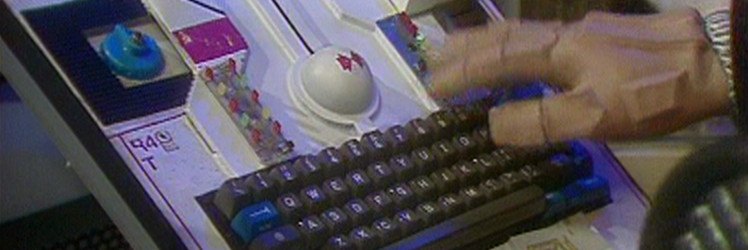
Kryten uses a BBC Micro

It is a truism that fandom has hugely changed over the last twenty years. My favourite example of this is Red Dwarf Series 1: it was only released on VHS in 1993, five years after broadcast. Before then, it was only passed around as grotty nth-generation off-airs. Meanwhile, Red Dwarf X was released on DVD a week-and-a-half after the final episode – and on iTunes throughout the run.

Another thing changed from that time is public domain software libraries. Gone are the days where you could order floppy disc upon floppy disc full of fascinating stuff, and have to wait excitedly for it to arrive. I distinctly remember wanting to order nearly every disc from that BBC Micro public domain library; I could only afford a handful. Now, everything is just a click away.

Out of the whiz-bang demos and, erm, mouse drivers, one disc in particular I did manage to order sticks in the memory. That was BBC PD Disc #165 (formerly a Mad Rabbit PD disc), Red Dwarf Documents“Answers to ‘Frequently asked’ questions about Red Dwarf, a complete episode guide and other text files of interest to the Red Dwarf fan.” (Proper Red Dwarf fans will realise that the disc number should clearly have been #169.)

[Read more →]

Read more about...

,

Gratuitous

Videogames

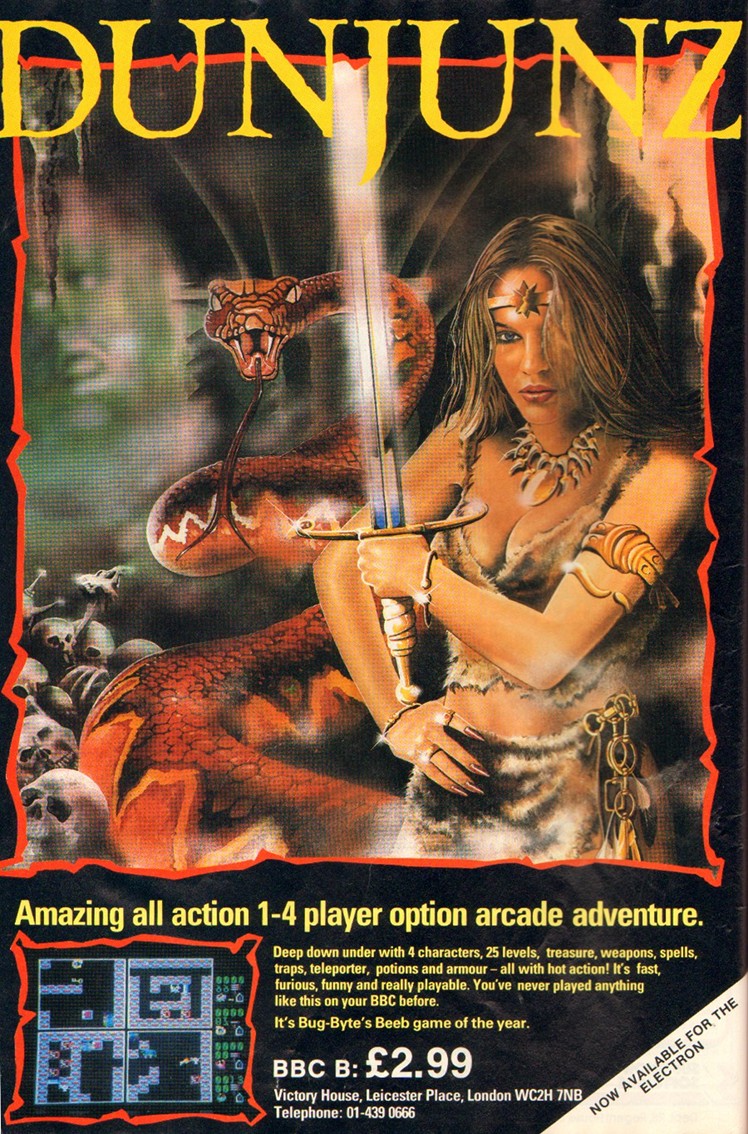
From the June 1987 edition of A&B Computing:

Scan of Dunjunz advert

And here was me thinking it was just ports which used such tactics, and homegrown BBC Micro games were a paragon of virtue…

Read more about...

*CAT

Computing

Sometimes I feel I do nothing more than to waste my life tediously pointing out that just because something is old, it doesn’t mean it’s worthless. Sometimes, however, even I have to admit that society has moved on. Slapping hot girls on the arse with no warning is no longer an acceptable part of society, and nor are public domain libraries. Going through a catalogue, selecting your discs, filling out the order form, writing out a cheque, popping it all in the post, and waiting for a week has been replaced by the simple click of a mouse.

However, going through yet another of my boxes recently, I found my old paper catalogue for BBC PD; a BBC Micro public domain library. It’s catalogue no. 15, from June 1993; vague memories tell me it was the penultimate one before the library closed down, but I can’t confirm. As I can’t find any scans online, I thought some of you might find it interesting. As ever, apologies for the bad state of the source material and my terrible scanning:

BBC PD Summary Catalogue No. 15 (PDF, 32MB)

Sadly, the library closed down before I could order more than one set of discs. Thanks to the wonders of the internet, however, most of the library is available from 8bs.com – search the page for “BBC PD Library”. (The disc-based version of the catalogue is also available.) Finally, I can hear all that music removed for copyright reasons…

Read more about...