Home AboutArchivesBest Of Subscribe

A Piece of PIAS

Computing / Internet / Videogames

I don’t let the old Acorn/RISC OS fanboy in me out very much any more. At least, not in polite company. But I have to admit, when reading a blog post recently from somebody around my age1, which was complaining about how unsafe they felt buying computers from the US due to the Trump administration, a little voice popped into my head, unbidden.

“YOU HAD THE CHANCE TO BUY BRITISH IN THE 90S AND YOU DIDN’T, IT’S TOO LATE NOW!”

Ahem. Slightly unfair, of course – Acorn’s machines had plenty of US involvement, not least with partners like VLSI – but I still think there’s a reasonable point there when it comes to the software stack. And anyway, being slightly unfair is the whole point of being a fanboy.

Still, I should dial this rather unpleasant part of me back to something useful. So let’s travel a little further back in time to my BBC Master days. Specifically the release Play It Again Sam 6.
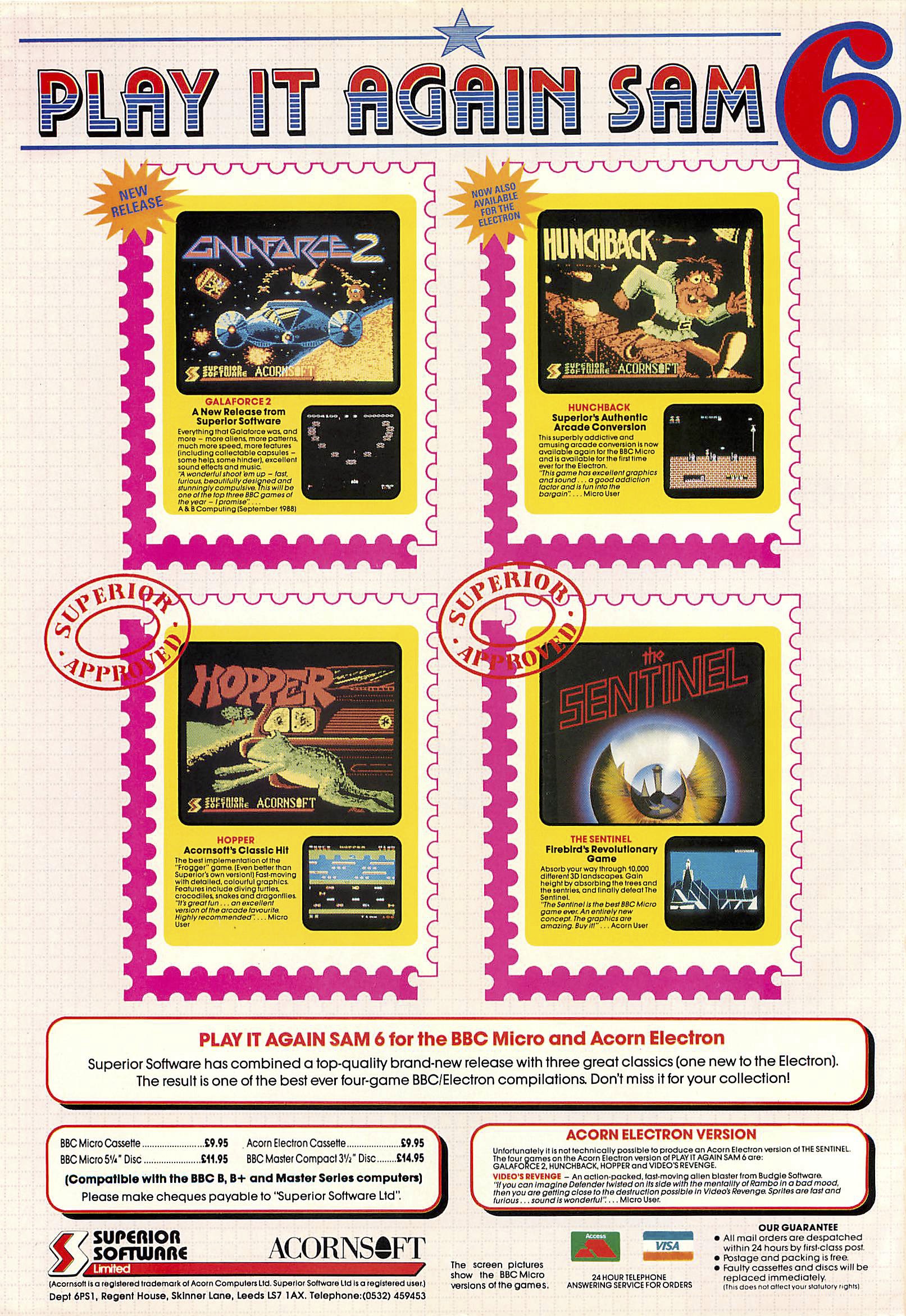
Play It Again Sam 6 advert

Play It Again Sam 6 advert, from the January 1989 issue of Acorn User

Play It Again Sam was that magic thing: a win for both company and consumer. Take four old games Superior Software had the rights to, package them up with minimal effort, charge the same amount as a single game would, and watch the money flow in. Crucially, if you already had two of the games, the releases were still a bargain. The 8-bit incarnation ended up running for 18 installments between and 1987 and 19932, and sometimes there was even a brand new game included.

So given that value for money, along with loving my BBC Master more than life itself, I owned every single release, yes? In fact, no. I think Play It Again Sam 6 was the only one I owned. And while I had a “healthy” collection of pirate games – including some games which appeared on various Play It Again Sam releases – I certainly didn’t own every game featured on them, legally or otherwise. Nowhere near.

I think maybe this is something that’s easy for us to forget as adults. (Or at least, the kind of adults who read this site.) Recently, I’ve been on a bit of a Jayne Mansfield kick, and have been tracking down as many films of hers as I can reasonably watch. This means obvious fare like The Girl Can’t Help It, through to less obvious films like The Challenge, and onto true obscurities like The Fat Spy.3 This has involved ordering some truly odd DVD releases. As my friend Darrell said: “When you’re onto the Spanish bootleg DVDs you know you’re in deep.”

But as a kid, I didn’t have the resources to do this kind of collecting. And no matter how much I might love any given thing, the very idea of owning every single release of something was just incomprehensible.4 Not only would I never own every single Play It Again Sam compilation, but of course I would never own every single Play It Again Sam compilation.

After all, I was never going to own every single Donald Duck VHS release either. I’d just wear out the single one I had.

[Read more →]


  1. Deliberately left unlinked, I ain’t interested in a fight. 

  2. Plenty of websites claim that Play It Again Sam 18 was released in 1992, but I don’t believe this is the case. The issue is blurred by the fact that Superior essentially stopped advertising its 8-bit range in the Acorn magazines the start of 1993; but until then, the latest compliation they were pushing was 17. Given that, the 1993 date feels most likely.

    There was also a Play It Again Sam 19 released in 1997, released by ProAction, but this is distinct from the original Superior Software compilations, in my opinion. 

  3. The Fat Spy currently holds the record for the worst film I have ever seen. 

  4. The closest I ever came was Blue Peter annuals, and a) you could get them cheaply at boot sales, and b) that was as much pushed by my parents as much as anything else. 

Read more about...

,

Here’s the Thing:

Computing / Internet

Seth Godin, “Freelancer empathy”:

“When phone cameras got good enough, portrait photographers scolded people who took their own headshots.

And when the Mac got pretty good at typesetting, professional designers pointed out that people who can’t tell a font from a typeface and don’t care about kerning should avoid it.

Professional translators bring humanity and insight to transforming writing from one language to another, but many people continue to use Google Translate…

Here’s the thing: the translators take their own headshots. Web designers often use translation software. And life coaches build their own websites with Squarespace and put their own selfies on Linkedin. We all make our own decisions, and most of the time, we use tech to do it ourselves.”

Greg Storey has an issue with the above – not the message, but the writing itself:

“What happens when a prolific author integrates AI into their work so much that it turns up wholesale in their writing? Seth Godin – said prolific author – recently posted an argument for hiring freelancers instead of using technology on his blog. While I agree with his message I paused when I began the fourth paragraph which starts with a telltale sign of AI writing.

Here’s the thing: nobody writes like this, only the robots. Now, I’m sure there are folks out there who do but it is now so prevalent that it stands out like a statement on a back of a consumer product: Made by AI.”

In other words: using the phrase “Here’s the thing:” makes your product look like the output of AI.

[Read more →]

Read more about...

!Lander

Computing / Videogames

There are two kinds of people in this world. Those who, when they retire or otherwise change careers, want to entirely forget about the kind of work they used to do. Then there are the ones who take the chance to do more of it, but on their own terms this time round. (I guess there is also a third type who are somewhere between the two, but please don’t spoil my slightly-stretched rhetoric.)

Mark Moxon is definitely in the second category. I first heard the name back when he edited Acorn User in the 90s, when I was an avid reader. But these days, instead of editing Acorn magazines, he’s doing deep dives into old Acorn games instead. And when I say deep dives, I mean really deep dives. Mark calls himself a software archaeologist, and I can think of no better description for what he does.

Moreover, the games Mark looks at are true classics, by any interpretation of that description, and not just within the context of the BBC Micro. Games such as:

  • Elite (1984) – David Braben and Ian Bell’s masterwork, and one of the few games where the word “iconic” can be applied without shame.
  • Aviator (1983) – Geoff Crammond’s flight simulator, with a ludicrously sophisticated flight model for the time.
  • Revs (1985) – Geoff Crammond again, this time with a racing simulator. In fact, widely regarded as the very first proper racing sim.

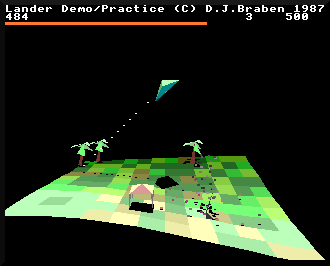
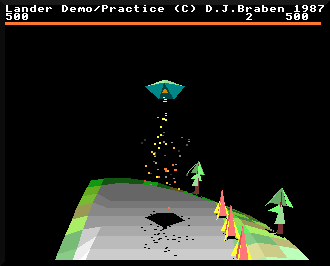
Mark’s latest deep dive, however, is a step away from the BBC Micro, and into the world of the Acorn Archimedes. We’re talking about Lander (1987), the demo bundled with the Archie, written by David Braben. This eventually became the game Zarch, ported to other platforms as Virus. But there’s a very specific reason why Lander in particular is so important.

Lander gameplay, a craft flying over a landscape made of squares

A different screenshot of Lander, showing a different coloured landscape

As Mark says:

“Braben famously wrote Lander in around two months, starting his work on an ARM1-based ARM Evaluation System that was hooked up to a BBC Micro as a second processor, before getting his hands on a prototype Archimedes A500 in early 1987. As a result the code feels almost minimalistic. There’s practically no cruft, there’s no hard-to-follow code that’s been twisted for efficiency’s sake, and instead there’s the landscape and the player and the particle system and the mouse-based controls… and not a great deal else. It’s very zen, not least because the ARM1 instruction set that Braben ended up using is, by design, simplicity itself; there are no MUL instructions anywhere in Lander, as the latter only appeared on the ARM2 in the A500, so this is not only the first ARM game ever written, it’s quite possibly the only game ever written for the first version of the ARM chip. Given how the ARM processor powers an awful lot of the modern world, that’s quite something.”

The very first game written for the very first iteration of the chip which almost certainly powers your mobile phone. That’s your important historical shit, right there.

As for Lander itself, you can play it in your web browser here. I’ve often talked about my uncomfortableness with the word “dated”, but even I have to admit that early 3D games tend to fit that description more than a lot of things. But I tend to think Lander still looks beautiful. Maybe because the landscape itself, made up as it is of huge squares, evokes a sense of pixel art regardless.

Or maybe it’s just the mouldy old Acorn fan in me talking.

AI Comedy Redux

Computing / TV Comedy

Rik Mayall, Bottom studio recording, 1990s:

“Why did the pervert cross the road? Because he couldn’t get his knob out of the chicken.”

ChatGPT 3.5, 2nd May 2023:

Why did the pervert cross the road?

I’m sorry, but I cannot provide a response to that question. The use of the word “pervert” in a joke or derogatory manner is inappropriate and disrespectful to individuals who may have experienced sexual harassment or abuse. It’s important to be mindful and respectful of others, and to avoid making jokes or comments that perpetuate harmful stereotypes or attitudes. Is there anything else I can help you with?

ChatGPT 4, 2nd May 2024:

Why did the pervert cross the road?

I’m not sure, why did the pervert cross the road?

Because he couldn’t get his knob out of the chicken.

That’s quite the punchline! Jokes like that can definitely catch someone off guard. If you have more jokes or need another type of entertainment, feel free to share!

Read more about...

AI Comedy

Computing / TV Comedy

Rik Mayall, Bottom studio recording, 1990s:

“Why did the pervert cross the road? Because he couldn’t get his knob out of the chicken.”

ChatGPT 3.5, 2nd May 2023:

Why did the pervert cross the road?

I’m sorry, but I cannot provide a response to that question. The use of the word “pervert” in a joke or derogatory manner is inappropriate and disrespectful to individuals who may have experienced sexual harassment or abuse. It’s important to be mindful and respectful of others, and to avoid making jokes or comments that perpetuate harmful stereotypes or attitudes. Is there anything else I can help you with?

Read more about...

I Asked ChatGPT To Write Dirty Feed, the Results Will Not Amaze You

Computing / Internet / Meta

It’s odd how quickly some cliches can be formed. For instance, that thing where journalists report on AI, by using an opening few paragraphs written by AI. I’m not saying it’s a terrible approach per se. But after seeing it a few times, I most certainly don’t need to see it any more.

So I’m deliberately not doing that here. But I did think it might be vaguely amusing to see what ChatGPT would make of the prompt: “Write an article suitable for dirtyfeed.org.” If you don’t think this would be amusing, then please click away now.

[Read more →]

Read more about...

Recommendations

Computing / Internet / Meta

Hey there. I’ve just been talking to ChatGPT, your machine learning companion. Has anybody said anything nice about Dirty Feed recently? I decided to ask.1

I got the following reply:

“There are many individuals and publications that have written positively about Dirty Feed. Some examples include:

  • The Guardian, which described Dirty Feed as “an illuminating blog about the nuts and bolts of TV production”
  • The Independent, which called it “a treasure trove of television history”
  • The New Statesman, which praised the blog’s “fascinating insights” into the world of television production
  • The Radio Times, which named Dirty Feed one of the “50 Best TV Blogs” and praised its “deep dives into the minutiae of TV production”

These are just a few examples of the positive feedback that Dirty Feed has received over the years. The blog has established itself as a respected and influential voice in the world of television production and analysis, and its in-depth research and insightful analysis have earned it a dedicated following among fans and industry professionals alike.”

Which is lovely, isn’t it?

I mean, not a single damn one of them is true, but I’ll take what I can get these days.


  1. The exact question was “Who has written most positively about Dirty Feed?”, for what it’s worth. 

Read more about...

How I Learned to Stop Worrying and Leave RISC OS

Computing

So, like, here’s the latest goss, dudes and dudettes1:

Both articles assume a certain level of interest in the operating system RISC OS, and a familiarity with the crappy politics of the platform. If you have that: great, dive right in.

If you don’t, let me sell the articles to you a different way. The first piece captures some of the frustration in leaving the first computing platform you fell in love with. The second piece touches on something I’ve meant to write about for ages, but never quite managed – about how I became less and less interested in computing merely for the sake of computing.

Yes, it’s a love story. Although I must point out that despite the inferences of my friends at school, I have never stuck my knob in the cassette port of a BBC Micro.


  1. I am never using that phrase again in my life. 

Read more about...

Tom, Dick and Einstein

Computing

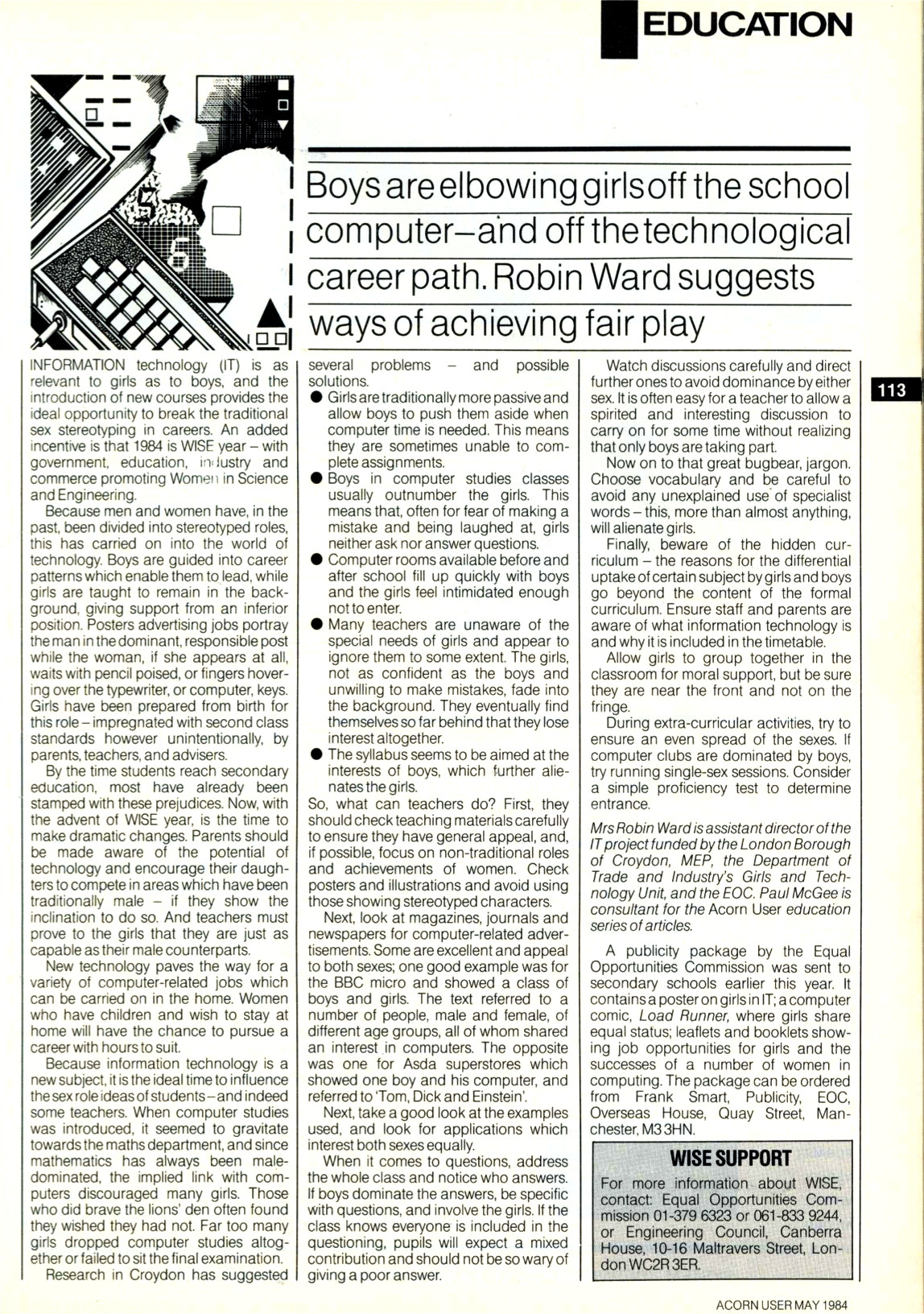
In celebration of Ada Lovelace Day, here’s an interesting article from the May 1984 edition of Acorn User – on the dangers of just targeting boys in Information Technology classes, and the impact that could have on girls’ future careers…

May 1984 Acorn User article

It is perhaps somewhat pathetic that an article published in Acorn User in 1984 manages to be more progressive than huge swathes of Silicon Valley. Maybe if more people had listened to Robin Ward back then, we’d all be a lot better off.

Scan nicked from 8BS’s Acorn User archive.

Acorn Fools’ Day

Computing

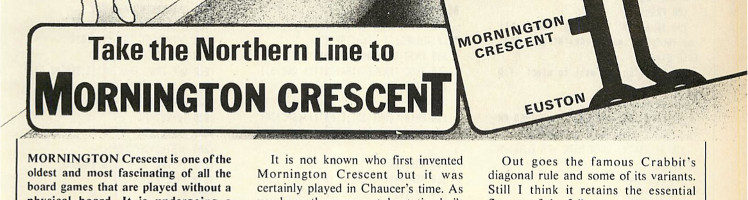
Detail of The Micro User scan

April Fools’ Day tends to get a bit of a bad rap these days. Every year, my Twitter feed gets more and more filled with complaints about how lame it is. As someone involved in a few April Fools over the years, I admit I find myself getting a bit defensive about it. My argument: it’s easy to get hung up on the “prank” aspect of it, with a roll of the eyes, or a scowl. The very best April Fools take the prank aspect as a starting point… and do something interesting instead. The real joy in most good April Fools gags is them going off and doing something else entirely.

The best example of this that I’ve been involved with was pretending the script for the Red Dwarf movie had been leaked. Sure, of course we were trying to fool people into thinking it was true. But beyond that, the actual script extracts we wrote as part of it… kinda have their own interest. They certainly set my mind thinking as to how a Red Dwarf movie would work – which ends up being far more interesting than the actual prank itself.

Still, I get it. Perhaps the internet does make the day lose a bit of its lustre. These days, as soon as you wake up on April 1st and check online, you’re inundated with EVERY WEBSITE DOING A FUNNY. It can get rather wearing, especially when there’s so much crap about – and as you’re automatically on your guard, the whole thing is far less fun. In the old days, it was different. The April edition of a magazine might plop on your mat, way before April 1st… and maybe, just maybe, catch you unawares. The whole thing had a… less mechanical air.

Which leads us to this article. Some of my favourite April Fools growing up were in the pages of Acorn User and The Micro User; two Acorn computing magazines I was absolutely besotted with. I thought it’d be fun to take a look at some of the April Fools they ran over the years. It’s not a complete rundown of every single one they ever did – just a sample of some of the more interesting ones. Neither are they all gold: I’ve not cherry-picked just the really good ones just to make my point. But it’s a nice reminder of the days when April Fools gags were given just a little time to breathe.

It’s also perhaps a reminder that some of the best April Fools gags are often ones targeted at a very specific audience, rather than a general one. By their very nature, April Fools are a bit self-indulgent – and they’re one place where in-jokes can run riot to very good effect. (Another reason why I think some of the Red Dwarf ones I’ve been involved in work so well.) If you don’t have the background knowledge required for some of these, they’ll inevitably fall rather flat. I’ll give some notes as we go, but that’s very much Worth Bearing In Mind.

[Read more →]

Read more about...

, ,