
Home AboutArchivesBest Of Subscribe

First of Six Episodes

Internet / TV Comedy

Last month saw the 35th anniversary of Red Dwarf. For someone who vaguely left organised fandom a few years back, I seem to still do an awful lot of writing about the show. What can I say? I fell in love with it when I was 13, and I still indulge in an awful lot of nasty habits which started around that age.

I also wrote for Dwarf fan site Ganymede & Titan between 2003 and 2020, which is a quite startlingly long time. One day in the mid-2000s – the exact year escapes me – my co-conspirator Ian Symes and I decided to take a trip to that great concrete block, since demolished, that was Birmingham Central Library. There, they had an almost-complete set of Radio Times issues, which we set to photocopying with aplomb. We had all kinds of plans.

Those plans never really came to fruition, because of course they didn’t, this is me we’re talking about. But in 2012, I came across that stack of photocopies, and thought it was worth posting one of them on its own – the original Radio Times capsule for the very first episode of Red Dwarf, “The End” (TX: 15/2/88).

As well as the capsule itself, I also posted the full Radio Times page for that day:
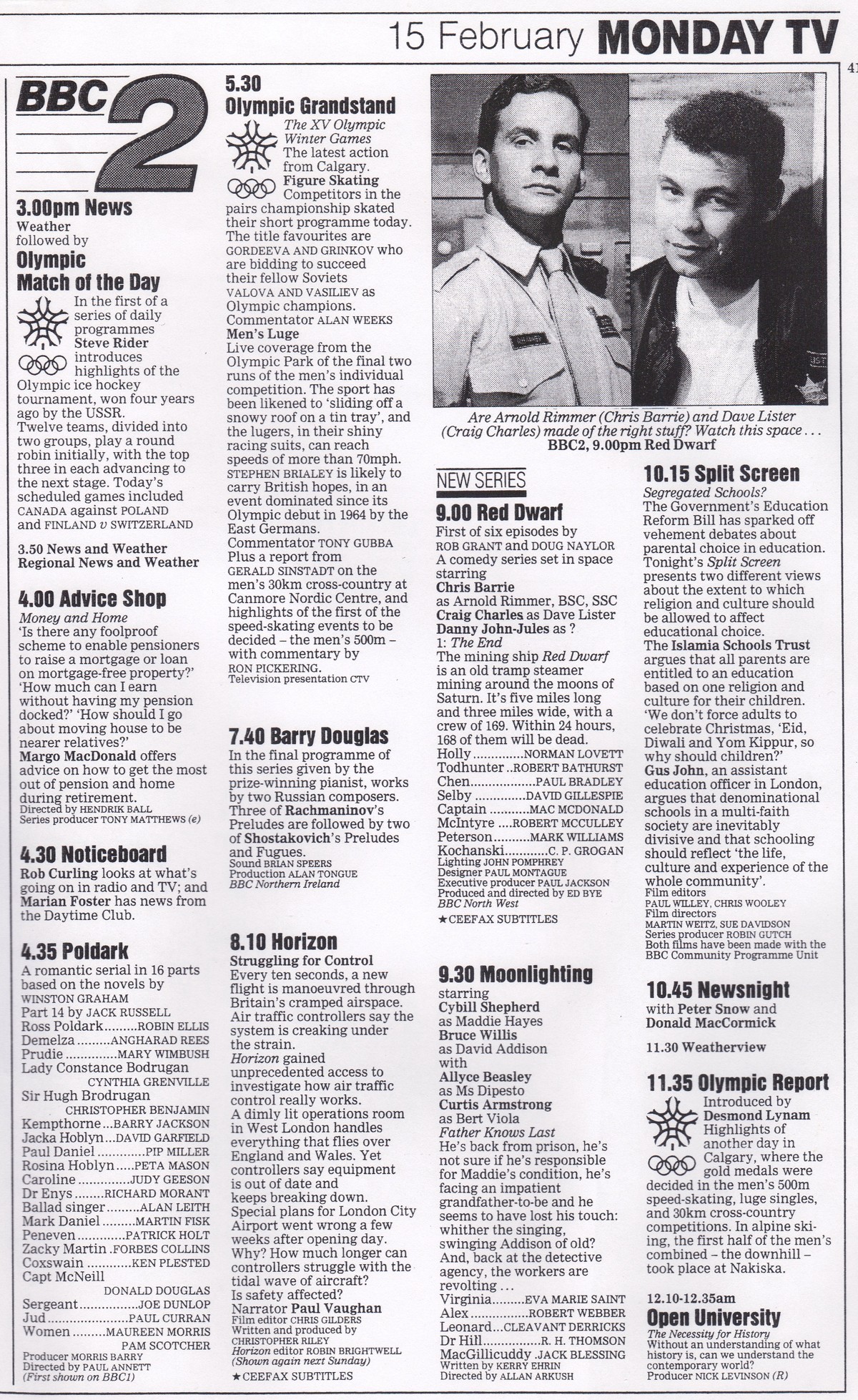
Full Radio Times page for the 15th February 1988, featuring the first episode of Red Dwarf

And there that scan sat on Ganymede & Titan, quietly causing no bother, until the 35th anniversary. When Rob Grant tweeted the image, followed shortly by the official Red Dwarf site using it, as part of a hopeful message about there being more Red Dwarf in the future. And it’s definitely, 100% the same image – it matches my scan perfectly.
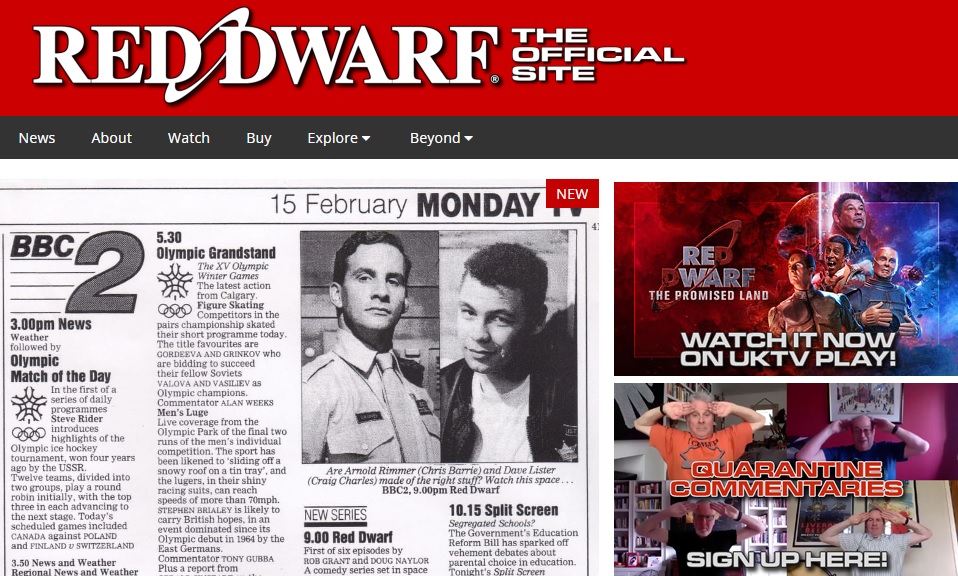
Shot of reddwarf.co.uk with my image

Which I find very strange. Not because of any ludicrous idea that I own copyright to the image or anything. I just find it intensely weird that my love of the show has gone from squinting at it on an old black and white telly in my bedroom in 1994, to rummaging through Radio Times back issues in the mid-2000s, to something that I dug out suddenly being randomly used as part of an official announcement about the show.

The thing I never could have predicted when I was 13, is that you truly can become part of what you love. A tiny, tiny part, maybe. But sitting in my bedroom, that idea didn’t even cross my mind. Millions of people watched Red Dwarf, how would anything I ever did ever be noticed?

But fandom does weird things. It turns millions of people into just a few. And it ends up having bizarre, unpredictable effects. Even after years of this stuff – interviewing Doug Naylor, appearing in fan films which got an official release, Ganymede & Titan being mentioned in DVD commentaries – I’ve never quite got used to it.

Mind you, I’m still not entirely sure how I ended up directing BBC One on a Saturday night, either.

A version of this post was first published in the February issue of my monthly newsletter.
Read more about...

The Docklands, May 1984

Music / TV Comedy

Here’s a question for you. What’s the link between Bananarama and Spitting Image?

Clue: the answer is not that Spitting Image did a parody of them. Let’s take a look at this video for “Rough Justice”, released in May 1984, and featuring Peter Woods being very funny:

I’m obviously going to be a sucker for any music video which shows a pop group TAKING OVER TELEVISION. But the immediate question comes to mind – my mind, anyway – is: where exactly was this video shot? Was it in a real television studio? Or did they just set up a recreation on a film stage somewhere?

[Read more →]

Read more about...

Obsessively Tracing Chris Barrie’s Movements in Late-1987

TV Comedy

While watching a 1987 episode of Spitting Image the other day, something rather odd occurred. And something odd occurring during an episode of Spitting Image has rapidly turned into this site’s speciality.

A bit of background first. In 1986, the show took to frequently featuring a Kenneth Williams puppet, for some reason. A typical appearance is in Episode 4, broadcast on the 26th January 1986, where he’s parachuted into the Tory cabinet:

The unmistakable tones of Chris Barrie providing the voice are… well, unmistakable. And utterly delightful.

Which makes it all the more peculiar that the following year, in the second episode of the series on the 8th November 1987, we get the Kenneth Williams puppet with a distinctly un-Chris-Barrie-sounding voice. (People with keener ears than me identify it as Steve Nallon.)

Chris Barrie had been with Spitting Image from the very beginning. If Barrie is working on your show, and had done a brilliant Kenneth Williams impersonation in the past, why would you suddenly not use him here?

Answer: because Chris Barrie didn’t work on that second episode of the series. Or indeed the first episode the previous week, on the 1st November. But he is present for Episode 3 on the 15th November, and for the rest of the series. What gives?

[Read more →]

Read more about...

, ,

Recommendations

Computing / Internet / Meta

Hey there. I’ve just been talking to ChatGPT, your machine learning companion. Has anybody said anything nice about Dirty Feed recently? I decided to ask.1

I got the following reply:

“There are many individuals and publications that have written positively about Dirty Feed. Some examples include:

  • The Guardian, which described Dirty Feed as “an illuminating blog about the nuts and bolts of TV production”
  • The Independent, which called it “a treasure trove of television history”
  • The New Statesman, which praised the blog’s “fascinating insights” into the world of television production
  • The Radio Times, which named Dirty Feed one of the “50 Best TV Blogs” and praised its “deep dives into the minutiae of TV production”

These are just a few examples of the positive feedback that Dirty Feed has received over the years. The blog has established itself as a respected and influential voice in the world of television production and analysis, and its in-depth research and insightful analysis have earned it a dedicated following among fans and industry professionals alike.”

Which is lovely, isn’t it?

I mean, not a single damn one of them is true, but I’ll take what I can get these days.


  1. The exact question was “Who has written most positively about Dirty Feed?”, for what it’s worth. 

Read more about...

You Stupid Ugly Goit

Radio Comedy / TV Comedy

Close-up of a pixellated Holly

The origins of Red Dwarf are oft-told. Radio 4 sketch show, Son of Cliché, Dave Hollins, job done, right?

And true, one of the first sparks of life of something which turned into Red Dwarf appeared on Radio 4 on the 30th August 1983, with the very first sketch of Dave Hollins: Space Cadet.1


Download “Dave Hollins: Space Cadet – The Strange Planet You Shouldn’t Really Land On” (MP3, 3:41)

Nick Maloney’s corpsing at the end of that sketch is brilliant.

Still, Dave Hollins wasn’t a running sketch in that first series of Son of Cliché. We’d have to wait until the following year for that privilege. And when it did come back, on the 10th November 1984, I would argue that it was as something far more recognisable as Red Dwarf.


Download “Dave Hollins: Space Cadet – Norweb” (MP3, 3:35)

“Jan Vogels” in the first sketch did nearly made it into Red Dwarf – most notably, a far shorter version is present in the US pilot (“You know a guy called Harry Johnson?”).2 But that second Dave Hollins sketch is stuffed with ideas which later found a home in actual, broadcast Dwarf.

[Read more →]


  1. The research for Son of Cliché in this article comes almost entirely from material written in 2003 by Ian Symes, on an early incarnation of Red Dwarf fansite Ganymede & Titan. It’s a measure of how well that research was done that it hasn’t yet been surpassed as reference material for the series. 

  2. The 2007 Red Dwarf DVD release The Bodysnatcher Collection also includes a never-shot version of the sketch, recreated using storyboards. 

Read more about...

,

Short.

Internet

Matt Gemmell:

“If you’ve wanted to start blogging but felt reluctant, I’d like to invite you to shift your perspective. Write less, and be at peace with it.”

Andy Bell:

“Get a lot of posts out quick, and suddenly you’re more confident in your writing, you’ve got some momentum and you get quicker.”

If you want to write online, then write. Short is fine. Short is useful. Just do it.

Read more about...

I Hate Doing Research, Part Three

Meta / TV Comedy

Thank you all for your kind words about my first piece on the flash frames in The Young Ones. Part Two is in the works, but is still a little way off publication. Perhaps the following will explain why.

Let’s take that missing flash frame for “Summer Holiday”, which I comprehensively examined in Part One. It’s something which definitely, never, ever, ever transmitted, or made it into any commercial release of the show, and I have the large pile of recordings here to prove it.

And yet take a look at the paperwork for the episode, back in 1984:

FILM:
1 frame from Shalako (+ BBC cap) property of EMI. Transferred to H25992.

And then read the relevant section of Roger Wilmut’s Didn’t You Kill My Mother-in-Law?, the seminal book on alternative comedy, published in 1989:

“The general style of anarchy, with cutaway sequences and a good deal of stunt work, was maintained: one new running joke was presumably for the benefit of the owners of expensive video recorders, since it consisted of cutting in four-frame flashes which cannot possibly be grasped in real time – they include a leaping frog, a dripping tap, a skier, a potter’s wheel and, finally, a notice signed by the video tape editor saying, ‘I never wanted to put all these flash frames in in the first place.'”

And finally, let’s listen to Young Ones producer Paul Jackson, interviewed on the DVD extra The Making of The Young Ones in 2007:

“It’s on the DVD, it’s on the video versions, but it never was broadcast.”

In other words: in order to find out the truth about whether that “Summer Holiday” flash frame was actually broadcast or commercially released, I’ve had to ignore a) the actual paperwork for the episode, b) a leading comedy historian, and c) the producer of the show. Brilliant.

I say all this not to point out how great I am, but simply to show how easy it is for these things to get warped and twisted down the years. Sometimes, the only way to get to the truth of what was broadcast is by watching the actual material, and seeing what’s there, and what isn’t.

And that’s only possible by getting people to dig out off-airs from 1984. Everything else is guesswork.

A version of this post was first published in the January issue of my monthly newsletter.

Read more about...

, ,

Dwarf on Film

TV Comedy

I used to have a brilliant little trivia question about Red Dwarf, you know. One that you could ask to really try and trip people up. It’s not perhaps one you’d bring out at polite parties with normal people, but hey, we’re all friends here. And that question is:

“What is the only footage of actual actors shot on film in Red Dwarf?”1

The answer is perhaps not immediately obvious. Whether studio or location, the live action scenes in the show have always been shot on videotape – or from Back to Earth onwards, digital video, directly to file. There’s no “film outdoors/video indoors” look, like many sitcoms still had, even in 1988.2

[Read more →]


  1. Excluding stock footage, so things like this don’t count. 

  2. Indeed, One Foot in the Grave was still doing it in 2000. 

Read more about...

,

Savage Garden Cuttings

TV Presentation

One of the joys of researching The Young Ones and flash frames is scouring through people’s old tapes. And sometimes, you find something just too good not to share. Last time, it was an ad-break from a 1984 episode of Spitting Image.

This time? A three minute trail shown in April 2001 on UK Gold, just after a showing of the Young Ones episode “Cash”.

I can’t in all honesty say that “To the Moon and Back” is one of my favourite songs.1 But it works in the context of the above trail, which is really rather wonderfully put together. The mix at 0:47 is particularly effective.

It’s also a reminder that the television of the late 90s/early 00s really does have a distinctive look about it now, entirely distinct from how TV looks today. A certain kind of film stock and transfer, with of course our obligatory 14:9 letterbox.

Anyway, I thought it was something worth sharing, from a time when UK Gold had some absolutely spectacular trails. I really do love it when a channel goes all out and uses virtually the entire length of a song to do something fun, rather than always chopping it down to 30 seconds. It occasionally happens today. But nowhere near enough.

Although maybe I just love that trail purely with my professional, TV channel director hat on. Seriously, do you know how useful three minute trails are, when a live programme finishes unexpectedly early? It can help get you out of a whole world of shit, believe me.

With many thanks to Dan Tootill for digging out this recording. Dirty Feed relies on many people providing access to their old off-airs for research, and I’m absurdly grateful.


  1. I did have a Savage Garden phase c. 1998, and believe it or not, that is not a euphemism. I wanted to make it look like I had cool music to listen to when I was feeling down. There are at least three things wrong with that sentence, and I have no justification for any of them.