Home AboutArchivesBest Of Subscribe

TC8, 19th May 1979

TV Comedy

What is special about the Fawlty Towers episode known variously as “Rat”, “Rats”, and nowadays as “Basil the Rat”?1

Most obviously: the episode was delayed due to strike action at the BBC. Originally intended for broadcast on the 26th March 1979, it finally made it to air on the 25th October 1979, billed in the Radio Times as a “Fawlty Towers Special”. This is all an interesting topic in its own right, and something I’ll write about properly at some point.

Today’s subject matter is slightly more oblique. The delay the strike caused in recording the episode was much appreciated by director Bob Spiers, for a very particular reason. He talks about it on the DVD commentary for the show; I will quote it at length, because it’s all relevant.2

“As it turned out, it worked brilliantly to our advantage. because after we had read through, and I’d analysed just what was involved in this episode in terms of special effects and rats running around all over the place and just the number of scenes we had to do, it had finally become in my opinion totally and completely impossible to do this show with one day in the studio.

So I think we had to finally say the game was up, this was just too complex to achieve in one hit, and we needed to pre-record certain bits with the rat, and with other bits and pieces. Just given the amount of work that we had to do camera-rehearsing the show in general. It just would never, ever have worked.

So luckily at the last minute, with this little delay, I went cap in hand to the powers that be, and just finally had to admit defeat, really, and just say: listen, boys, this just ain’t gonna be possible. So very grudgingly, they agreed to allow me two days in the studio, and some pre-record time to do the special effects pieces. So this is an episode that had two days in the studio.

In other words: while every single other episode of Fawlty Towers had one day in the studio, “Basil the Rat” had two.3 A few years later, certain complicated sitcoms such as The Young Ones would have two days in the studio as a matter of course. But in 1979, it was not a common occurrence.

Those two recording days for “Basil the Rat” were the 19th and 20th May 19794, in Studio 8 at Television Centre. On the 19th, they pre-recorded various scenes without an audience; on the 20th the rest of the episode was recorded with an audience present. Of course, the inserts recorded on the 19th would also be played into the audience sessions on the 20th5, in order for the audience to follow the story, and to record their reaction to the pre-recorded scenes.

So far, so good, and the story usually ends there. But, to quote a particularly troublesome guest at the hotel: “I’m not satisfied.” It’s all very well to hand-wave the pre-recorded sections as “certain bits with the rat, and with other bits and pieces”. I want to know exactly which bits they deemed complicated enough to need pre-recording. Of course, we can make some guesses from watching the episode, but that’s not good enough, is it?

What is good enough, is – waves vaguely – a scrap of paper I have here, which lists every single section of the show pre-recorded on the 19th May. And while it doesn’t give time codes for each pre-recorded section, it does list the actors involved, and the exact duration of each insert, which makes it all relatively easy to work out. And some scenes which turn out to have been pre-recorded are ones you really wouldn’t expect… at least, at first glance.

Let’s take a look. For each pre-recorded section, I’ve made a video which labels exactly when the audience recording transitions into the pre-recorded section, and then back to the audience material.

[Read more →]


  1. The history of Fawlty Towers episode titles is too complex to go into here. Suffice to say that the episode titles as we now know them are not the ones used when the series was in production. 

  2. Many people don’t like the Bob Spiers Fawlty Towers commentary, because he talks about boring things such as a pillar being removed from the upstairs landing set. I really enjoy the Bob Spiers Fawlty Towers commentary, because he talks about boring things such as a pillar being removed from the upstairs landing set. 

  3. Not including reshoots made to the pilot, which is a special case, and not the kind of thing we’re talking about here. 

  4. As per Andrew Pixley’s article on Series 2 of Fawlty Towers in TV Zone #152, and confirmed by an independent look at the production paperwork for the series. 

  5. There were two audience sessions on the 20th, not one, but that’s a different article. 

Read more about...

,

The Stories on the Lips of the Nation

TV Comedy

One problem I’ve always had with Dirty Feed is my desire to move onto the next big thing.

That may sound a tad ridiculous, when the next big thing appears to be Fawlty Towers. Or, indeed, Love Thy Neighbour. What I mean is: I’m always pushing on to write about the next thing which captures my interest, and I’m incredibly bad at updating old articles to reflect new information gleaned from various sources. (Unless somebody corrects an absolutely outrageous error.)

So let’s take a moment to revisit this piece I wrote in 2018, about the unbroadcast pilot of Drop the Dead Donkey. It’s an article I remember very fondly, because it felt like a real step towards writing about things in the way I do now. Dirty Feed launched in 2010, but it took me years to figure out what I really wanted this place to be like. That article is as good a waypoint as any.

But there was one big mystery still remaining about that unbroadcast pilot, expressed in the comments of the original piece, from Iain Hepburn:

“One question (one I suspect you won’t be able to answer but I’ll try anyway) that’s always bugged me: just how untransmitted the pilot was.

I know the full thing wasn’t available until the DVD release, and admittedly I was 12 when the first episode aired, but I could swear I’d seen the Ridley joke and the crop circles joke before the first episode. I’m not sure if it was a trailer or some preview clip on something, but I’ve a very strong (and probably erroneous) feeling that at least one clip of the pilot was shown before the actual first episode, and it was a standout joke at that.”

My reply was:

“It wouldn’t surprise me at all if clips from the pilot were used to represent the series in some kind of early publicity for the show. As the show was recorded the day before transmission, if they wanted to trail the series in any way, unless it was some kind of specially shot trail, they’d *have* to use clips from the pilot. And surely they trailed the series, didn’t they?

So if anybody reading this has any Channel 4 continuity from around August 1990, now is the time to look…”

And there that little question sat for seven years. Until Will Tudor pointed me towards, erm, some Channel 4 continuity from around August 1990. Specifically, from the 9th August 1990, the day the first (proper) episode of Drop the Dead Donkey was broadcast.1

From 4:14 in:

And so now we can see that Iain was entirely correct – the promo did indeed contain both the Ridley joke and the crop circles joke, both using from footage taken from the otherwise-unbroadcast pilot! I always go on about people’s faulty memories with this kind of thing – including my own – so it’s nice to see one which was absolutely bang on.

Of course, the reason for using clips from the pilot is obvious: the episode itself would only have been recorded on the 8th August 1990, the day before the above promo aired. And not only is that not really enough time to include clips in a carefully-planned promo broadcast the next day, but we can also assume that versions of this promo were broadcast in the week leading up to transmission. These clips probably aired before the “real” first episode of the series was even recorded.

So now we now for sure: clips from the pilot of Drop the Dead Donkey really were broadcast on Channel 4 all those years ago. Brilliant. One article updated, only 658 to go.


  1. Incidentally, it’s well worth browsing all the videos uploaded by ‘Sticky tape ‘n’ rust’, the brilliant YouTube channel responsible for this. 

Read more about...

“There Are Herrings on the Roof Again!”

TV Comedy

Doing a parody of Fawlty Towers would, at first glance, seem a most inadvisable thing. Parodies of comedy are always a tricky proposition; parodies of one of the funniest comedies ever made is even more so.

This hasn’t stopped many of the great and the good attempting it over the decades. So to celebrate 50 years of Basil and the gang, let’s take a look at all the different take-offs of Fawlty Towers over the years. The good, the bad, and The Laughter Show.1

The Mike Yarwood Christmas Show

TX: 27th December 1976 • BBC1

Mike Yarwood went through a spate of Basil Fawlty impressions, but this sketch from his 1976 Christmas show is the one to focus on. Partly because it’s so early; just a year after Series 1 of Fawlty Towers first aired, it’s by far the earliest parody of the show I could find.

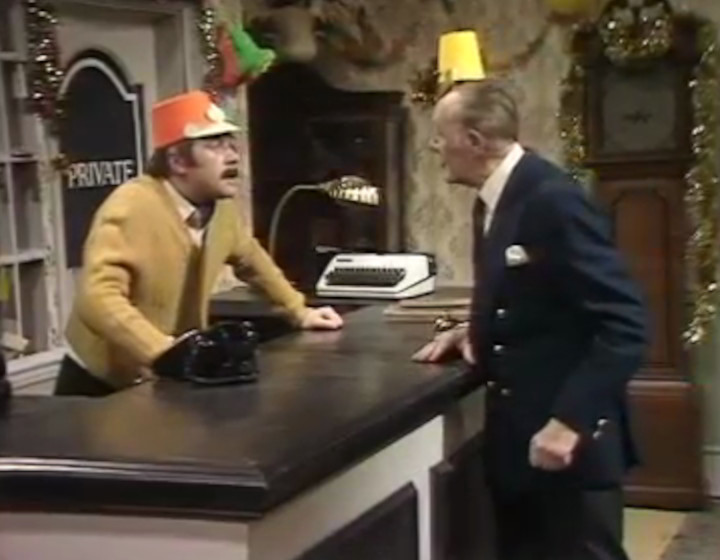
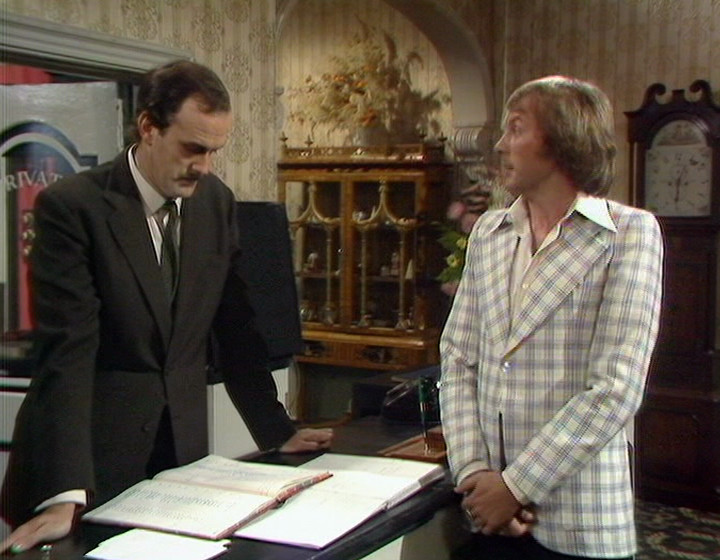
Oh, and partly because the sketch clearly uses parts of the actual Fawlty Towers set, albeit rejigged to take less space in the studio:

The Mike Yawood Show: Yarwood as Basil, with Ballard Berkely as the Major

Fawlty Towers: John Cleese as Basil, and Trevor Adams as Alan. Although the main point here is that the set in both pictures is extremely similar.

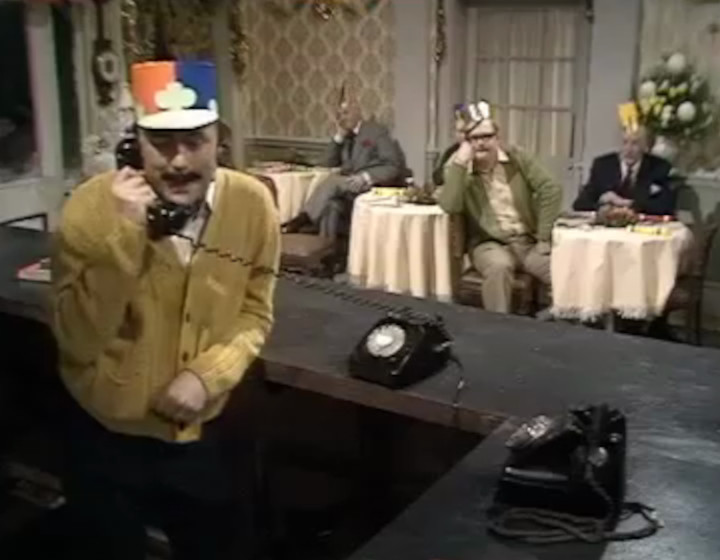
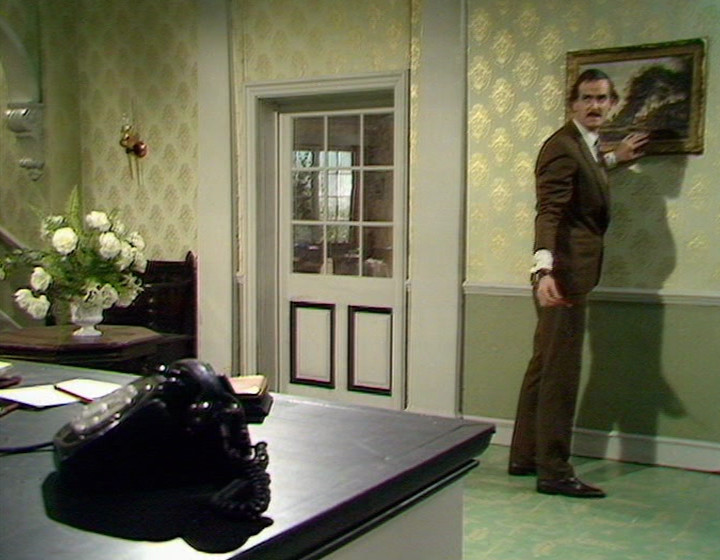
Note that in the above, the window in the door to the office has been blanked out, so you can’t see that they haven’t erected the office set. And saving space in the studio is the clear rationale behind combining the lobby and the dining room, which gives a peculiar sense of visiting Fawlty Towers in an alternate universe:

The Mike Yawood Show: Yarwood as Basil, with various guests sitting along the wall to the dining room

Fawlty Towers: John Cleese as Basil, and of course nobody sitting in the lobby, because that's not how the show worked

Sadly, all the set nonsense above is pretty much the most interesting thing about the sketch, which is one of the the least effective parts of Yarwood’s 1976 show. I guess the ventriloquist stuff is making the point that Cleese occasionally talks through clenched teeth? Precious little of it is anything like Fawlty Towers at all; rather, it’s just an excuse for Yarwood to do his own material in a slightly different setting.

Nice to see Ballard Berkeley and Renee Roberts, though.2

[Read more →]


  1. Look, I allow myself one cheap shot per year on this site. 

  2. Speaking of Ballard Berkeley, I saw him in The Playbirds the other day. Sadly, he didn’t get to have sex with Mary Millington. Pity, it would have livened the film up a bit. 

Read more about...

, ,

“Lucky Old Bin, I Say”

TV Comedy

What is the most famous ending to an episode of Fawlty Towers? Surely “Gourmet Night” has to be up there, first broadcast on the 17th October 1975.

“Duck’s off, sorry.”

Great stuff, yes? Well, one of the delights with Fawlty Towers is hearing John Cleese endlessly tear apart classic moments of the show on his DVD commentary. It always bugged me that Basil doesn’t quite put the lid of the dish down correctly in the above scene, and Cleese concurs:

“When I put the dish down I should have cleanly covered the trifle. Then I should have waited longer before I leaned down and peeped…”

On the famous “Duck’s off, sorry” line, he’s happier:

“And that’s all you need at that moment – it’s almost a dying fall ending, there’s not a big laugh, but it rounds it off nicely.”

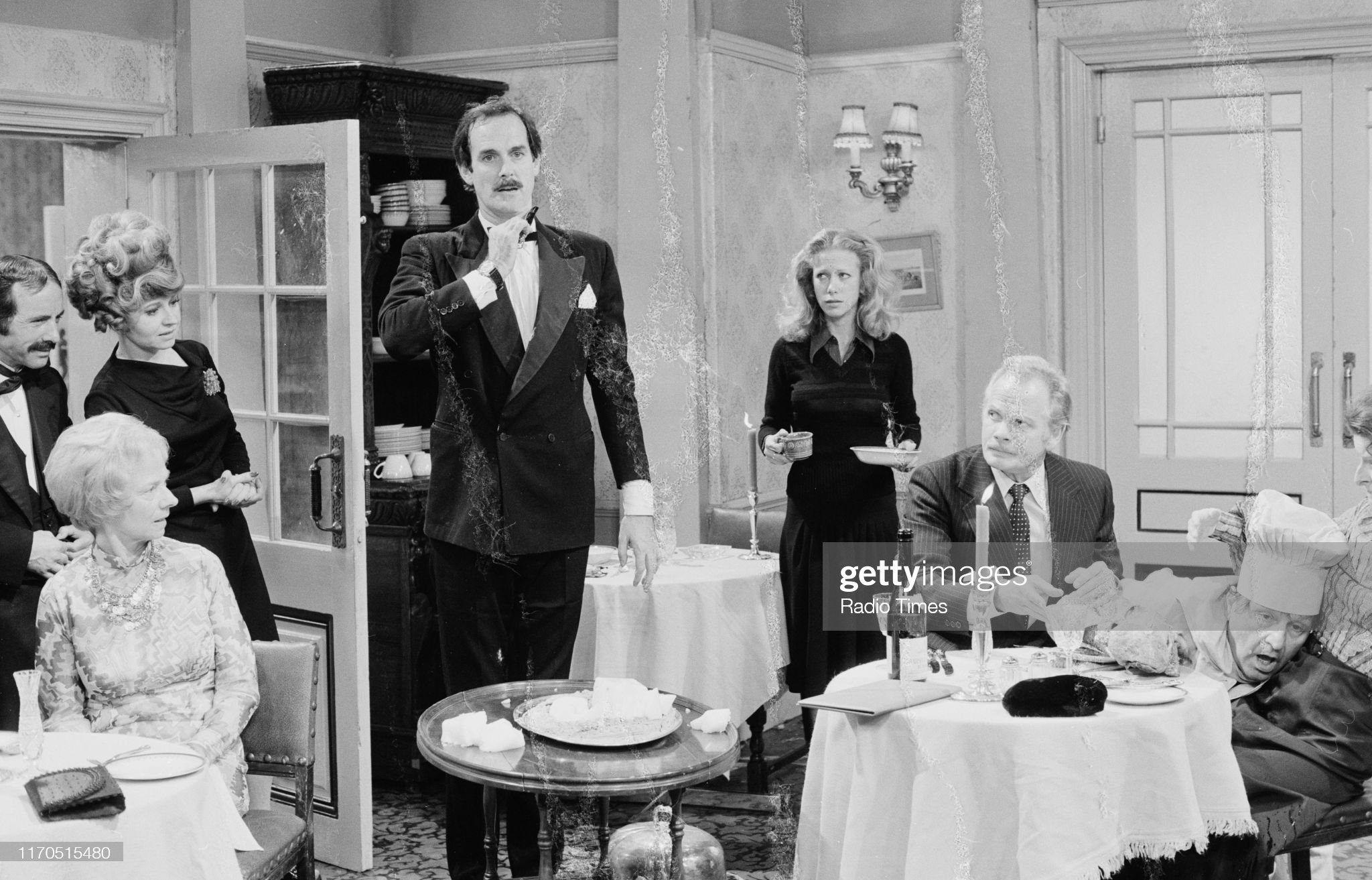
Yet there’s a mystery about this particular ending, which I first touched on a couple of years ago. And Cleese unfortunately doesn’t tackle it in the DVD commentary at all. Sitting on Getty Images is this intriguing photo, taken by Don Smith for the Radio Times, during the afternoon dress rehearsal of the episode.1

Actors (L-R) Andrew Sachs, Betty Huntley-Wright, Prunella Scales, John Cleese, Connie Booth, Allan Cuthbertson and Steve Plytas in a scene from episode 'Gourmet Night' of the BBC television sitcom 'Fawlty Towers', September 6th 1975. (Photo by Don Smith/Radio Times via Getty Images)

What the bloody hell is our drunken chef Kurt doing there on the right, in Mrs Hall’s lap? At no point in the broadcast episode does he appear in that final scene. What’s going on?

[Read more →]


  1. Note that they clearly didn’t want to waste a real trifle during the dress rehearsal. 

Read more about...

,

“Beam Us Up, Scotty…”

TV Comedy

There are, in general, two kinds of TV script books. The first is when the book is based on a draft of the script used in the actual production of the show, such as Father Ted: The Complete Scripts (Boxtree, 1999). The second is when they bodge together a load of transcripts and pretend it was something worth publishing, like with Blackadder: The Whole Damn Dynasty (Penguin, 1998). Perhaps the former is more common than the latter, but damn, that Blackadder one still hurts.

Luckily, The Best of Men Behaving Badly (Headline, 2000) is one of the former, only losing points for not actually including every single episode… but to be fair, with 42 of them, that would have been a big ask. It also includes brilliant introductions to every included episode by Simon Nye, all of which make me want to sit down to tea with him and have a massive chat where we talk about exactly how comedy works.

As for the scripts themselves, they are very specifically described as the versions taken into rehearsals, and include plenty of juicy differences from the televised episodes. So juicy, in fact, that I kinda feel like writing a whole series of articles listing them all. While I try and figure out whether I can be bothered doing that, here’s one of my favourite revelations from the book.

The episode “Watching TV” from Series 6 has a bit of an odd ending as it stands. Here’s what was actually broadcast, on the 27th November 1997:

So as they’ve been watching Star Trek all episode, we do… a beaming-up joke. Which is both a bit crap, and doesn’t fit in with the world of Men Behaving Badly in the slightest.1 The show may be broad at times, but exploding garden sheds can happen in real life. This can’t.

The thing is, Simon Nye knows that. In his introduction to the episode in the script book, he says:

“Difficult endings, part 13: the last line we ended up with, ‘Beam us up, Scotty’ is all wrong, but it’s too late to change it now…”

But there’s a hint in the above: the broadcast version is the last line “we ended up with”. Which wasn’t what they actually took into rehearsal. Which means that the book preserves the originally intended final moments of the show:

Deborah turns the TV back on, in time to hear the end of the theme music for Star Trek. Tutting, rolling of eyes, etc. A silence.

TONY: That was good. What’s on next?

DEBORAH: No, we’re going to talk for a change.

She snatches the remote away and turns off the TV. They sit in silence, trying to think of something to say. A long silence.

DEBORAH/DOROTHY: Okay. / Go on, then.

Tony gratefully turns the TV on again. Gary comes in with the pizzas. They watch TV. Gary puts a Coke down on top of the TV, then tips it accidentally into the back of the set. It explodes, hugely. The smoke clears.

TONY: Well, we don’t watch much telly anyway…

I’d perhaps be wary of proclaiming the above to be the best ending of a sitcom episode ever, but it sure is better than what ended up being broadcast, with Tony’s final line being especially amusing after a whole episode of being slumped in front of the telly.

Sometimes, it’s all too easy to write past where you really should have stopped.

A version of this post was first published in the April issue of my monthly newsletter. But don’t bother signing up, I just killed it.


  1. One of the non-Fegen/Norriss episodes of The Brittas Empire, “Body Language”, broadcast on the 12th March 1996, pulls a similar gag. That doesn’t work either. 

Read more about...

,

Location, Location, Location Redux

TV Comedy

Some videos in this article contain racist views and language.

Of all the things I expected to write on this site in 2025, “The unbroadcast Love Thy Neighbour pilot is really interesting” wasn’t top of the list.

Anyway, the unbroadcast Love Thy Neighbour pilot is really interesting. Completely reshot for the first episode of the series proper, the pilot starts with a lovely unbroken two-minute location shot of the Reynolds leaving their new house, and the Booths arriving at theirs:

[Read more →]

Read more about...

Insults, Cups of Tea and Quips

TV Comedy

Recently, we had some tradesmen round to our house to fit a new hob. Before they arrived, my partner decided to hide our newly-purchased copy of the complete Love Thy Neighbour DVD boxset. After all, they might think we were massive racists. Or even worse, start telling us that Enoch was right.

Now, I’m most certainly not the right person to mount a full-throated defence of the show, not least because parts of it don’t deserve a full-throated defence. But while watching it for an article recently, I have to admit that the series kept surprising me. Partly because, away from the racial slurs, how line-by-line funny it can be.

EDDIE: I’m not going to go where I’m not wanted.
JOAN: Well, if you kept to that, you’d never go anywhere.

But also: the show kept going to areas that I didn’t quite expect. The fourth episode of Series 11 does a great parallel story between the men striking at work and the women striking at home, which is far more intelligent politically than most of the racial material. The first episode of Series 2, after opening with the usual sitcom shenanigans, contains a startling moment where Barbie, the black neighbour, bawls her eyes out at Eddie calling the police on her housewarming party. A scene which is not played for laughs in any way.

Oh, and the second episode of that series? I could have guessed that Eddie would be convinced to make a fool of himself by his black neighbour. I could have guessed this might involve a stupid fake voodoo dance around a tree at midnight. I might even have guessed that this dance would be naked. What I wouldn’t have guessed is that Jack Smethurst would fully commit to the bit, and we would get lots of luxuriant shots of his bare arse. All shot in a way where it’s very clear that it’s him, and not a stand-in.

For many, the language alone will render the series forever unwatchable. I won’t argue those people are wrong, and I certainly won’t argue that anybody reading this article is obligated to give it a go. But I will say that I went into the show expecting to watch the bare minimum for research purposes… and instead, I found far more of interest than I expected.

To be honest, that’s the main thing I want out of television these days.

[Read more →]


  1. Fifth on DVD order. 

Read more about...

, ,

“From Here?”

Film / TV Comedy

Over the years, I’ve written plenty about comedy writers reusing jokes. Today’s topic is one of the most famous and most-quoted examples of the lot.

So let’s turn to ersatz Bond film Never Say Never Again, which premiered in the US on the 6th October 1983. Oh dear, James Bond isn’t having much fun.

NURSE: Mr. Bond? I need a urine sample. If you could fill this beaker for me?
BOND: From here?

The tale surrounding this is well-known by now. Dick Clement and Ian La Frenais did some emergency rewrite work on Never Say Never Again, coming in three weeks after the film had started shooting, and staying with the production for three months.1 Of course, they nicked the above joke from their own Porridge, and both writers have openly and repeatedly discussed this.

For instance, in the Omnibus edition “Whatever Happened To Clement & La Frenais?”, broadcast on the 20th July 1997:

DICK CLEMENT: We’re always tempted to recycle jokes, We did use one… it’s not a similar joke, it’s the same joke, in Never Say Never Again as in Porridge. If you see them back-to-back, it’s quite amusing.
IAN LA FRENAIS: We call it homage. We don’t call it recycling. (laughs) But it doesn’t happen very often.

The joke was actually taken from the very first episode of Porridge2, “New Faces, Old Hands”, which first aired on 5th September 1974:

DOCTOR: You see those flasks over there? I want you to fill one for me.
FLETCH: What, from ‘ere?

For me, it’s the lightning-fast reaction from Barker which really sells it. He knew when you shouldn’t have time to anticipate the gag.

Obviously, this scene has become one of those clips over the years – if not quite rivalling Del Boy falling through the bar, then definitely in the ballpark. You do get to the point where at least as many people remember the clip from documentaries and anecdotes as they do from the actual show.

With that in mind, it’s worth noting at least one newspaper reviewer enjoyed the joke so much on first transmission, that they quoted it in their column the very next day. Peter Fiddick, in The Guardian:

“The jokes are there though both verbal and visual. (“I want you to fill that glass” says the prison doctor to Barker. “What – from here?” – and the camera cuts away from them precisely to emphasise the distance.)”3

So far, so standard. But the big question is: can we trace the joke back even further?

[Read more →]


  1. More than Likely: A Memoir (Weidenfeld & Nicholson, 2019). 

  2. Not including Seven of One‘s “Prisoner and Escort”, obviously. 

  3. Not a perfect quotation, sure, but in 1974 without the aid of home video, let’s not be too picky. 

Read more about...

,

Snookered

TV Comedy

As I’ve spoken about many times before on this site, I’m constantly surprised at how often the generally accepted transmission dates for various TV shows turn out to be a load of rubbish. Sometimes, the confusion is understandable – a last-minute schedule change not reflected in the Radio Times, say. Other times, I struggle to see the thought process.

This time? Well, we have ourselves a bit of a strange one.

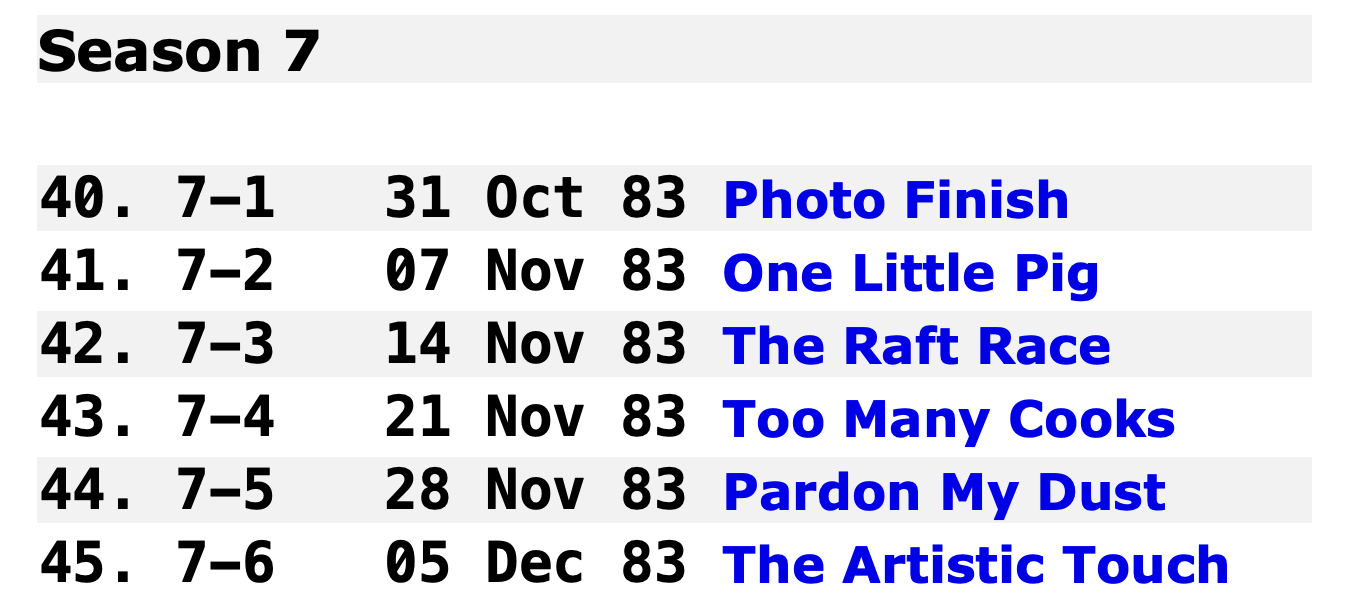
As part of the research for my last piece on Terry and June, I had cause to look at the transmission dates for the series broadcast in late 1983. Here’s what epguides.com thinks:


Season 7
40.	7-1 	31 Oct 83	Photo Finish
41.	7-2 	07 Nov 83	One Little Pig
42.	7-3 	14 Nov 83	The Raft Race
43.	7-4 	21 Nov 83	Too Many Cooks
44.	7-5 	28 Nov 83	Pardon My Dust
45.	7-6 	05 Dec 83	The Artistic Touch

Six episodes, broadcast weekly from the 31st October 1983. Simple enough. And at the time of writing, this is also exactly what Wikipedia, IMDB, and the British Comedy Guide think happened too.

But on bbc.co.uk, we have a different story. The first four episodes of the series are indeed broadcast weekly… but then the show skips a week. The BBC has “Pardon My Dust” airing on the 5th December, and “The Artistic Touch” airing on the 12th December.

[Read more →]

Read more about...

,

“I Know How Much You Like It at Ross…”

TV Comedy

Right, after my last piece about mocked-up newspapers in sitcoms, time to get on with some real work. Anyone got any suggestions? How about friend of the site Rob Keeley, have you got anything?

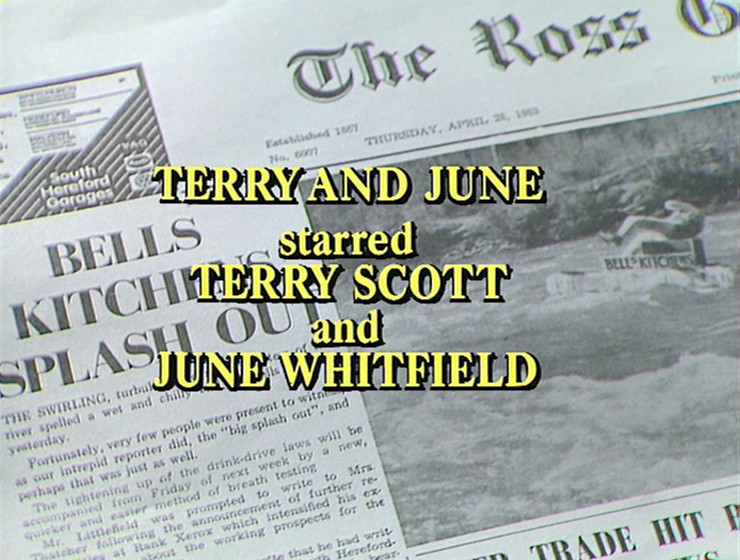
“If you’ve still got an appetite for mocked-up newspapers, John, I saw a subject for you the other day in the Terry and June episode ‘The Raft Race’. The end credits play over a local newspaper from Ross-on-Wye, telling about Terry’s river antics, and there’s a photo, headline and two quite convincing paragraphs, then the article suddenly turns into the original one, about drink-driving! They obviously thought no one would read any further. I did.”

Oh, alright then. Let’s do one more.

The Terry and June episode in question, indeed called “The Raft Race”1, was first broadcast on the 14th November 1983. Location filming took place on the 13th and 15th of April, and it was recorded in studio on the 14th May, exactly six months before transmission.

The episode sees the pair take a trip away from Surrey, and into the dark, jungle-like depths of, erm, Herefordshire.

TERRY: Oh, by the way June, would you press the trousers of my brown suit for me?
JUNE: Well of course, but can they wait until Friday when I do the ironing?
TERRY: If you want me arrested for walking around Ross-on-Wye in me shirt tails, yes.
JUNE: You’re going to Ross-on-Wye?
TERRY: Yes, Sir Dennis has arranged an important business meeting for me on Friday, and I’m travelling down tomorrow afternoon.

I wonder if anybody has figured out exactly what percentage of Terry and June episodes involve Terry attempting to impress his boss.

Anyway, to cut a short story even shorter, Terry ends up embarrassing himself in the eponymous raft race, and gets in the local paper. We don’t have to squint at the screen in order to read it – the programme helpfully makes it full-frame over the end credits:

A close-up of a newspaper. The masthead reads: THE ROSS G... (the rest is not visible)
Headline: BELLS KITCHENS SPLASH OUT

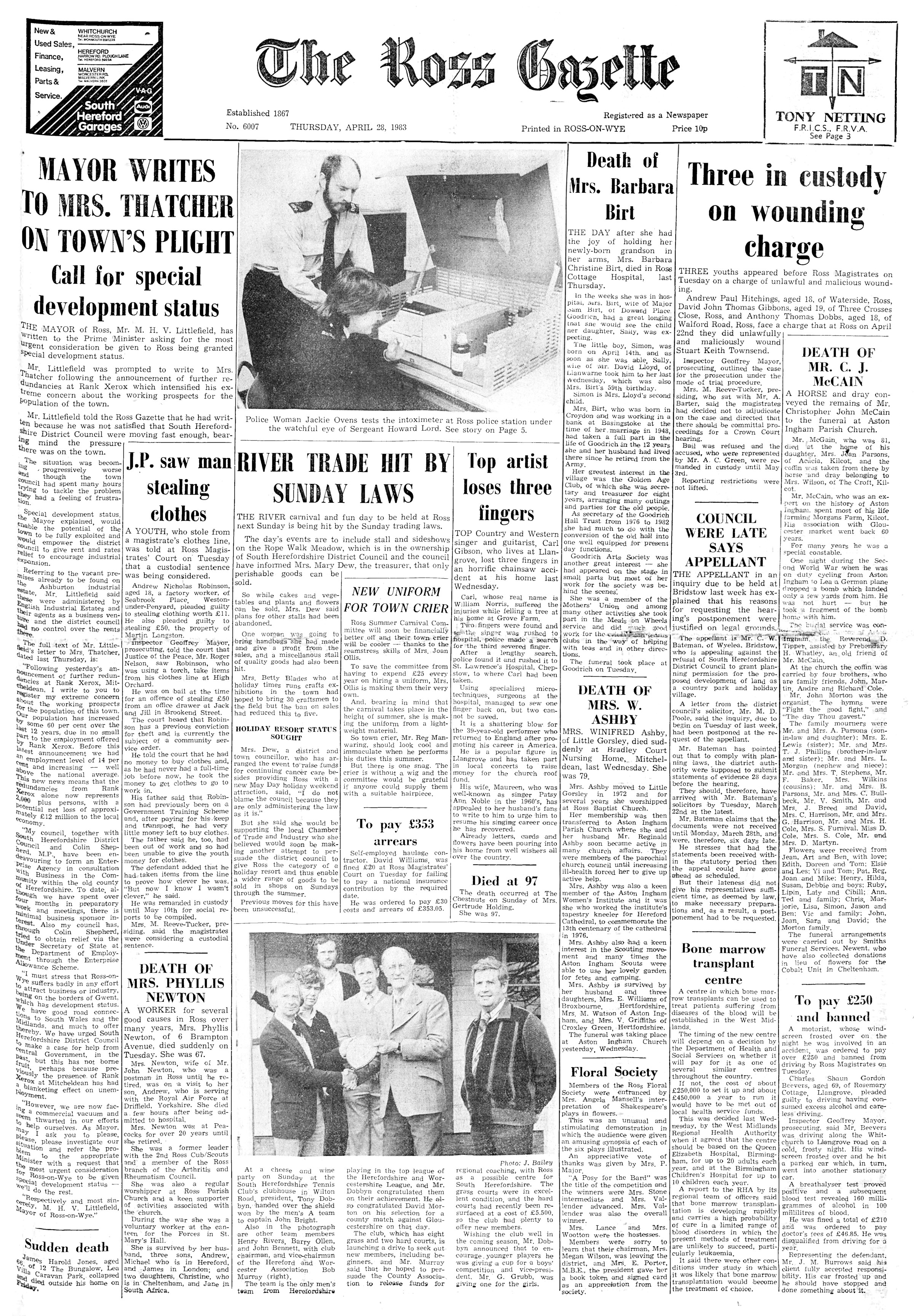
The title of the newspaper isn’t difficult to work out either. This is The Ross Gazette, the real local paper of Ross-on-Wye. And luckily, there is a digital archive of the paper available online. With the date of the paper clearly in view – it was the edition published on the 28th April 1983, a couple of weeks after the location filming – it doesn’t take too long to find the original edition of the paper which the prop was based on:

The Ross Gazette
Main headline: Mayor Writes to Mrs. Thatcher on Town's Plight - Call for special development status

[Read more →]


  1. Other places give the episode different names; Wikipedia, for instance, calls it “In the Navy”. However, the paperwork for the episode clearly states the episode title as “The Raft Race”, so this was its actual title during production. 

Read more about...

,