Home AboutArchivesBest Of Subscribe

Poor Old Jackie Rae

TV Gameshows

The Golden Shot logo

Researching a programme like The Golden Shot (1967-75) is a nightmare. As I pointed out last time, for a show which ran for hundreds of editions, vanishingly few of them actually survive. Even fewer are generally available to view. You’re left scrabbling for what you can find in old newspapers and magazines… and the odd autobiography.

Such as Bob Monkhouse’s incredible Crying With Laughter (Century, 1993), often regarded as the gold standard in celebrity memoirs. And one of the most arresting sequences in the whole book is the section where he details his thrilling takeover of The Golden Shot from first host, Jackie Rae.

“Having concluded that I was lucky not to be presenting this calamity and so suffering condemnation by press and public alike, I was puzzled when Peter1 phoned to say I was wanted as the guest star for the tenth week. The fee was insignificant and the inconvenience considerable as it meant travelling from Liverpool to Elstree and back again for my midnight jobs at Jack Murphy’s Cabaret Club in Duke Street. And who was watching ‘The Golden Shot’ now anyway? Its Saturday ratings had plunged. ‘I know, love, but it’s a chance for you to show ’em a thing or two on that set.’

I got the message.

Having made sure the set was standing, I drove out to the studio and looked it over. The guest had to fire the bow using a joystick in a glass booth. The booth looked like the one featured in a frequently seen soap commercial of the day where a man went into a phone kiosk which turned into a bathroom shower. I sought out my pals in special effects and had the booth rigged to do the same. Next, I consulted the props men and they agreed to build what I’d drawn.”

According to Bob, his guest performance went spectacularly well.

“Half an hour of the usual stuff, tedious as ever, with no audience reaction other than cued applause where required. Then I was announced and my first appearance brought a crack of laughter that registered on the Richter scale. I was dressed as a big target, the golden bullseye over my middle. The absurdity of anyone showing up at an archery contest in such an idiotic costume delighted the previously bored crowd. A fusillade of gags followed as I removed my outer costume to reveal a Tyrolean outfit in the style of William Tell, put an apple on my head and did some comic business with a curved crossbow that could shoot round corners. Then I announced that I had my own private armourer, ‘Heinz the dolt!’ A four-foot tin of Heinz Potted Shrimp was wheeled on and tiny Johnny Vyvyan climbed out, dressed as a stormtrooper with a spiked Prussian helmet and carrying a gigantic door bolt. We plunged into a fast and crazy routine in which I fired at various objects he was holding up, each of them rigged to explode when hit and shower the stone-faced little man with their contents. The laughter was just as explosive, roars of hysterical mirth and applause bursting from two hundred and fifty people who had been spending an evening starved of any semblance of fun.

When I started stuffing Johnny feet first into a large cannon, Jackie Rae must have been wondering what had hit him. Unrehearsed, he was rooted to the spot by his need to read his lines off idiot boards.

I ran into the glass booth to fire the cannon and rattled off a few funny lines while Johnny was secretly replaced by a dummy. On a signal that Johnny was out and clear, I pressed the firing button. There was a hell of a bang with confetti and red smoke, the dummy soared fifteen feet in the air and its spiked helmet stuck firmly in the bullseye.

The crowd went wild and Jack Parnell, watching the show on the screen of a TV monitor in the bandroom, waited for the din to diminish before giving his orchestra the downbeat. Precious seconds were ticking by.

Then the music from the then famous soap advert filled the air and, just as in the familiar commercial, the lighting changed to make a silhouette of me as my firing booth became a shower stall. A cascade of water hit me from above and I washed myself, working up a lather with the detergent already in my clothing.2 If an audience ever howled with laughter any longer and louder, it could only have been in comedy heaven.”

The inevitable then happened:

“On the Thursday of that week Lew [Grade] sent for Peter. ATV’s light entertainment booker Alec Fine joined the meeting and Lew told them to do a deal for me to take over as host on ‘The Golden Shot’ as soon as possible.”

All very nice. The question is: how much of it is true?

[Read more →]


  1. Peter Prichard, Bob’s agent. 

  2. With many thanks to Simon McLean, the advert Bob is referencing here must be this one for Lifebuoy soap, or a similar one in the same series. 

Read more about...

, , ,

That Which Survives

TV Gameshows

If history is written by the winners, then television history is written by the survivors. Survivors of magnetic tape or celluloid, that is. And The Golden Shot, which originally ran on ITV between 1967-75, has a frankly pitiful rate of survival.

Which means that sometimes, the only record of something you really, really want to see can be found in contemporary newspaper reports. Such as the following, published in the Daily Mirror on the 18th September 1972, under the headline “Golden Gatecrasher – Building worker takes over TV show for demo”:

“A building worker took over a top TV show yesterday.

He staged a one-man protest spectacular on ATVs “Golden Shot” while it was going out live from Birmingham.

He seized the microphone from compere Norman Vaughan just as the comedian was introducing the programme’s first contestant to the viewers.

Then the small, dark-haired gatecrasher, aged about twenty-four, shouted slogans and urged other building workers to continue their strike.

Cameras swung away from the scene, and screens were blacked out for about fifteen seconds as studio staff dashed out to hustle the unknown invader away.

Compere Vaughan quickly tried to laugh off the incident.

While the leather-jacketed protester was being led away, Vaughan joked that it must have been Jimmy Tarbuck or Charlie Drake.1

The protest is believed to have been linked to the hard line being taken by Midlands building workers opposing last Thursday’s pay settlement after the official national strike.

The gatecrasher made his entrance just two days after 100 Birmingham building workers seized control of the building employers’ headquarters in the city and occupied it for nearly two hours.

When they were finally persuaded to leave by police, the protesters promised that they had some more spectacular demonstrations planned to draw public attention to their grievances over the national pay settlement.

ATV’s general manager, Mr. Leonard Matthews, was in the studio audience yesterday.

Angrily, he ordered an investigation into how the building worker managed to get into the studio.”

One thing the above report misses out is exactly what the protester manages to say before he was taken off air; The Birmingham Post reported that he said something akin to: “Support the building workers. No work on Monday.”

The 1972 Building Workers’ Strike is far too complicated to get into here, but it’s worth pointing out that this is the strike that landed Ricky Tomlinson in jail for two years… a conviction for which he was eventually cleared in 2021. In a parallel universe, this clip from The Golden Shot is used as the introduction to every single retrospective documentary or news report about the case.

In ours, it merely exists as smudged ink, and pixellated representations of that smudged ink. And there are a million such moments.


  1. I know Vaughan gets slated for his time on The Golden Shot, with Monkhouse memorably saying in his autobiography that he took to the show “like a cat to water”, but this sounds very funny. 

Read more about...

“What Can They Do, Fire Me?”

TV Gameshows

If you’re the kind of person who reads this site, it’s very likely that you have childhood memories of Bob Monkhouse. Mine? Definitely his Central game shows of the 1990s, such as The $64,000 Question and the revival of Celebrity Squares.1 Oh, and my Mum ringing up the BBC after an appearance on Have I Got News For You, to complain he had been racist against the French.

As I got older, I followed the general trend of many comedy fans, in my reassessment of Bob from “that nice man on the telly”, to “one of the funniest men who ever lived”. And once you heard about his vast film and television archive and realise he was one of us into the bargain – except also doing that better and more comprehensively than virtually anybody else as well – that’s when the awe really began to set in. I choose to believe he might even have enjoyed reading Dirty Feed, and you can’t prove otherwise, leave me alone.

It was apparent years before if you were paying attention, but I can trace my realisation of Bob as an archive fiend to the documentary The Secret Life of Bob Monkhouse, first broadcast on BBC Four on 3rd January 2011. And one of the most fascinating parts of that documentary was the section on Bob’s sacking from The Golden Shot in 1972, including clips of his final show2, from a copy taken from Bob’s archive. I could watch it endlessly.

[Read more →]


  1. Years which were unfairly and pointlessly maligned in the 2015 Gold documentary Bob Monkhouse: Million Joke Man

  2. Before his return in 1974, of course. 

Read more about...

, ,

Quick to Angers

TV Gameshows

Give Us a Clue is such a glorious, fun, friendly show, that part of me doesn’t want to do what I’m about to do. Can we not just enjoy a fun show without dragging it through the mud, or worse yet, perilously close to the dreaded “culture wars”? Why don’t I write an article about how the timing of the cue dots spoils the outcome of some of the rounds instead?

Sadly, in this case, I can’t help being annoying. Out of the first 105 episodes of the show, seven episodes are missing on the 2022 DVD release.1 Well, we weren’t going to get through 105 episodes of the show without a few disgraced celebrities, were we?

Our three problems are Dave Lee Travis (one episode), Rolf Harris (three episodes), and Freddie Starr (three episodes). The editions missing from the DVD are the following:

[Read more →]


  1. Most sources say eight episodes are missing, but there appears to be a dummy episode in some guides dated 14th May 1981, which was probably a repeat rather than a new episode. With thanks to Billy Smart for clarification on this. 

Read more about...

Nudie Prod Games

TV Gameshows

What’s the most entertaining way of starting a post about an old gameshow? How about a piece about how my cat died last month? That’s hilarious, maybe I could follow it up with some talk about my miserable teenage years as an encore.

But much as I could write a long eulogy about my poor Tom – and he was a really good cat – that’s not really what this place is for. Instead, here’s a related question: what TV is best to watch in order to cheer yourself up when things like this happen?

My first answer would be a favourite sitcom, but that doesn’t seem to be quite right. When sitting in mourning for a kitty who’s become part of the family, you don’t really want TV screaming at you to laugh; you’d feel like telling it to sod off. Likewise, another initial idea was Kenny Everett’s Thames shows, but much as I love that man to bits, I suspect a concentrated burst of zaniness isn’t quite what I need right now.

So what is the answer? A drama? No, I can’t deal with anything remotely serious. A vaguely light, comedic film? No, I can’t sit still and concentrate for that long. A cookery show? No, I still want to remain awake.1

In the end, the solution was already sitting on my shelf, awaiting exactly the right moment: Network DVD’s boxset of the first few years of Give Us a Clue. A show seemingly designed to cheer you up, without haranguing you. And with a parade of pleasant faces on offer, it’s a little like a continuous group of friends popping round to raise your spirits.

[Read more →]


  1. You may think I’m being unfair on cookery shows here. They do, of course, have a perfect right to exist. I might even watch and enjoy them occasionally. I just think 53 hours of MasterChef in various forms across the BBC in 2022 is a bit much, when Ofcom claims they only did 108 hours of scripted comedy in the same year. And that doesn’t include MasterChef Australia, or any signed broadcasts. 

Read more about...

Floor Is Lava Season 4, Which Sounds Like a Clickbait Post Title but I Swear It Isn’t

TV Gameshows

It’s a very peculiar thing, to absent-mindedly read a newspaper article… only to find a quote from yourself.

So it was the other day, when I was trying to find out whether the highly amusing Netflix game show Floor is Lava had been recommissioned for a fourth season. I now have the dubious honour of being immortalised in The Sun.

“Taking to X, formerly Twitter, one said: ‘Are we getting season 4 of Floor is Lava? My kid is dying to know!’

Another said: ‘My @netflix is costing $$$$ it really makes me wonder what Netflix is providing or changing that costs SO much?!? I need to have a new season of Floor Is Lava monthly! Where’s the new season?!? They cancel shows ALL the time! HIT shows!’

And a third echoed: ‘You can see with Floor is Lava, where Netflix have made just 20 episodes since 2020. Rubbish. Make some more television.'”

I’m the third person quoted there. Although they have slightly misquoted me; what I actually said was:

“Make some television” is a vaguely witty way of putting it. “Make some more television” is deathly dull. Oh well, at least my name wasn’t attached to it.

Anyway, in answer to the question: no, it doesn’t seem that Floor is Lava has been recommissioned for a fourth season. It doesn’t seem to have been officially cancelled yet either, mind you. It appears to be in an annoying limbo.

Moreover, calling it a “fourth season” is generous. Season 1 was ten episodes; Seasons 2 and 3 were five episodes each, and made as part of the same production block. It really feels like we’ve only had two seasons: one in 2020, and one in 2022. And you have to wonder: 20 episodes of what by all appearances has been a very popular game show, over four years? What the hell are Netflix playing at?

In the same amount of time – five different calendar years – Anglia Television managed to make 72 episodes of Knightmare. (I like using Knightmare as an example, because it seems to me that the more you think about it, the more similarities it has to Floor is Lava.) The BBC managed to make 69 episodes of Total Wipeout. Channel 4 broadcast 65 episodes of The Crystal Maze in its first five years; even the revived series managed 45, excluding the initial Stand Up to Cancer special. (And the revived Crystal Maze is widely considered not to have been the success Channel 4 hoped.)

Or if you’d prefer I compared the series to other Netflix shows: Nailed It! has managed 56 episodes over five years.

You have to wonder: why are Netflix so reticent about making more Floor is Lava? What’s going on over there? A worldwide pandemic explains some of the issue, sure, but certainly not all of it. At the back of my head is the idea that Netflix are embarrassed about making a silly show like Floor is Lava, but at this point I’m not sure that fully explains things either.

Shouldn’t they be on 60 episodes by now, and ready to call it a day? That’s what some television is: you make loads of it in a short period of time, it burns itself out, and then you move onto making something else. The churn of television is not a bad thing.

But with Floor is Lava, it feels like they’ve barely even got going. For a supposedly successful show, it’s just odd.

BBC100: Richard Osman’s House of Games (2017-)

TV Gameshows

For more on this BBC100 series of posts, read this introduction.

BBC100 logo with Richard Osman PUSHING a BUTTON

So as these BBC centenary pieces reach a climax, and we wander blinking into the 2010s, it seems obvious what I’m supposed to do. To support the fact that the BBC is still relevant in a Netflix-obsessed world, I should grab some big, obvious piece of “prestige” drama. I May Destroy You, for instance, or Bodyguard. The BBC can still play with the big boys, aren’t they great, job done.

Sure, we need those programmes. Of course we do. But television can’t be those kind of shows alone. Forget the fact that the BBC couldn’t afford it; my brain couldn’t cope either. The idea of watching something of the intensity of I May Destroy You every evening brings me out in a rash. Television needs its quieter moments too.

And let’s be clear: getting those quieter moments right is hard. To call those kind of programmes “schedule-fillers” misses the point; they are vital parts of that schedule. It’s one thing to create good television by making an impact; to make good television by being a little quieter is a skill all of its own. And too many productions manage to fall foul of that old cliche: turning television into moving wallpaper. It’s all too easy, in the scramble for a cheap show which still entertains, to end up with nothing.

At first, House of Games looks like a straightforward show, and that’s because it is. We have our host Richard Osman, fresh from Pointless, and four celebrities. They play five rounds of games – often word-based, but not always – each episode. At the end of each episode, the celebrity with the most points wins a terrible prize. (Think: any household object you can imagine, with Richard Osman’s face plastered over it.) The same celebrities play through five episodes, Monday – Friday, and the person at the top of leaderboard at the end of the week wins a trophy. That, in a nutshell, is it.

The beauty of House of Games is exactly how well it does the above format. For a start, it would be incredibly easy to get locked into doing the same rounds all the time. House of Games has literally dozens. (A particular favourite of mine is Highbrow/Lowbrow – an academic question and a pop culture question, both with the same answer.) Not only does this mean you can’t get easily bored of the games, but there are so many that it gives the feeling of a show bursting at the seams with ideas.

Secondly, the range of celebrities is extraordinary. It’s extremely generous in the kind of people it will have on. Steve Pemberton and Fern Britton don’t appear on many TV shows together. Much like the variety of rounds, the variety of guests means that what could be a programme with the same old faces each week never gets boring. It also means that the comedians of my childhood can make a reappearance on television, and I get a warm, fuzzy feeling. (Hello, Simon Hickson.)

Thirdly, it has a brilliant host. Being a good quiz show host is an incredibly hard thing, and British television currently has a dearth of them. This is obvious from the parade of actors and presenters who awkwardly squint their way through a series of afternoon quizzes across all channels. Including plenty of people who I otherwise like, when they’re in their usual habitat. Richard Osman makes it look easy, and that’s all you could ever want with this kind of show.

What’s more, it does all of this despite being shot on an extremely fast schedule: five episodes per day. This kind of shooting schedule is usual on daytime quiz shows, but the beauty of this schedule for this particular programme is that you only need to book each celebrity for a single day’s recording, and you get a full week of shows out of them. Of course, none of this matters for the audience watching at home, but it’s difficult not to admire a show that takes a budget limitation, and makes a virtue of it. If more programmes managed that as well as House of Games does, maybe cheap television would look a little less cheap.

At the beginning of this piece, I made a comparison of the BBC’s output with that of Netflix. This was not an idle comment. It’s worth remembering that making a show like House of Games is something that Netflix really does struggle to achieve. Take their brilliant Floor is Lava, a game show involving people who are less clever than they think, an obstacle course, and… lava. (Well, orange gunge, anyway.) Over the past two years, the show has managed to produce a grand total of 20 episodes across three seasons. House of Games manages to shoot more episodes than that in a week, and a grand total of 280 episodes over just the last two years.

Now, sure, Floor is Lava is a far more complicated show to shoot than House of Games, I grant you. It’s certainly a louder one, and a more expensive one too. But I think the comparison holds. Floor is Lava should surely be about having endless contestants falling into endless lava in endless different ways. I would suggest that 20 episodes over two years is a vaguely prissy way of approaching that aim. What that show needs is a real production line mentality.

Does that sound a terrible thing? Shouldn’t we be promoting a more artisanal way of making television? Tough: sometimes, a production line is exactly what you need. Making lots of good television quickly is not an embarrassing thing. It’s a deeply necessary one. The BBC needs its splashy, expensive shows. But it’s also vital that it can still make shows like House of Games.

So here’s to making all kinds of television, and doing it well. Whether it’s one-off plays, sitcoms, live entertainment spectaculars, or quiz shows. Or the many kinds of TV that I haven’t had the chance to cover in these articles, but are just as important. There may be more column inches in doing certain “important” kinds of shows, but it’s the BBC’s job to get all kinds of programming right.

It’s a tough job, but someone’s got to do it. And hey, they’ve had 100 years practice.

Read more about...

“Pedestrian, camp fantobabble”

Children's TV / Meta / TV Gameshows

There are many pieces of terrible pop culture writing online. I’ve done plenty of it myself. But sometimes, a piece of work is so dreadful, that it lingers in your head for well over a decade. To the point where it actually falls offline, and you need to use the Wayback Machine to find it.

Such was the case with this piece on Knightmare from 2002. And it really is absolutely bloody awful.

The scene is set in the third paragraph, with possibly the least promising sentence ever written:

“Actually, as I write, I realise that I haven’t seen Knightmare for sodding years.”

An admission which leads to beautiful moments like this:

“It got rubbisher, as well: in a desperate attempt to fiddle with the formula, the producers ditched many of the more atmospheric locations and charismatic characters (notably Pickle, Treguard’s wonderful gay elf sidekick) in favour of comic hangers-on and tedious gimmicry. The eyeshield, anyone? Pah.”

Unfortunately, the facts are as follows: both the eyeshield and Pickle debuted in the same series. Series 4, to be exact.1

After that, deconstructing the article is like shooting fish in a barrel, to the point where it’s pretty much worthless. For instance, take this, on why Knightmare ended:

“It died because its niche fanbase eventually either a) got older, b) got computers or c) got sex – in any case, the market for its pedestrian, camp fantobabble was never going to last.”

This article was published in 2002. Three years earlier, creator Tim Child had already written a history of the show on Knightmare.com, which gave detailed reasons for why the show wasn’t recommissioned. But the writer of this piece isn’t interested in the actual facts; they’re interested in a pithy turn of phrase. Which also explains the bizarre line about “pedestrian, camp fantobabble”, which comes out of absolutely nowhere.

I could go on – what the hell is the bit about the “niche fanbase” all about, when it was an absurdly popular show, and a touchstone for a generation? – but you get the point. The main reason I bring all this up is because I realised the other day exactly how much this article influenced me when it came to writing my own piece about Knightmare, published last month. A piece that yes, has its fair share of reminiscing about the show.

It also throws in plenty of cold hard facts, as well. It transcribes actual sections from the show. It quotes Tim Child twice, from two separate sources. It’s a piece which proves you can still write about your memories, and fact check them at the same time without destroying anything.

That old piece from 2002 makes a point of acknowledging “nostalgia’s rose-tinted eye”, but doesn’t actually do anything about it. The way to avoid nostalgia is to watch and research what you’re writing about. And who knows? You might find that what you’re writing about doesn’t “look a bit, erm, crap”. You might just find it’s still fucking great. And if you don’t think it’s great, at least you can explain why, rather than guessing.

And I write this not because I want to say I’m brilliant. Well, not entirely. But it did shape something in my approach to writing that I think is worth noting: that just because you’re writing about pop culture, it doesn’t absolve you from doing the legwork. Just because you liked a kid’s TV show when you were younger, it doesn’t mean your half-remembered guff about it is enough.

Realising that at least sets you on the right path, however well you ultimately manage to traverse it. I think I get to the start of Level 2 before being killed off, but at least that’s better than dying in the first room.


  1. There’s also no evidence that Pickle was gay, either, but I have no issue with slash being written about him. 

Read more about...

,

Condition: Red

Children's TV / TV Gameshows

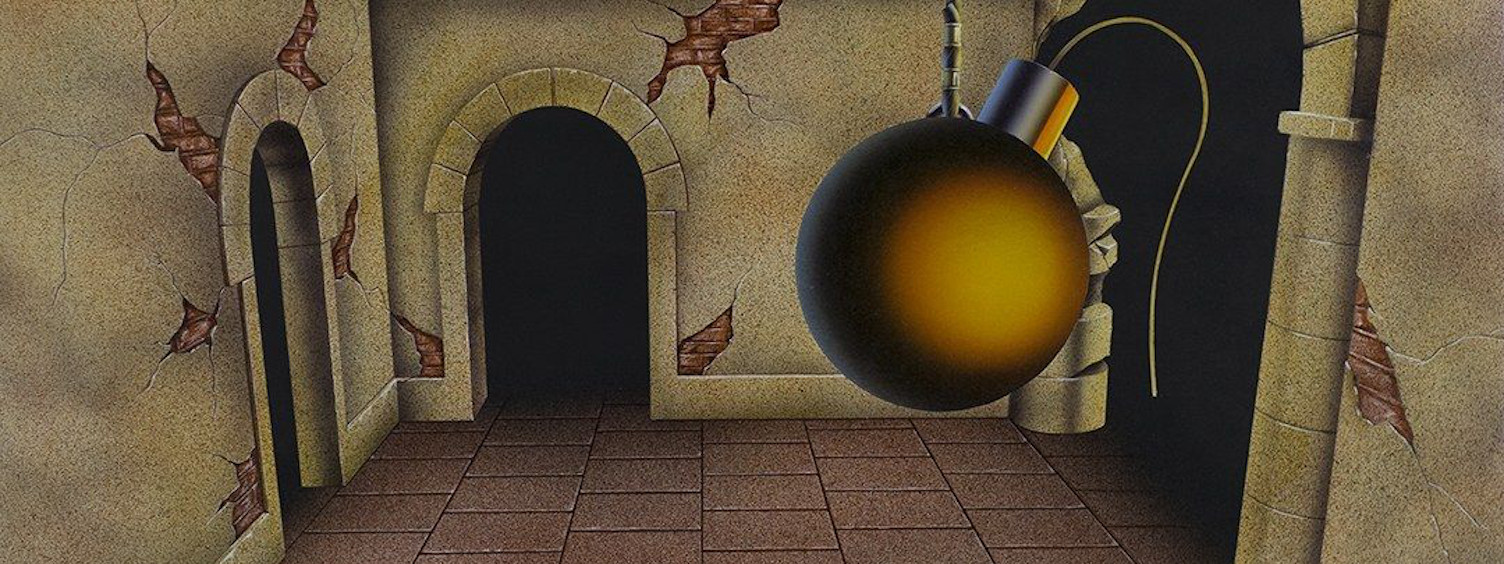
Bomb room in Knightmare

It’s 1990, or something vaguely close to it. I’ve cleaned my teeth like a good boy, and am now running to my room. Something is going to get me, you see. I mean, I have a happy home life. So happy that my parents even make sure I clean my teeth. But right now, I’m in danger.

I barge into my bedroom, flinging the door open, and dive under the covers. I lie, panting. I strain my ears, but of course, everything is fine. As long as I’m under the covers, I’m safe.

But I’d best not come out. I can see it in my head. A decomposing skull. It followed me into the room, and is now sitting against my bedroom wall. If I come out, it’ll zoom into my face and kill me.

It’s hot under the duvet. Far, far too hot. It’s the height of summer. Sweat covers my body. I do an experimental waft of the duvet to cool me down. It’s frightening enough – it gives the manifestation on my wall a moment of opportunity – but I get away with it. I drift into a fitful sleep. I might even dream about that… thing.

It’s just waiting for me, you know.

[Read more →]

Read more about...

,