Today, we’re going to answer a huge burning question about The Young Ones. No, nothing to do with flash frames, or hidden fifth housemates. This is the really important stuff.
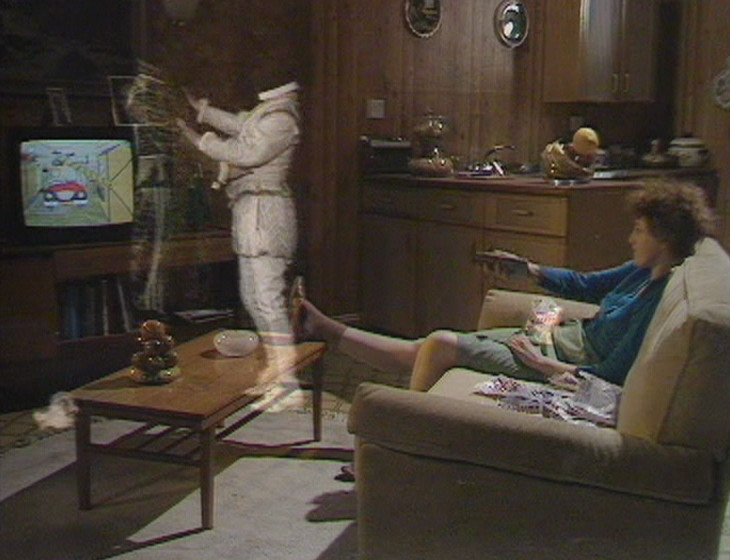
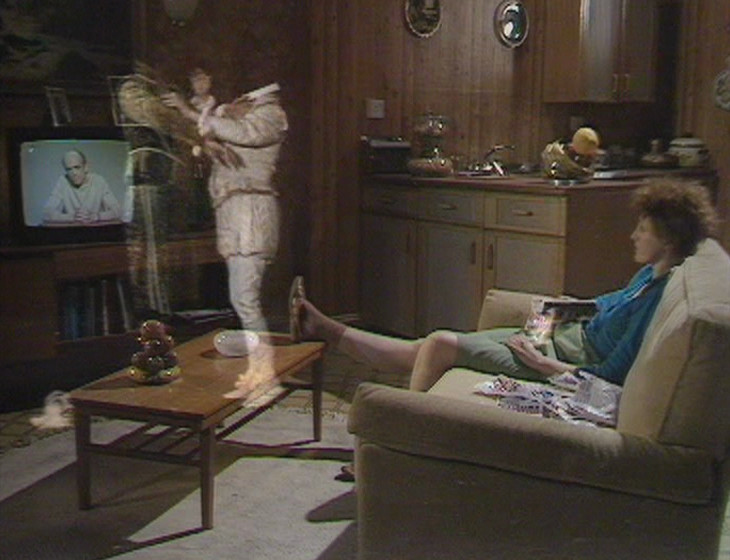
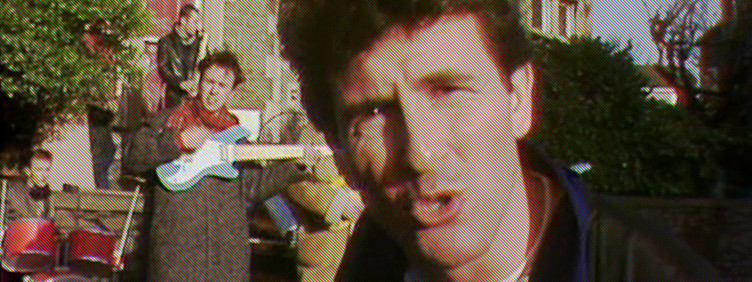
Exactly what is the farty neighbour watching on her television in “Cash”, just before she switches over to Andy De La Tour doing a public information film?
Squinting at it, it seems impossible to tell. Some kind of drawing of a car? Unless it’s some well-known cartoon, or mentioned in the paperwork for rights reasons, or specified in the script, how could we ever figure it out?
Spoiler: it’s not a well-known cartoon, or mentioned on the paperwork for rights reasons, or specified in the script. We have only our wits to go on here.
Well… wits, and a certain video of Young Ones raw studio footage, sitting patiently on YouTube. I wrote recently about the section of this video containing material for the episode “Nasty”, but the second half of the video is entirely dedicated to “Cash”. And crucially, it includes the entire recording session for this scene.
It’s January 1999, and Ronald D. Moore – writer/producer on Star Trek: Deep Space 9 – is chatting on AOL, answering fan questions about the show.
One particular question catches my eye. You don’t need to know the actual storyline, or have watched any of the episodes – that isn’t the important bit here.
Ron, I read on the boards that there was a scene in “To the Death” in which Weyoun somehow slipped Odo some virus that eventually resulted in his having to return to the Link in “Broken Link.” I read that this ended up on the cutting room floor. Is this true or just a wild rumor?
It’s just a rumor.
Now, one delightful thing about DS9 is that – unlike most TV shows – every single script is available for us to read. Not a boring transcript. The actual script, as used in production, including cut material, and the scene descriptions. Which means we can check and see if Moore is correct in this instance.
So, in the script for “To The Death”, we can read the following1:
Weyoun looks at Odo for a beat, then gives him a good-natured clap on the shoulder. (In case anyone’s interested, when he touches Odo, Weyoun is purposely infecting Odo with the disease that almost kills him in “BROKEN LINK.”)
WEYOUN: Then it’s over. After all, you’re a Founder. I live to serve you.
And with that, Weyoun steps back into his quarters.
True, this scene didn’t end up on the “cutting room floor” – it’s in the episode as broadcast, just without the physical act of Weyoun clapping Odo on the shoulder. But the main thrust of how most people would interpret Moore’s response – that the episode never intended to contain Weyoun infecting Odo – is incorrect.
I very much doubt it was a deliberate lie. There’s certainly no obvious reason to try and hide anything. Moore almost certainly just forgot. That’s what happens when making TV shows; you can’t remember everything, there’s far too much important stuff jostling for position in your head. It’s completely understandable.
Still, the moral is clear. Don’t trust people’s recollections. Always trust the paperwork.
* * *
It’s 2020, and I have decided to trace every single piece of music used in The Young Ones, for some godforsaken reason. But not to worry. I have some production paperwork to help me out, which should list every track cleared for use in the show.
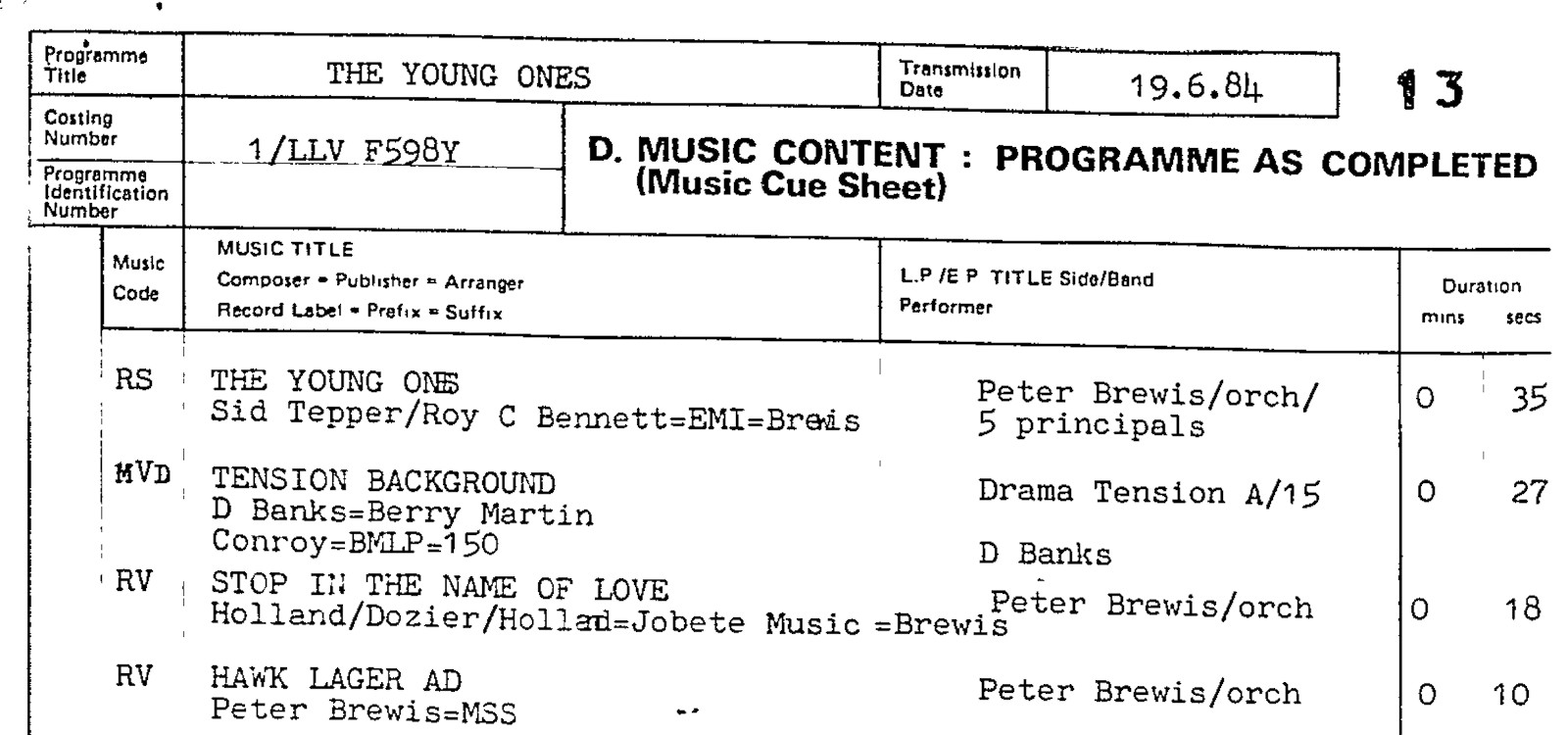
So let’s take a look at part of the sheet for the episode “Summer Holiday”:
Ah, “Tension Background”. Wonder what that was used for? Let’s take a listen, I’m sure all will become obvious.
Oh. That literally doesn’t appear anywhere in the episode at all. Brilliant.
To cut a long, tedious story short: the paperwork is wrong. Not entirely wrong; a track from the Conroy library album Drama – Tension is actually used in the episode. But the cut used is Track 3, “Chase Sequence”, not Track 15, “Tension Background”.
And that piece of detective work means that we can enjoy the full version of the music used when Neil goes all Incredible Hulk:
So, the moral is clear. Never trust the paperwork.
It’s the 6th February 1984 in studio TC4, and Rik Mayall is having a circular saw aimed at his knackers.
I write a lot about comedy on here. Sometimes I write some very silly things about comedy indeed. Take, for instance, this analysis of one of the main sets in Blackadder Goes Forth, and how it showed up in various forms throughout the series. You have to have a certain kind of mind to find that interesting, and admittedly, part of it is a pure puzzle box mentality: “What bit goes where?”
But there is also something a little deeper going on there. For all the careful explanations of what writers were hoping to achieve with their work – which for the avoidance of doubt, is something I’m also extremely interested in – what I really want to be able to do is transport myself back, and be present in the room where the comedy was actually made. I get obsessed with wanting to know how a room felt, either in the writing, or in the shooting. Trying to figure out what piece of wood went where while recording a sitcom is an attempt at nothing less than time travel, however ludicrous that sounds.
Which is where your good old fashioned studio recording tapes come in. Whether it’s just clips in documentaries, longer extracts released as DVD extras, or bootlegs passed quietly around as though we’re all crack dealers, there’s nothing quite seeing the raw footage of how a show is made to get a sense of how things felt. An incomplete sense, of course. Nothing can quite replace a real time machine. But it’s something.
All of which preamble is leading up to this glorious video on YouTube. Two hours of raw studio recordings of The Young Ones, precisely none of which is officially sanctioned for release, and precisely all of which is fascinating.
Let’s be very clear about what the above footage represents. Each episode of The Young Ones – unusually for a sitcom of the era – had two days in the studio. These consisted of a pre-record day for the complicated technical bits, without an audience, followed by an audience record the very next day. The above footage is the bulk of the pre-record days for the episodes “Nasty” and “Cash”. The fact that these are the pre-record days explains the lack of audience laughter on the footage, something a few people in the YouTube comments are a little confused by. An edited version of this material would have been shown to the audience the next day on the studio monitors, along with recording the rest of the show in front of them, in order to get the laughs.
Not that what we are seeing is the edited footage that the audience would have seen, either. This is the complete – or near-complete – recording of the day, featuring multiple takes of the material. In short: this really is as close as we can get to skulking around in the studio for the day, silently watching as the team shoot one of the best sitcoms ever made. We even know exactly when everything occurs; the timecode at the bottom of the screen is literally the time of the recording.
There is no substitute for simply watching the video embedded above. But I thought it might be useful to write some notes to go alongside it. Here then, are some observations on the first half of the video, covering the pre-record day for “Nasty”. In particular, I’ve tried to identify any part of the script which don’t make it into the final edit, along with which of the multiple takes were actually used in the finished show.
I really need to get back to watching Orange is the New Black, you know. I got bogged down at the end of Season 4. Is she gonna shoot him? Is she? IS SHE?
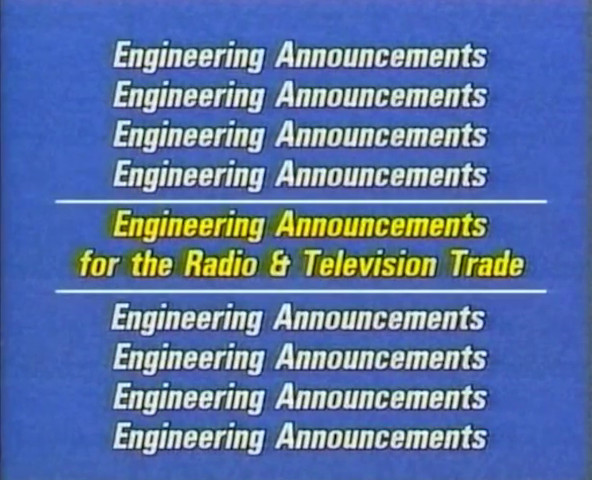
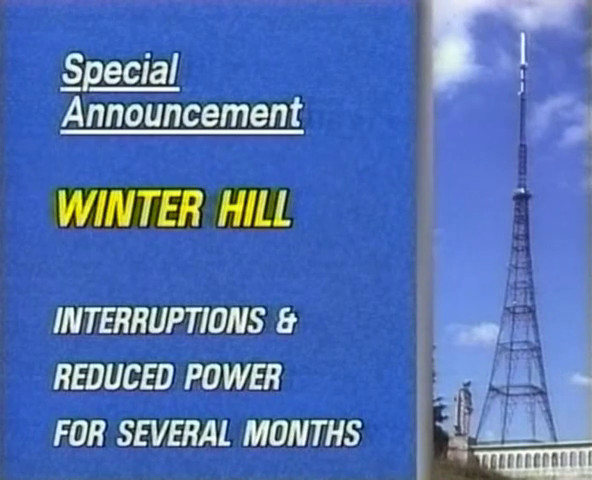
So in order to get back on track, recently I… erm, watched an old IBA Engineering Announcement from 1990 instead.
I feel I’m supposed to be nostalgic for the Engineering Announcements – those hidden, weekly 10 minute programmes on your local ITV station, giving the trade all the latest news and transmitter information. I’m supposed to say that I watched them through my childhood, that they got me interested in how telly works, and are responsible for me working in the industry today. Truth be told, I don’t think I ever actually saw one as a kid. If I did, it left no impression on me whatsoever. I was rather more interested in Central Television idents instead. (Well, I had to show my TV geek credentials at that age somehow.)
Which means that watching them online now is a faintly bizarre experience. Broadcasting ephemera that I feel I should have seen, but never did. For example, take this one, broadcast on Tuesday 26th April 1990, at 5:45am. I would have been eight years old. Why didn’t I just get up early? I didn’t need sleep at that age, surely?
“Beam me up Scotty” was never said in original Star Trek. “Play it again, Sam” was never said in Casablanca. Or how about my least favourite example: “Don’t tell him your name, Pike” is not the actual line in Dad’s Army. A sentence which is so lacking in comic rhythm that I could punch somebody… so obviously, it had to be plastered in large letters inside the audience foyer of New Broadcasting House.1
This article is about another misquote. But unusually, it’s about a very recent misquote. One which we can see spreading before our very eyes.
So let’s take a look at this article in the Metro on the best Basil Fawlty lines in Fawlty Towers, published February 2018. I have to be honest: it is not an especially good article. I don’t plan to eviscerate it; I will leave that fun as an exercise for the reader, if you so desire.2 I merely want to point you all towards the very first quote that the article gives as an example of Basil at his best:
“For someone called Manuel, you’re looking terribly ill…”
Here’s the thing. That line doesn’t appear in any of the 12 episodes of Fawlty Towers.
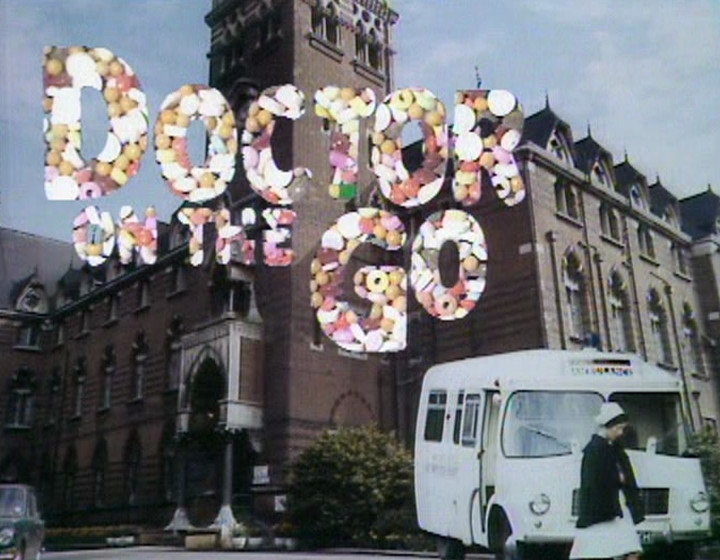
Between Doctor in the House, Doctor at Large, Doctor in Charge, Doctor at Sea, and Doctor on the Go, LWT made a total of 137 episodes of medical sitcom between 1969 and 1977. And I think it is virtually impossible to make 137 episodes of sitcom, without going a little strange at some point.
This is not a bad thing.
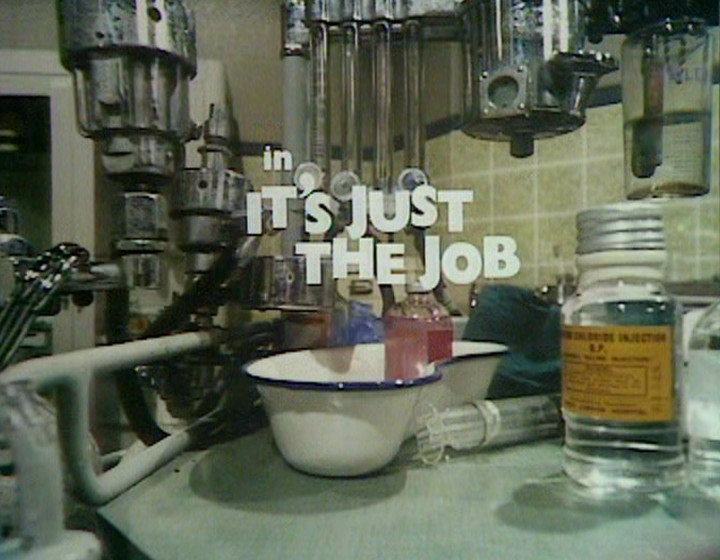
Take, for instance, the Doctor on the Go episode “It’s Just the Job” (TX: 8/6/75), written by Bernard McKenna and Richard Laing. The TV Times capsule merely promises us “another epidemic of of medical mayhem”. Which, sure enough, is true as far as it goes.
This year on Dirty Feed, I’ve talked about identifying the dates of some of my early TV memories.
Here’s a little tale about identifying the date of somebody else’s.
* * *
Long before Paula Yates invited people On the Bed, Emma Freud was doing the same on Pillow Talk, part of ITV’s late night programming Night Network.1 And who did she have on the bed in 1987? None other than a certain Chris Barrie, who spends much of the interview looking fairly uncomfortable. They should have just had sex in multiple different positions and had done with it.
A few things to ponder, then, before I reveal the real MEAT of what has turned out to be a rather remarkable little time capsule.
Previously on Dirty Feed, I took an in-depth look at the music used in Series 1 of The Young Ones. This turned out to be a surprisingly popular move. So, how about Series 2?
No preamble, let’s get on with it. Only pop music can save us now…
As before, there are some tracks that I just haven’t been able to identify yet. If you have any ideas, let me know in the comments or elsewhere.
It’s odd, the things you assume, with absolutely zero evidence whatsoever.
Take Red Dwarf repeats, for example. Over the years I’ve written countless stupid articles about the show. But one thing I never got round to is a full list of repeats Dwarf has had over the years. So if you want that, you should read Christopher Wickham’s excellent The Red Dwarf BBC Broadcasts Guide.1
Still, one self-confessed omission from that article is anything to do with cable/satellite repeats and the like. I don’t intend to provide a full list of these, because while I might be a moron, I am not an absolute fucking moron. It seems worth asking one question, however: when was the first repeat of Red Dwarf in the UK which was not on the BBC?
Before researching this post, my massively naive guess was: around 1992. UK Gold launched on the 1st November of that year; I’d just assumed that repeats of Red Dwarf had been part of the channel from the very beginning. But then, I never had access to the channel back when it started; the first time I ever experienced the wonders of multichannel television was in the late 90s, when we got NTL analogue cable, and even then we couldn’t afford any of the extra pay channels. Instead, I whiled away my days cheating the receiver into giving me 10 minutes of free Television X. Believe me, when you’re 18, 10 minutes is all you need.
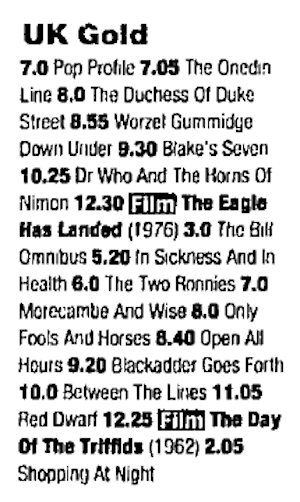
Anyway, there is a very easy way of telling when Red Dwarf was first shown on UK Gold, and it doesn’t involve doing any hard research. Just ask people on Twitter, and get them to do that hard work for you. And here is the answer from Jonathan Dent, cross-referencing the Guardian’s TV listings and this Usenet post. The repeats of Dwarf on UK Gold started with a double-bill of “The End” and “Future Echoes”, and premiered on the Sunday 5th October 1997 at 11:05pm.
That’s a bloody great day of telly, isn’t it? But I digress.
What I find especially interesting about all this is that it coincides with the 1997 resurgence of Red Dwarf, which started with the first broadcast of Series VII 10 months previously, along with the programme’s first Radio Times cover. A resurgence which I look back on with mixed feelings, to say the least – but very much part of the second wave of the show and its fandom. Being someone who got into Red Dwarf during the 1994 BBC2 repeat season, I had no idea that I was already watching the show before it got its very first non-terrestrial UK showing. These repeats are all so much later than the history I had made up entirely by myself in my own head.
Now, would it be too much to hope for that this first broadcast on UK Gold was captured by someone on video? Maybe even with the accompanying – and presumably quite excitable – continuity announcement?
A version of this post was first published on Ganymede & Titan in September 2019.
In fact, you should read his blog Ludicrously Niche regardless. TV edits, gamebook analysis, and Radio Times capsules, who could want anything more from the internet? ↩
I’ve had it up to here with Twitter. This is not an in-depth article about the perils of social media. It’s just a simple statement of fact. I’ve had it up to here with Twitter.
I could list the many reasons why I’m bored with it right now. People coming into your mentions and explaining your own jokes back to you is a big one. People piping up with the ludicrously obvious take, when you’ve tried your hardest to tweet something more interesting, is another.1 The constant stream of unpleasant news is a third. I know the world’s going to shit, I am literally paid to put news bulletins on air, and monitor them closely. I don’t need to be told all this stuff in my free time as well. It’s just too much to cope with.
Then there’s the thing which pushed me entirely over the edge yesterday: making a crap joke about “nations and regions” in terms of television playout, only for someone who doesn’t even follow me to pipe up with some nebulous political point against me. And when I tried to politely explain I’m talking about something technical rather than anything wider, they block me. I got enough of this kind of aggressive, bad faith shit in the playground when I was 12. Right now, I don’t feel like willingly putting myself through it as an adult. I am bored of other people making their neuroses my business.
So for now, I’m deactivated.
Of course, it won’t last. I’ve not stormed off for good. Lots of people who I really like talking to, I only actually know on Twitter. And speaking entirely selfishly, Twitter is where I get the vast majority of hits for Dirty Feed from.2 At some point I’ll be back, like a dog eating its own fetid puke. But the longer I can take a break from it, the better for my mental health. So if you wondered where I’d got to, there’s your answer. I’m just trying to do something more useful for a bit.