MARY RICHARDS: I think you had a dream. You dreamed that you started from nowhere, and you made it all the way to the top. Became rich, successful in every way, loved… and recently, you’ve begun to become aware that time is slipping away, and your life has turned out a little differently from the dream. In fact, compared to the dream, you think your life isn’t all that terrific. And it’s begun to bother you.
TED BAXTER: That’s amazing, Mary. How did you know that was my problem?
MARY RICHARDS: Ted, that’s everybody’s problem. I had a dream once. I dreamed of becoming a ballerina. Took so many classes, I practiced so hard. In the hopes one day I’d dance with the finest ballet company, and I’d win the cheers of audiences all over the world.
TED BAXTER: So you wanted to be a real famous dancer. And you wound up as the producer of a local news show.
MARY RICHARDS: That’s right.
TED BAXTER: Boy, you really blew it.
– The Mary Tyler Moore Show, “Hail the Conquering Gordy”,
CBS TX: 5th February 1977“I think I’ll always consider myself a failed dancer, not a successful actress.”
– Mary Tyler Moore, The Los Angeles Times, 20th December 1981
An Utterly Worthless Experience
I have to be honest: I’ve been feeling a little guilty over the past couple of weeks. When I fell in love with The Dick Van Dyke Show, I wrote something which tried to explain at least some of what I loved about it. With The Mary Tyler Moore Show, I leapt straight into stupid production minutiae. I feel like I’ve given poor Mary a bit of a bad rap.
So let’s try to redress things a little. I want to talk about one of my very favourite scenes in the show. No, it’s not from “Chuckles Bites the Dust”, which is clearly an amazing episode, but has been talked about far too much by this point. Instead, it’s the closing scene from “Mary and the Sexagenarian”, first broadcast by CBS on the 12th February 1977, and written by Glen and Les Charles.
The whole episode up to this point has been about the trials and tribulations of Mary dating a man 30 years older than her, a topic which could have been potentially queasy, but is dealt with in the show’s typical sensitive fashion. And then we get the final scene of the show. What have we learnt today?
And instead of answering that question, Mary Tyler Moore expertly skewers TV’s propensity for giving life lessons and issuing moral guidance.
LOU GRANT: You take two very different people. Different backgrounds.
MARY RICHARDS: Different outlooks.
LOU GRANT: Right, right. One more than 30 years older than the other. You bring them together. With all the odds against it. Even though the whole world ridicules it. It can still turn out to be… an utterly worthless experience.
MARY RICHARDS: Thank you.
There are so many reasons why I love this. Firstly, it was slightly surprising even to me to find a US sitcom from 1977 be quite so relentlessly cynical. This feels more like a gag from The Simpsons than anything else. Sorry Simpsons, Mary Tyler Moore already did it.1
Secondly, I adore Mary Tyler Moore’s performance in this scene. True, it’s a scene which is more about selling an abstract idea than an emotional beat. But the actors have to make that idea work within an emotional context, and they do a magnificent job. Mary looks so revolted and defeated as she leaves the office, and she never gets enough credit for just how good she is at those kind of scenes. The very opposite of “turning the world on with her smile”.
We dumb down Mary Tyler Moore into being merely a bright, smiling, all-American gal at our peril. When needed, she brought as much edge to that show as anyone.
But thirdly, and perhaps most importantly: the scene is a reminder to me that I truly love comedy with what I like to call “an evil, beating heart”. I sometimes worry that people misinterpret what I mean by this; that I’m specifically referring to, say, racist or homophobic gags, or at least material which goes into those kinds of areas. But that’s not what I mean at all.
Instead, it’s something a little more subtle: that I enjoy comedy which does not always have a pleasant meaning behind it. Here, it’s the idea that we can all go through painful experiences, and there truly is no real lesson we can learn from them. The pain has been for nothing.
It reminds me very much of one of my favourite jokes from Some Mothers Do ‘Ave ‘Em:
FRANK SPENCER: As my mother used to say – a trouble shared, is a trouble doubled.
A joke which, as friend of the site Mike Scott pointed out, is amusing because of the rhyming trouble/double; it just sounds funny. But what I love most about it is that it talks about a real truth which we would all prefer to ignore. Of course we should talk about our problems… and of course that has a bad side too. By sharing a problem, you literally are giving a piece of it to someone else.
And that’s life. Some troubles just have to be doubled. And sometimes, a relationship you had was an entire waste of time, and there’s nothing positive you can take from it. Sucks to be you.
But maybe comedy like this does have a message after all. It sucks to be all of us.
With thanks to Tanya Jones.
The James L. Brooks connection is not lost on me. ↩
We’ve Put It All Together
The great thing about YouTube is that it’s full of unusual clips of TV programmes which used to be difficult or impossible to see any other way. The less great thing about YouTube: often, these clips are given little or no context.
With that in mind: what exactly is the following, ostensibly from The Mary Tyler Moore Show?
The Mary Tyler Moore Show: Prod. #7001
The problem with coming of age as an archive TV nerd through Red Dwarf DVDs is that you get thoroughly spoilt. You expect every single sitcom release to feature a copious selection of deleted scenes. Sometimes you hit lucky; the Seinfeld releases are absolutely incredible. But for older shows, you’re pretty much always going to be disappointed.
Luckily, we know how to make our own fun around here. Last time, we saw how the script for the first episode of The Mary Tyler Moore Show pointed towards a reshoot of a key scene. And in that script, there’s a fair amount of material from other scenes which was removed before the show was broadcast.
Let’s investigate. I haven’t noted every single minor change in dialogue phrasing, as that would be immensely tedious, but all significant differences are noted. Times given are from the Region 1 DVD release of the show.1
The DVDs of The Mary Tyler Moore Show contain the original broadcast versions of the programme – albeit with the odd edit – not the cut syndicated versions. So this article is definitely about material which was never broadcast. ↩
“Aunt Rhoda’s Really a Lot of Fun”
In 2025, I watched all of The Dick Van Dyke Show (1961-65) and its spiritual successor The Mary Tyler Moore Show (1970-77), with a chaser of Rhoda (1974-78). That’s such a concentrated burst of greatness that I feel like anything I watch this year will be a disappointment.
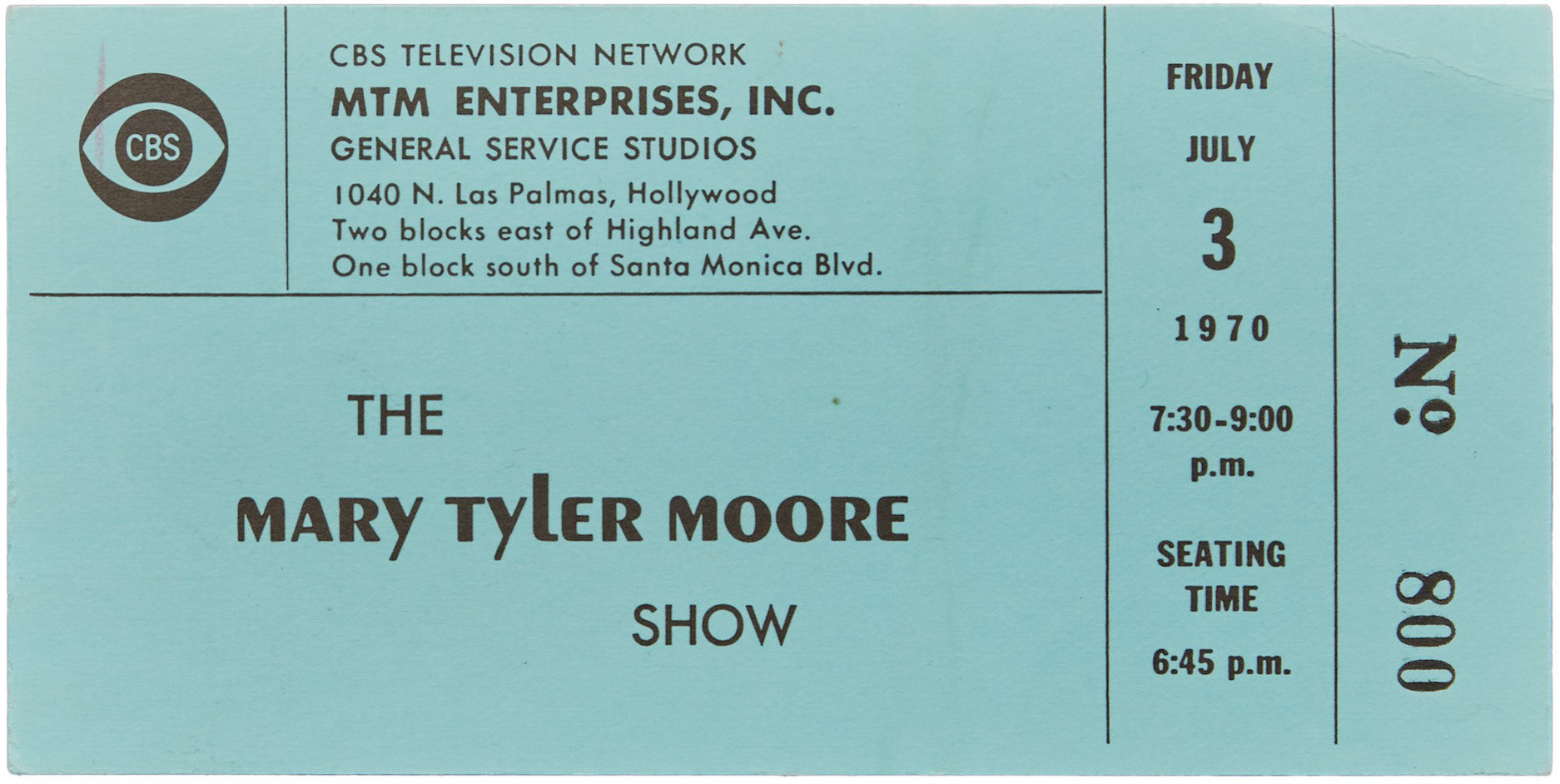
So while I scrabble around for something to replace the giant hole in my life – and no, spin-off Phyllis (1975-77) doesn’t quite cut it – I can at least throw myself into the usual behind-the-scenes books and documentaries. Very quickly, you learn all the standard tales which have come up over the years. And with The Mary Tyler Moore Show, one tale looms above all: the disastrous preliminary filming of the opening episode, three days before the real one.
This is probably most succinctly expressed in the book Mary and Lou and Rhoda and Ted (Simon & Schuster, 2013):
“The day of The Mary Tyler Moore Show’s first chance to perform in front of a studio audience began with news of a bomb threat on the lot… The threat was determined to be unfounded, and audience members were herded in. But the folks in the stands couldn’t see the actors over the cameras, which were twice as bulky as the standard kind, so they were forced to try to catch the action on small monitors instead. The air-conditioning broke down, so the two-hundred-member audience and the actors were left to swelter in 90-degree July temperatures while watching a practice run of a series already being promoted to viewers as if it were a done deal. The microphones didn’t work properly.”
The problems continue from there. At times, the stories about this recording take on an almost absurd tinge; everything that could have gone wrong, seemingly did. Showrunners James L. Brooks and Allan Burns did a dreadful job with the warm-up; the actors weren’t quite ready; the director hadn’t had enough time with the camera crew… the excuses just keep piling up. The dodgy aircon and sound system would surely be enough to kill a recording, let alone anything else.
And then there was Rhoda, a character which seemingly made a few people nervous. To be fair, she is set up initially as an antagonist to Mary, and spends the entire episode trying to nab her apartment. But also: never underestimate some people’s unpleasant reactions to a gobby Jewish woman.
Either way, she certainly didn’t test well with the studio audience that particular night. What to do? Back to Mary and Lou and Rhoda and Ted:
“Script supervisor Marge Mullen, who’d held the same job at The Dick Van Dyke Show, stopped by the producers’ office. She had an idea – maybe not the biggest one, but it was something. “People don’t seem to like Rhoda,” they remember her saying. “There’s this little girl who’s Phyllis’s daughter, and if the little girl likes Rhoda, it’ll give the audience the opportunity to love her, too.”
It was the only substantive idea for an improvement Brooks and Burns had heard all evening. They decided to take Mullen’s suggestion, cut a few other lines, and call it a night, putting their faith in what they’d written and the cast they’d hired. Many things had gone wrong with that first taping, but the words and the talent, they believed, were there.”
Come the second recording, three days later?
“The only major change to the script was pigtailed twelve-year-old Lisa Gerritsen as Phyllis’s daughter, Bess, saying, “Aunt Rhoda’s really a lot of fun,” as Mary opened the curtains in her new apartment to see a harried Rhoda on her balcony in the opening scene. Gerritsen was the granddaughter of child actor and later screenwriter True Eames Boardman, as well as the great-granddaughter of silent film actors, but she had now made her own showbiz history.
This time, the audience roared. Gerritsen’s new line seemed to indeed be the magic bullet.”
Unlike all the other problems with the first recording, which was a smorgasbord of failure, this at least is a nice, neat anecdote. One single line changed how the audience felt about Rhoda, Marge Mullen and Lisa Gerritsen save the day, job done.
The problem is, it’s not quite the full story.
Everything That You Need to Know
Something unexpected has happened with The Peter Serafinowicz Show over the years.
For a programme which had just eight episodes, one of which was a Best Of, and which has never been repeated by the BBC1, the show has become a fixed reference point for certain strata of comedy fans. When I first watched it back in 2007, I rather liked it, with a few reservations. In 2025, it lives rent free in my head. If you think people endlessly quoting Python are annoying, just wait until I do my Ringo Remembers. “I just thought it was inappropriate. Especially at Christmastime.“
But of all the characters in the show, the one with the longest life has turned out to be inept businessman Brian Butterfield. A character inspired by this ludicrous advert, but which became something stranger and wilder almost immediately. A character which ended up going on tour fifteen years after the series was first broadcast, with all the associated paraphernalia. Who would have predicted that back in 2007?
All of which means it’s high time I wrote something interesting about it. So let’s take the second episode of the show, broadcast on the 11th October 2007, and one of the most well-remembered sketches of the lot: the Butterfield Detective Agency.
Of all the incredible moments in that sketch, my favourite might be Peter’s eye-flick upwards on “Australian”, as though Brian has just begun to realise he might have got it wrong.
But if you know this site well enough, you can probably guess where I’m about to go. What about the fabulously inappropriate music for the sketch, trying desperately to give a sense of showbiz that Brian Butterfield is incapable of providing? Well, it probably won’t surprise you to learn that it’s a library track: “Theatre Land”, credited to David Arnold2 and Paul Hart, and first released in 1991 by Carlin on the album TV/Radio/Showbiz/Logos (CAR 188).
Specifically, it’s three different versions of “Theatre Land” bunged together. All three are included below.3 I shall leave where the edit points between them are in the original sketch as an exercise for the reader.
So, job done, yes?
Not quite.
Aside from the Christmas Special, which had a repeat a couple of days later in a different edit. I’ll write about that one day. ↩
Ah, the everlasting confusion with there being two British composers called David Arnold. One scored multiple James Bond films. The other did the themes for The Big Breakfast and Live & Kicking. We are dealing with the latter. ↩
There are nine versions of “Theatre Land” in total on the album. ↩
Various Cutaways of Rat
(You’ll need to have read this piece on the Fawlty Towers episode “Basil the Rat” and its two-day recording schedule, along with this short follow-up, in order to get anything out of this post. Also, fair warning: we get deep into the weeds with this one.)
Somebody recently emailed me with a reasonable enough question: where do I get all the old television scripts I use in my writing here on Dirty Feed?
You may perhaps expect me to be hanging around various libraries and archives, but for boring practical reasons, that isn’t usually the case.1 Instead, I have various other sources. Some of them are already published in books, like the Absolutely Fabulous pilot.2 Some of them are just sitting online if you know where to search, such as the pilot for Mary Tyler Moore. Some of them I simply get sent by friendly people every now and again. (Yes, I will write about that Love Thy Neighbour script one day, promise.)
Then there’s auction houses. And while I occasionally buy scripts from eBay and the like, I can’t afford to do that too often.3 But just occasionally, you get lucky. As I was when it came to Fawlty Towers, and – you’ve guessed it – “Basil the Rat”, or just “Rat”.
Oh, you want a longer explanation? Fine. I believe I’m very careful here on Dirty Feed when it comes to copyright and fair dealing. I only use extracts of copyrighted works for the purposes of criticism or review – and the stuff I do here definitely counts as that.
However, archives are generally a bit stricter than this when you’re actually quoting material they hold, and demand that you get permission from the copyright holder. It’s a) a faff, b) you might not get permission, and c) I seriously want to make sure I don’t upset anyone and make myself persona non grata by disobeying the rules. So with a lot of my stuff, it’s ironically easier to avoid official avenues. ↩
Though you have to be careful to figure out you’re not working from transcripts, or scripts which have been edited to take all the fun stuff out of them. ↩
I recently had to stop myself from buying the script for an episode of long-lost Bob Monkhouse sitcom The Big Noise. I still slightly regret controlling myself. ↩
“I Don’t Own a Television Machine”
Every so often, when struggling to analyse what I love about a TV show, I reach for the phrase “a complete comedy”. It’s a bit of a shitty, half-arsed idea. Let me at least try to explain what the hell I mean.
Some shows are built to do very specific things. Fawlty Towers is one of the best sitcoms ever made, but it’s essentially a wind-up engine for producing farce. Something like The Young Ones might look wild and anarchic and like it could do anything… but watch how the show immediately has to retreat once it brings up the death of Rick’s parents in “Summer Holiday”. There are some places the programme simply can’t go.
Then you have shows like Hi-de-Hi!, where it feels like they can go anywhere, and do anything. One episode might be a sadistic parody of light entertainment with Ted which would make Filthy, Rich & Catflap blush, the next could be another chapter in the touching Gladys/Jeffrey near-romance, then we’re headlong into a farcial plot about illicitly screening mucky movies.
An even better example is Frasier, a show which would seemingly mould and bend itself to take any kind of comedy the writers felt like doing. Oh, you want to do Mr. Bean this week, but with Niles? No problem.
Of course, it’s not a perfect categorisation. With any show, you’ll eventually bump into its boundaries and limitations; it’s just a question of how far you can wander first. It’s also not meant to be a criticism of shows which are more limited in scope; slagging off Fawlty Towers for not being something it’s not even trying to be would be completely ludicrous.
And yet I have to admit a certain fondness for those shows where you simply don’t know what kind of comedy you’ll be getting this time round. And The Dick Van Dyke Show, which aired on CBS between 1961-66, falls squarely into this category of a “complete comedy”.
Zodiac and Co.
This week, I have watched two things from 1977. One was The Spy Who Loved Me. The other was a mostly-forgotten BBC South West regional programme called Zodiac and Co. You will be unsurprised to hear I have more to say about one of those things than the other.
Zodiac and Co., best described as an astrological What’s My Line?, was presented by Jan Leeming. Her fantastic autobiography1, Addicted to Love (Robson Books, 2003) gives a good account of the series:
“I’d been approached by Bryan Skilton, a colleague from my BBC Bristol days, and asked to front a new series of programmes to be recorded in Plymouth. Zodiac and Co.2 had an interesting format. Very often with a new idea, a series will have a local showing. Then, if it is successful, it might go nationwide. This was the hope with Zodiac. However, to begin with, it was only for transmission in the West Country and our guests had to either live in the area or have an association with it.
The programme comprised a team of an astrologer, a graphologist, and a palmist. Julia Parker, whom I knew well from Women Only, was our astrologist. In advance of the programme, she would be given the guest’s birth date, time and place; Albert Hughes, the graphologist, would receive a sample of handwriting, and Lori Reid, our palmist, got a palm print. The three team members would have to reduce their deductions to one and a half minutes on camera, in which they delivered their findings about the guest. The guest would remain in a room hidden away from the panel, but a camera would record their reactions, which were shown to the audience at home. After the prognostications, the guest would join me and the team to discuss the findings.”
All very interesting. Not least because Jan Leeming has just taught me the word “prognostications”.
But there’s a particular reason why the show is of interest to us here, and it’s related to the one complete edition of the programme available on YouTube. For those of you who want to experience the complete programme as you might have done back in 1977, I’ll only give away the identity of the guest in the second half of the show after the cut.
It really is worth reading, by the way. Anecdotes like this are typical, regarding her attack by strangers at TV Centre in 1987:
“There was a lot of discussion about security at the BBC. Actually in my opinion it was a joke. At the front of Television Centre it is like Fort Knox… but at the back of the building it was a leaky sieve. All my assailants had to do was shin over the iron railings and get in through the scene dock, or the Outside Broadcast Bay, where the cars were constantly coming and going.” ↩
You will be unsurprised to hear that this programme has many permutations when it comes to the title. Despite the logo of the programme itself not including the full stop, I’ve decided to go with the format that Jan herself uses here, which was also mostly used in contemporary publications. ↩
Basil the Rat Redux
Last time, we talked about how “Basil the Rat” was unique among Fawlty Towers episodes, in that it had two days in the studio. But there is another thing which makes it unique: the episode was also shot in front of two separate studio audiences.
Both of these audience sessions were on the second day of recording: the 20th May 1979. A matinee, followed by the evening performance. Bob Spiers gives full details on the DVD commentary:
“I think we were able to actually get it together by something like 4 o’clock on the second day, and consequently we showed this I think to two audiences, which gave the actors to really play two separate performances, which they were delighted to do. So I think mainly this is the second performance, but again we used bits of both performances.
I don’t think any actor would turn that down. They know the first performance is like a proper dress rehearsal with an audience, so they can sense the timing and can sense where the laughs are coming.”
Note that the above is different to the famous example of dinnerladies, which was also recorded in front of two separate audiences. But dinnerladies had one audience recording on the first day in the studio, and then the other audience recording on the second day, which gave Victoria Wood a chance to rewrite parts of the script based on the audience reaction of the first recording. “Basil the Rat” did both one after the other. Well, with a dinner break in-between.
It’s a point which is worth hammering home: “Basil the Rat” having two days in the studio had many advantages, rather than simply being useful for recording live rodents. The gang got both extra time for rehearsing the main show, and two bites of the cherry into the bargain.
* * *
Bob states above that while most of the episode was taken from the second recording, a few moments were taken from the first. The obvious question is: which ones?
Oh, how I’d love to write that article. I’m sorry to disappoint you. Details of that are lost to the mists of time, and I doubt even the darkest depths of Caversham could shed light on it. If I had a time machine, I’d spend most of my life going through Bob Spiers’ bins.
Also lost to the mists of time are the studio tapes of both performances. Very little unbroadcast footage of Fawlty Towers is known to exist; the bloopers ripped from the Christmas tapes are about your lot. Sure, in an ideal world, the BBC would have been aware that they were making something so special, that they should save every last scrap of material recorded for the series for posterity. But my brain is corrupted by years of DVD extras, and it’s unreasonable to expect the Beeb in 1979 to share my stupid brain. They were too busy making the next piece of great television.
But just imagine. “Basil the Rat” is one of the best half-hours of sitcom ever made. And for an indeterminate period of time, there existed two complete versions of the episode… just played in a slightly different way. All the same lines, all the same beats. Like a version of the episode which slipped in through a wormhole from a parallel universe. I’m imagining the DVD menu. “Basil the Rat: Alternative Version”.
Tell you what, though: considering the raw footage dragged up for the Gold documentary in 2018, I bet you could do it for dinnerladies. And that would have the added interest of seeing all of Victoria’s rewrites. Someone commission me, quick.