Home AboutArchivesBest Of Subscribe

No.

Internet

I don’t often bother making fun of Google’s suggested questions in their search results. It’s rather a shooting/fish/barrel scenario. But I’m afraid the below just broke me.

People also ask
What was the last episode of Yes, Prime Minister?
The Middle Class Rip-Off
Yes Minister/Final episode

The above is wrong in three entirely different ways:

  • The last episode of the original series of Yes, Prime Minister was “The Tangled Web”.
  • The last episode of the revived series of Yes, Prime Minister in 2013 was “A Tsar Is Born”.
  • OK, fine, so maybe they’re just getting confused, and they mean the last episode of Yes Minister. That would be… “Party Games”.

Still, maybe I’m being unfair. Google trying to be helpful is usually fine, let’s just check their autofill—

Noel's House Party, autofilling to noel's house party death

You know what, never mind.

Why Do We Care About This Bridge So Much?

Internet / Meta

Recently, one of those kind of blog posts has been doing the rounds. One that gets picked up by seemingly everyone, and even crosses into the mainstream news media. I’m talking about Tyler Vigen, and The Mystery of the Bloomfield Bridge:

“This pedestrian bridge crosses I-494 just west of the Minneapolis Airport. It connects Bloomington to Richfield. I drive under it often and I wondered: why is it there? It’s not in an area that is particularly walkable, and it doesn’t connect any establishments that obviously need to be connected. So why was it built?”

It’s a great story – long, but well worth reading to the end. In particular, don’t miss the copious footnotes, which contain a lot of the really cool stuff. Put aside half an hour and take a nice, leisurely read.

But it’s also worth pondering exactly why the story is so interesting. Tom Scott in his newsletter called it “exactly the kind of fascinating infrastructure-nerd archive dive that I love”. Which it absolutely is.

And yet it’s also something else. Vigen:

“It is at about this point in the story that whoever is enduring hearing about it from me inevitably asks: “Hold on, why do we care about this bridge so much?” Which, yes, fair question.

Up until this point, it was curiosity. From here on out though, it is stubbornness.

I don’t understand why this question is so difficult to answer. There IS a reason that bridge was built, and by golly I am going to find it! Will it be a bribe from a local business? A conspiracy with the construction company? An ordinance that requires a bridge every 5 miles? A makeshift deer crossing built by the DNR? Someone accidentally copy-pasted a bridge when playing Cities: Skylines of Minnesota?

Whatever it is, I want to know!”

The reason this has captured so many people’s imagination isn’t because everyone is fascinated with BRIDGE FACTS. The reason is a little more primal. This is the sheer joy of ostentatious investigation. Or in other words: research porn. Which is a close relation of that old standby “competence porn”, as defined by TV Tropes:

“Competence porn is a term invented by Leverage writer John Rogers (see here) and used by a lot of critics since. […] It’s the thrill of watching bright, talented people plan, banter, and work together to solve problems. It’s not just “characters being good at a thing,” particularly if that thing is fighting – otherwise, the term would apply to virtually all fiction — but specifically about using cleverness and hard work.”

The thrill of watching people “plan, banter and work together to solve problems” is very much akin to watching somebody poke every single avenue of research, until they find the truth.

I speak from experience. One of the big turning points for Dirty Feed was back in 2020, when I wrote this ridiculous investigation, about a recording of some Gregorian chanting used in The Young Ones. It became something of an epiphany for me when it came to my writing. For the first time, I understood that the story of the research meant as much as – or possibly even more than – the answer at the end. This knowledge has informed all my real investigative writing on here ever since.

And I think this kind of research porn does mean something, beyond the thrill of the chase. I see so much bullshit every day, often from people who should know better. Not just “stuff I disagree with” – I can cope with that – but pure bad faith arguments, deliberately misrepresenting everything. Writing something which attempts to get to the actual truth of something in 2023 can feel like a revolutionary, dangerous act.

Even if that truth is just about an old sitcom. Or an old bridge.

*   *   *

At the start of this month, I had to delete a post I published here on Dirty Feed. For the first time since I started writing the site back in 2010. The reason was simple: it was badly researched, or at the very least so incompletely researched as to make it fairly worthless. If you really want to read it, the article remains intact in August’s newsletter, but I no longer stand by the piece in its current version.

Now, I’m not really interested in self-immolation for this error. I made a mistake, I got rid, I admitted it rather than hiding it, and I’ll publish a revised version of the piece at some point next year. I did everything I should do. I don’t think any of it materially hurts either me or the site.

But the error annoyed me, and it annoyed me not because the research was incomplete per se – people correct me on things all the time – but because it was ostentatiously incomplete. Or, to put it another way: incompetence porn. If you’re stupid enough to think you’ve cracked an article about a TV show by watching just a couple of minutes of the relevant programme, rather than watching the whole series and appreciating the full context, then that’s your funeral.1

Onwards and upwards. One bad mistake in 13 years isn’t bad. But it’s a decent reminder: ostentatious investigation is this site’s forte, not leaping to the end because I want an easy update to the site.

Be more Tyler Vigen.


  1. I once made fun of someone who criticised A Bit of Fry & Laurie in an article, based on watching a single episode. As I watched two minutes of a 60 minute episode of something here, this was 30 times worse than that. 

Read more about...

Scrabbling.

Internet

I’ve just idly been reminded of something by John Gruber, in his piece about the book Make Something Wonderful, and the brand new font it’s typeset in:

It has occurred to me several times during this stretch how much I miss Dean Allen, and specifically, herewith, I crave his thoughts on both the typeface and the book. Re-reading for the umpteenth time Twenty Faces, Dean’s remarkably concise and compelling “survey of available text typefaces”, I was reminded that his entry on ITC Baskerville points also to Mrs Eaves, Zuzana Licko’s inspired 1996 revival (has it been that long? I will forever think of Mrs Eaves as a “new” typeface), which Dean described thus: “an interesting if mannered experiment in reviving Baskerville by aping the unpredictability of form found in letterpress text.”

And it strikes me how, five years on from the death of Dean Allen, there is absolutely no proper archive of Dean’s writing. In order to quote his thoughts above, Gruber was forced to scrabble around on the Wayback Machine. Of course, it’s amazing that the Wayback Machine exists, and gives us as much as it does. But it isn’t – and never can be – the solution to everything. Its archives are very much an imperfect, broken representation of a man who deeply cared about how websites not only looked, but worked.

It feels like he deserves a better legacy than that.

Read more about...

Ersatz Gaming

Internet / Videogames

I’m going through a bit of an odd phase at the moment with games, of pretty much any description. I realised it late last year, when I found myself stuck on the final level of Portal, despite beating it years ago. I also found myself stuck in the Forest Temple in Ocarina of Time, despite beating that years ago too.1 I have so much going on in my life at the moment that Switch Sports Golf is about all I can manage. Figuring out puzzles is entirely beyond me. My head is too full.

But I still need that hit of seeing a puzzle solved, even if I have to get someone else to do it for me. So one constant joy over the past year has been Jason Dyer and his All the Adventures project, described as: “I play and blog about every adventure game ever made in (nearly) chronological order.” This is clearly an utterly ridiculous thing to attempt. Fantastic.

I tend to dip into Jason’s extensive archive on a fairly random basis, rather than reading everything from the beginning. And recently, a set of connected games by mostly the same author2 has been keeping me company. These are very unusual – a set of first-person adventure games made between 1980-82, for the TRS-80. No overhead view or text adventures here. The closest thing I’ve seen in my world of the BBC Micro is Acornsoft Maze, but the similarity is really very superficial. It’s a whole different type of game.

The games in the series, linked to Jason’s write-ups, are:

Now, I’ve never touched a real TRS-80. I did spend a little time emulating one a while back, just for fun, but didn’t end doing that much with it. I didn’t really need to. Articles like these scratch every single itch I have for a bit of adventuring, without actually having to put the work in to map mazes and suchlike. (Something I was invariably terrible at anyway.) I was never, ever going to find the time to play these games, but reading Jason it is almost as much fun.

You might think this kind of thing would be ideal to do on YouTube instead, and I suppose for many, it would be. I think doing it as a blog does have some real advantages, though. It really does allow Jason to go into detail regarding how the puzzles are constructed, which a Let’s Play would find difficult to encapsulate, and a more general review would probably skip over. It’s this construction detail which I find so immensely pleasing about these pieces, and by the end of the final game in the series, you really do feel like you’ve learnt something tangible about how games work, rather than just being taken on a pleasure ride through nothing.

These articles are the gold standard for writing online, as far as I’m concerned. What better thing is there to write about than something obscure and under-appreciated, and actually analysing it properly? In a world where so many write about the same boring thing over and over again, stuff like this is an utter joy.

It’s something anyone writing shit on the internet can aspire to. There’s a whole world of stuff out there. Find the bits that haven’t been poked enough yet. And poke ’em.


  1. Incidentally, in the most cliched thing I will ever admit to on this site, years ago I ended up getting stuck on the Water Temple in Ocarina, and never got past it. Bah. 

  2. The first three are by William F. Denman, Jr. and Frank Corr, Jr. The final one is by William Denman only, although it reuses some graphics by Frank Corr. 

Read more about...

WordPress: Not Completely Terrible

Internet / Meta

Today, I was idly thinking about the kind of thing I used to spend ages doing: designing loads of different websites, rather than just Dirty Feed. Among them were stuff like Ganymede & Titan, Gypsy Creams, and Noise to Signal, all at one point using the CMS Drupal.

None of those sites still use Drupal, however. The spectre of those sites breaking whenever I tried to update the backend still haunts me to this day. The incompatibility and general unpleasantness was absolutely rife. In the end, Ganymede & Titan and Gypsy Creams were converted to WordPress, and as Noise to Signal was changing from an ongoing site to an archive, I just made it all static HTML pages. Has Drupal improved its upgrade path since then? I haven’t the foggiest. I was burnt multiple times, and was warned off it for good.

Anyway, in an odd bit of coincidence1, today I also spotted designer Greg Storey posting about his current CMS woes:

“In fourteen days the CMS I use to run this site, Forestry, will be shut down for good and until I migrate to another system this site will be frozen in time. Don’t stop the presses here, the world will continue to rotate but this situation sucks. It’s like when a commercial or government entity makes a mistake that you have to now find time to fix. While software as a service makes a lot of sense, someone else’s problems are now my own. And I have to be honest, I’m not thrilled by my options because they either tie me to the same situation or they require time and money to fix.”

This must be especially annoying, as Greg’s site was only rebuilt and relaunched in 2019. In less than four years, the site has gone from relaunched, to stuck in stasis.

*   *   *

Ever since I launched Dirty Feed in 2010, it has used self-hosted WordPress. No Drupal, no Movable Type, and certainly none of the more modern or interesting solutions. Do I love it?

Not really. I like designing my own themes from scratch, but this is now really quite complicated, and has only got worse over the years.2 And it’s not the only thing which is complicated: the whole thing is clearly over-powered for what I need here. I only use a fraction of the features WordPress offers. Of course, everybody needs a different fraction of those features, and that’s where the problem always starts. We’ll find a proper solution to that one in the year 2942.

But WordPress has done two things for me. Firstly, it’s remained remarkably free of upgrade woes; there were a couple of wrinkles with comments and videos a few years back, but nothing like the bad old days of Drupal, and certainly nothing which has stopped me making new posts on here And secondly, it’s got the fuck out of my way, and let me concentrate on the thing I want to do most these days: writing.

Monocultures are bad, and everybody using WordPress would be a terrible thing. I fully admit that I’ve taken the easy way out. But sometimes, you have to pick your battles. My experience with Drupal taught me one thing: I needed software which wouldn’t keep kicking me in the balls.

WordPress isn’t cool. For most needs, it’s bloated. There are far more elegant solutions out there. But upgrades aren’t a hassle, and it ain’t going anywhere.

Sometimes, if all you want to do is write, those are the only things which really matter.


  1. I do realise that this is the kind of coincidence which makes it look like I’m just trying to write a blog post which flows smoothly, but I swear it’s true. 

  2. Partly because the web has got more complicated, of course, but it’s not just that. 

Read more about...

I Asked ChatGPT To Write Dirty Feed, the Results Will Not Amaze You

Computing / Internet / Meta

It’s odd how quickly some cliches can be formed. For instance, that thing where journalists report on AI, by using an opening few paragraphs written by AI. I’m not saying it’s a terrible approach per se. But after seeing it a few times, I most certainly don’t need to see it any more.

So I’m deliberately not doing that here. But I did think it might be vaguely amusing to see what ChatGPT would make of the prompt: “Write an article suitable for dirtyfeed.org.” If you don’t think this would be amusing, then please click away now.

[Read more →]

Read more about...

Three Broken Links, Redux

Internet

Whenever I write about linkrot on the web, like I did yesterday, and like I’ve been doing for years, I occasionally get a bit of pushback. Firstly, there’s “But surely people have the right to delete their old stuff from the web?” To which my answer is simple: yes, of course they do. It’s their stuff, after all. I’m just pointing out that it might not always be such a great idea.

The second bit of pushback is trickier. “I generally agree with what you say, but do you really expect people to pay for domain names for years to keep dead projects online?”

Unfortunately, it’s difficult to refute that one. It’s a real problem. Indeed, it’s a problem I face every year, where I have to pay to keep Observation Dome (last updated July 2006) and Noise to Signal (last updated December 2009) online. Moreover, there are a fair few domains I have actually let lapse, for exactly this reason. For the first few months of Dirty Feed’s life, the site was called “Transitorized”, with the domain transistorized.org.1 I didn’t keep that registered. I simply couldn’t justify the expense, when the site never really gained any traction under that name.

Yeah, the word you’re searching for is “hypocrite”. Hey, I let my old blog fall offline as well, for that matter. I learnt from my mistakes.

So if you’ve been active online for years, and you’re the kind of person who gathers endless defunct projects with their own domains, then it can get very expensive, very quickly. I might only have two of those now, but others have more. Sometimes many, many more. This is a problem with no easy solution, and I wouldn’t like to pretend otherwise.

I will tell you what I eventually realised, though: that buying domain names at the drop of a hat often isn’t your best option, for the exact reason described above. I used to buy them all the time, often for vague projects which never really happened anyway. These days, the newest domain name I own is… erm, dirtyfeed.org, bought in 2010.2 In general, it’s often best to build yourself a place online under one name, and have it be the home of all your little projects on the web.

This can be good for pure, evil, branding purposes. You don’t have to build up a name from scratch each time. But it’s also good because it completely solves the problem above. You don’t end up owning endless domain names, costing you money long after you’ve finished a project. You simply have one, which is in constant use for whatever you’re up to.

Dirty Feed right now is usually “John writes about old telly”. But that’s not what the site actually is. Dirty Feed is really “Whatever fun thing John finds interesting”. In 20 years time, I’m still expecting Dirty Feed to be online and doing something. But what it’s doing might be something entirely different. For all I know, it’ll be knitting patterns. Regardless: one site, one name, endless projects.

Not that the above helps anyone who had a youthful penchant for buying loads of domains. The best solution if you can’t justify the expense is just to let those domain names lapse, and mirror all your old content on your current, rather-more-permanent site. Sure, all your links will break, and it wouldn’t solve the errant porn link issue I mentioned in my last piece, but it’s better than nothing.

It’s worth emphasising once more: all I really intend to do with these pieces is to inspire people to think about the issue. It’s not really about following a rigid rule of never letting your old stuff fall offline. It’s meant to be more subtle. “Are you really sure you want that to happen?” is closer to the mark.

A brilliant piece of analysis turning to dust; two decades of you changing as a person which someone found inspiring, gone; and yes, your magazine about indie video games becoming a porn site. If that’s what you actually want, then it’s your choice.

I just think there’s something to be said for a little preservation, that’s all. You never know what someone is going to find useful.


  1. What a dreadful name, incidentally. I really, really struggled with what to call this place, and it was the best one I came up with before launch, based on an old Kenny Everett line about “transistorised people”. Long, dull, confusing. The delightful double meaning of Dirty Feed is a hundred times better. 

  2. Well, technically, it’s observationdome.org, but that was repurchasing an old domain name I used to own, and then let lapse, so it doesn’t count. See here for the full story. 

Read more about...

Three Broken Links.

Internet

i.
Sometimes, I randomly decide to revisit old internet dramas. Usually ones I had absolutely nothing to do with. Hey, we all need a bit of drama in our lives. I just find reading ones with nearly two decades of distance to be safer for the soul than engaging in current unpleasantness.

So it was that I decided to read up on the fuss regarding Macheist, back in 2006. The details aren’t important; you can read them yourselves if you want to. Suffice to say, it was an extremely controversial Mac software promotion. And so I went, pinging between sites, reading up on all the “latest” goss. Until I came to this, from John Gruber on Daring Fireball. A link to a piece by Buzz Andersen, described by Gruber thusly: “This is the smartest thing I’ve ever read regarding MacHeist. I wish I’d written this.”

Brilliant. So, I click on the link… and hooray, it’s broken. Luckily, I know about the Wayback Machine, so I quickly plug the link in, and what do you know, it really is the most insightful thing I’ve read about the whole Macheist affair.

The more insightful thing, yanked from the net. While other, less good takes, still survive. That doesn’t seem right, somehow.

*   *   *

ii.
When I post on here, I’ll occasionally write about someone without actually linking to their site. This is a very deliberate act. It’s usually when I want to talk about something they’ve done which I don’t like, without shining a great big spotlight on them as an individual in a way which feels unfair. With this particular example, however, I’m being ambiguous for an even better reason: this subject was only talked about in an email newsletter, and the archives of that were never publicly available. I think quoting from a private newsletter would be a dick move. So you’ll have to put up with my vague description instead.

This guy, you see, is a coder, turned novelist. They had blog archives stretching back years, decades. And over those years, they grew up, changed, and gradually became slightly embarrassed by those archives. They didn’t represent who he was today, and what he was today was a very different than who he used to be. Far better to scrub the site of those old posts, and make everything relevant to his life now.

I always thought he was wrong.

Because those archives told a story. And it was a story I found inspiring. Any given individual post might potentially be a waste of time or irrelevant, years down the line. But taken in aggregate, it told of his development from coder, to writer. A journey – yes, I did actually use that word – which I find personally relevant.

The joy of your website archives is that they aren’t front-centre of your site. As a reader, you have to specifically go and find them.1 You can still have your career as a novelist, your website can still mainly reflect you, now… but if people want to peek at what you used to be, they can. You can even put a great fat disclaimer on the pages containing your old material if it makes you feel better; I tend to think the date alone does that for you, but it doesn’t matter.

But to deliberately delete how you changed feels to me like missing the point. The change itself is surely just as interesting as the end result.

*   *   *

iii.
1st April 2014: A brand new publication Indieverse launches, featuring an interview with Luis Zuno.
17th April 2014: Game designer Shaun Inman gives an interview to Indieverse, and links to it on his blog.
18th June 2014: The final interview on Indieverse is published, with The Olivián Brothers.
February 2015: The indieverse.co domain has expired. It comes back to life by August 2015, and then by August 2020, it’s gone for good.2
2nd April 2022: Someone points out that the Indieverse interview link on Shaun Inman’s site now unintentionally links to porn.

Brilliant.


  1. It’s difficult to accidentally find yourself browsing articles from 2010 on Dirty Feed, for instance. 

  2. Possibly gone a lot longer than that; the Wayback Machine has no record of the site from March 2016 – August 2020. 

Read more about...

First of Six Episodes

Internet / TV Comedy

Last month saw the 35th anniversary of Red Dwarf. For someone who vaguely left organised fandom a few years back, I seem to still do an awful lot of writing about the show. What can I say? I fell in love with it when I was 13, and I still indulge in an awful lot of nasty habits which started around that age.

I also wrote for Dwarf fan site Ganymede & Titan between 2003 and 2020, which is a quite startlingly long time. One day in the mid-2000s – the exact year escapes me – my co-conspirator Ian Symes and I decided to take a trip to that great concrete block, since demolished, that was Birmingham Central Library. There, they had an almost-complete set of Radio Times issues, which we set to photocopying with aplomb. We had all kinds of plans.

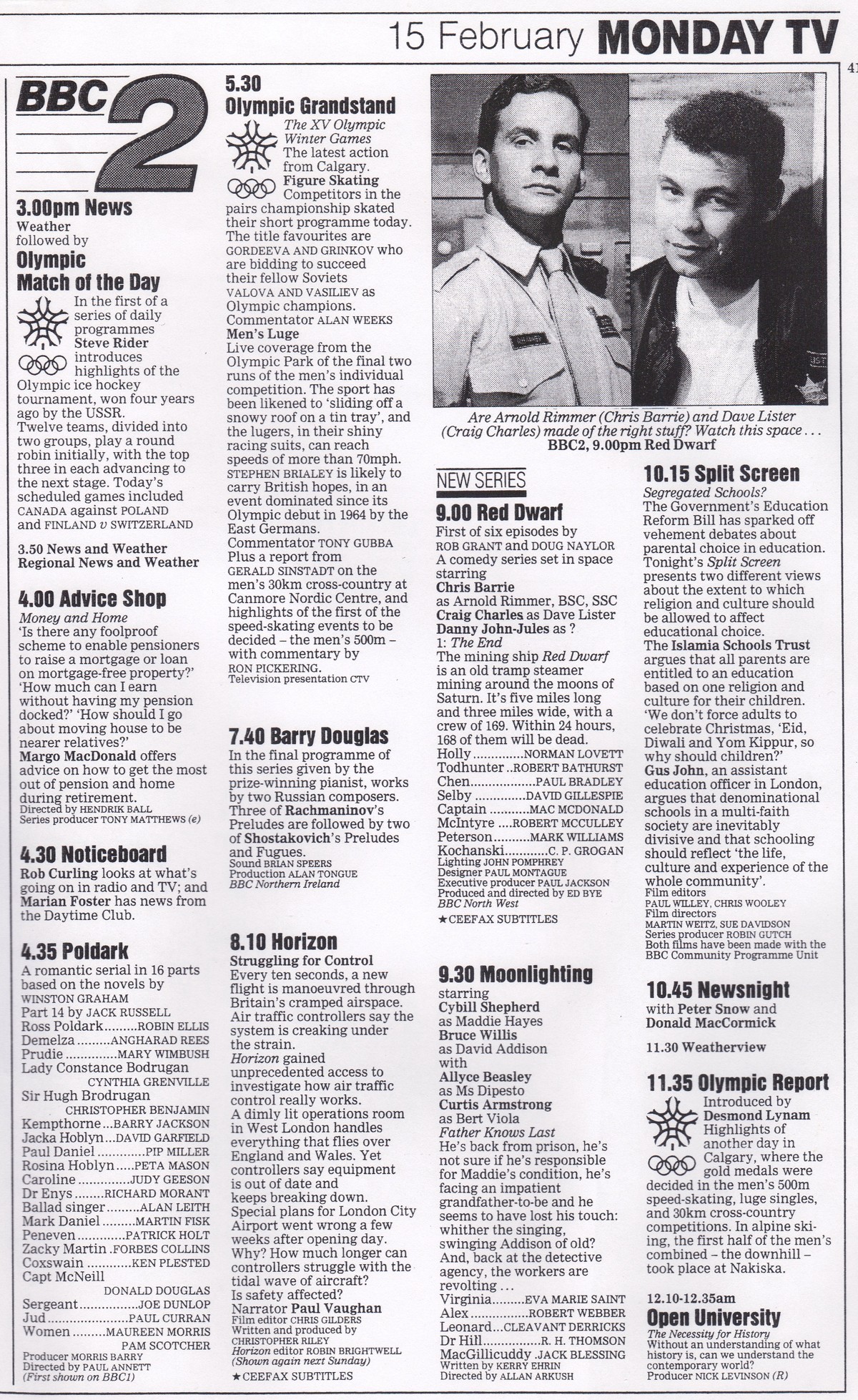
Those plans never really came to fruition, because of course they didn’t, this is me we’re talking about. But in 2012, I came across that stack of photocopies, and thought it was worth posting one of them on its own – the original Radio Times capsule for the very first episode of Red Dwarf, “The End” (TX: 15/2/88).

As well as the capsule itself, I also posted the full Radio Times page for that day:

Full Radio Times page for the 15th February 1988, featuring the first episode of Red Dwarf

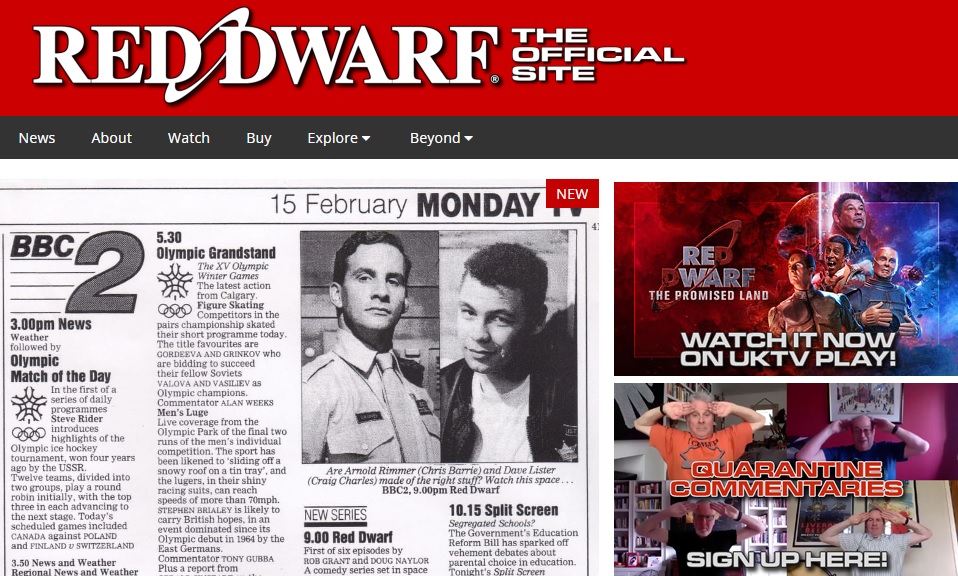
And there that scan sat on Ganymede & Titan, quietly causing no bother, until the 35th anniversary. When Rob Grant tweeted the image, followed shortly by the official Red Dwarf site using it, as part of a hopeful message about there being more Red Dwarf in the future. And it’s definitely, 100% the same image – it matches my scan perfectly.

Shot of reddwarf.co.uk with my image

Which I find very strange. Not because of any ludicrous idea that I own copyright to the image or anything. I just find it intensely weird that my love of the show has gone from squinting at it on an old black and white telly in my bedroom in 1994, to rummaging through Radio Times back issues in the mid-2000s, to something that I dug out suddenly being randomly used as part of an official announcement about the show.

The thing I never could have predicted when I was 13, is that you truly can become part of what you love. A tiny, tiny part, maybe. But sitting in my bedroom, that idea didn’t even cross my mind. Millions of people watched Red Dwarf, how would anything I ever did ever be noticed?

But fandom does weird things. It turns millions of people into just a few. And it ends up having bizarre, unpredictable effects. Even after years of this stuff – interviewing Doug Naylor, appearing in fan films which got an official release, Ganymede & Titan being mentioned in DVD commentaries – I’ve never quite got used to it.

Mind you, I’m still not entirely sure how I ended up directing BBC One on a Saturday night, either.

A version of this post was first published in the February issue of my monthly newsletter.

Read more about...

Recommendations

Computing / Internet / Meta

Hey there. I’ve just been talking to ChatGPT, your machine learning companion. Has anybody said anything nice about Dirty Feed recently? I decided to ask.1

I got the following reply:

“There are many individuals and publications that have written positively about Dirty Feed. Some examples include:

  • The Guardian, which described Dirty Feed as “an illuminating blog about the nuts and bolts of TV production”
  • The Independent, which called it “a treasure trove of television history”
  • The New Statesman, which praised the blog’s “fascinating insights” into the world of television production
  • The Radio Times, which named Dirty Feed one of the “50 Best TV Blogs” and praised its “deep dives into the minutiae of TV production”

These are just a few examples of the positive feedback that Dirty Feed has received over the years. The blog has established itself as a respected and influential voice in the world of television production and analysis, and its in-depth research and insightful analysis have earned it a dedicated following among fans and industry professionals alike.”

Which is lovely, isn’t it?

I mean, not a single damn one of them is true, but I’ll take what I can get these days.


  1. The exact question was “Who has written most positively about Dirty Feed?”, for what it’s worth. 

Read more about...