Home AboutArchivesBest Of Subscribe

A Programming Note

Film / Meta

It may not have escaped your attention that this year, Dirty Feed is taking a slightly different tack to normal. Yes, I’m currently on a Mary Tyler Moore kick. And if you think writing about programmes which were never that successful in the UK is a bad idea, just wait until I get onto Mary’s variety shows, which as far as I can tell were never even broadcast in the UK.

I’m doing this for a few reasons. Firstly, yes, I’ve completely fallen in love with Mary’s work. (Seriously, get a Region 1 player, the complete boxset of The Mary Tyler Moore Show, and knock yourself out.) Secondly, I’ve been getting a bit itchy about writing about the same things over and over again. Fawlty Towers and The Young Ones are amazing, but there is a limit to how much I can write about those shows without them becoming tedious. I’ve already ruined Red Dwarf for myself. I don’t want to ruin any of my other favourite things.

Oh, and thirdly, I need to make sure this site isn’t purely writing about BBC shows. I got a new job in December last year which makes this a really good idea. You can join the dots there for yourself.

Anyway, while I fool around with things like this, there’s something else I’ve started recently which I’ve found thoroughly enjoyable. I’ve finally got myself a Letterboxd account, and have been logging – and mostly reviewing – every film I’ve watched so far this year. That’s a total of eighteen films in January, and represents a side of my viewing habits which I don’t really talk about very much on here.

I have to say – years late – I really have fallen in love with Letterboxd. As someone who has mainly grown to despise social media, I’m having a ludicrous amount of fun with it. Most social media is filled with people who will punish you for not covering every single possible thing in any given post. And while I love writing Dirty Feed, my pieces on here these days have grown so complex, that it really can feel like work.

Letterboxd allows me to write random thoughts on what I’ve just watched, without feeling like any given review of a film has to be “complete”. The result is something where I can just take five minutes to write up some vague ideas, without it being in any way stressful. It’s the kind of thing which makes you fall in love with writing all over again.

Perhaps my favourite little piece I’ve written over there so far this year has been on Frank Tashlin’s brilliant The Girl Can’t Help It:

“Of COURSE the thing everyone talks about with Tashlin is how is animation background is obvious in his live action films. This is true. But it goes well beyond sight gags like melting ice, cracked glasses, and overflowing milk bottles. Note how the actors here not only strike very obvious, fixed poses, reminiscent of Warners animation, but how *quickly* those actors move from one pose to another. Jayne Mansfield putting her head in her hands is this film at its most animated.

The lesson everyone should learn from films like this is that to make great comedy doesn’t mean dialling everything down to nothing. You can do your big gestures, your stupid jokes, your heightened acting. You just need to make sure all of those things are hanging off real people in situations which mean something. It’s a lesson which is obvious with every frame of The Girl Can’t Help It, and yet so many simply don’t get it. It’s just a shame that too many of those people keep making comedies.”

And yes, I’m currently on a Jayne Mansfield binge. Which is a difficult thing to do these days, with most of her films being slightly less available than you’d think, especially in the UK. It’s things like this which make me fantasise about setting up a boutique Blu-ray label. And losing hundreds of thousands of pounds doing so.

So there we have it. Less nonsense about The Young Ones, more nonsense on The Mary Tyler Moore Hour and The Las Vegas Hillbillys. That may not feel like a win to many of you. But it will probably stop me going slightly mad, at least.
“From Here?”

Film / TV Comedy

Over the years, I’ve written plenty about comedy writers reusing jokes. Today’s topic is one of the most famous and most-quoted examples of the lot.

So let’s turn to ersatz Bond film Never Say Never Again, which premiered in the US on the 6th October 1983. Oh dear, James Bond isn’t having much fun.

NURSE: Mr. Bond? I need a urine sample. If you could fill this beaker for me?
BOND: From here?

The tale surrounding this is well-known by now. Dick Clement and Ian La Frenais did some emergency rewrite work on Never Say Never Again, coming in three weeks after the film had started shooting, and staying with the production for three months.1 Of course, they nicked the above joke from their own Porridge, and both writers have openly and repeatedly discussed this.

For instance, in the Omnibus edition “Whatever Happened To Clement & La Frenais?”, broadcast on the 20th July 1997:

DICK CLEMENT: We’re always tempted to recycle jokes, We did use one… it’s not a similar joke, it’s the same joke, in Never Say Never Again as in Porridge. If you see them back-to-back, it’s quite amusing.
IAN LA FRENAIS: We call it homage. We don’t call it recycling. (laughs) But it doesn’t happen very often.

The joke was actually taken from the very first episode of Porridge2, “New Faces, Old Hands”, which first aired on 5th September 1974:

DOCTOR: You see those flasks over there? I want you to fill one for me.
FLETCH: What, from ‘ere?

For me, it’s the lightning-fast reaction from Barker which really sells it. He knew when you shouldn’t have time to anticipate the gag.

Obviously, this scene has become one of those clips over the years – if not quite rivalling Del Boy falling through the bar, then definitely in the ballpark. You do get to the point where at least as many people remember the clip from documentaries and anecdotes as they do from the actual show.

With that in mind, it’s worth noting at least one newspaper reviewer enjoyed the joke so much on first transmission, that they quoted it in their column the very next day. Peter Fiddick, in The Guardian:

“The jokes are there though both verbal and visual. (“I want you to fill that glass” says the prison doctor to Barker. “What – from here?” – and the camera cuts away from them precisely to emphasise the distance.)”3

So far, so standard. But the big question is: can we trace the joke back even further?

[Read more →]


  1. More than Likely: A Memoir (Weidenfeld & Nicholson, 2019). 

  2. Not including Seven of One‘s “Prisoner and Escort”, obviously. 

  3. Not a perfect quotation, sure, but in 1974 without the aid of home video, let’s not be too picky. 

Read more about...

,

Great Brain Robbery

Film

FREDERICK: The study of birds and their habits is quite fascinating, Mrs. Gamely. I was only reading about it in stir… Sir Benjamin Stir, I mean… he’s the leading author on the subject, you know.
MILDRED: Oh yes?
FREDERICK: For instance, did you know there are some species of birds which are now practically extinct?
MILDRED: Really?
FREDERICK: Now, you take the little bustard. Now it seems that 50 years ago, the south part of England was overrun with little bustards.

The standard line about The Big Job (1965) is that it’s an ersatz Carry On. It’s generally a fair enough comment, great fun though the film is in is own right. A caper movie directed by Gerald Thomas, produced by Peter Rogers, co-written by Talbot Rothwell, and starring Sid James, Joan Sims, and Jim Dale, how could it really be anything else than Carry On Nicking?

Yet I’d argue there are a few differences. While it’s certainly a genre film, it’s certainly less of a genre parody than most Carry On films were around this point; we’re not really in Spying, Cleo, Cowboy or Screaming territory here. Secondly, it does rather feel like we’re missing one more key Carry On face; you could well imagine Hattie Jacques in the place of Sylvia Syms, or Charles Hawtrey instead of Lance Percival.1 Or, indeed, Kenneth Williams in place of Deryck Guyler, as the police sergeant more interested in choir practice than policing.

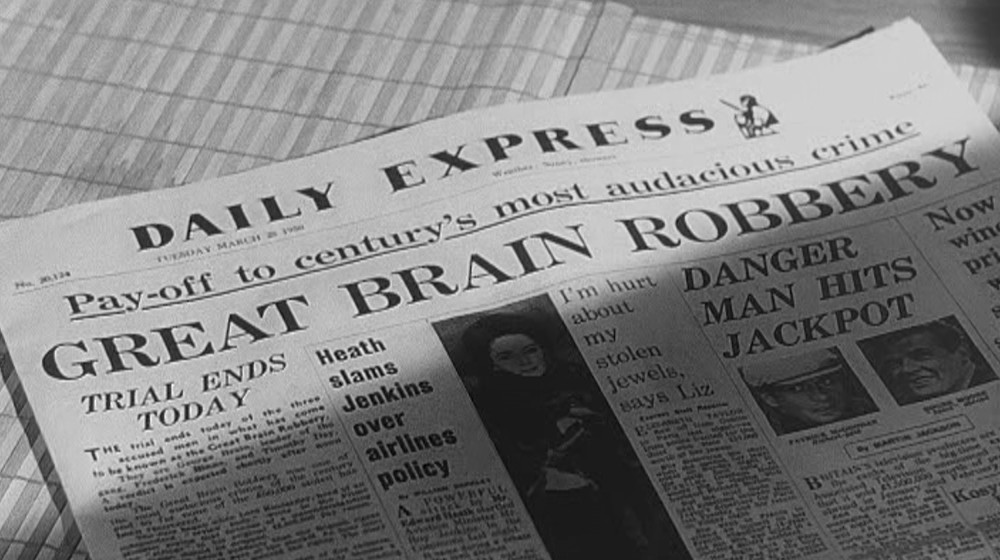
Another thing which sets the film aside from most of the Carry Ons is the opening. The first fifteen minutes are set in 1950, and the gang’s bungled robbery. Unusually, we then skip ahead a full fifteen years to 1965, and their release from prison. As part of this opening sequence, we get a Daily Express front page, featuring news of the gang’s exploits:

Daily Express as seen in The Big Job. Headline: GREAT BRAIN ROBBERY

It’s difficult to tell the exact date from the DVD, but the paper is clearly supposed to be from March 1950; entirely correct in terms of the plot. So do you think the production went out and grabbed a period-correct copy of the Daily Express?

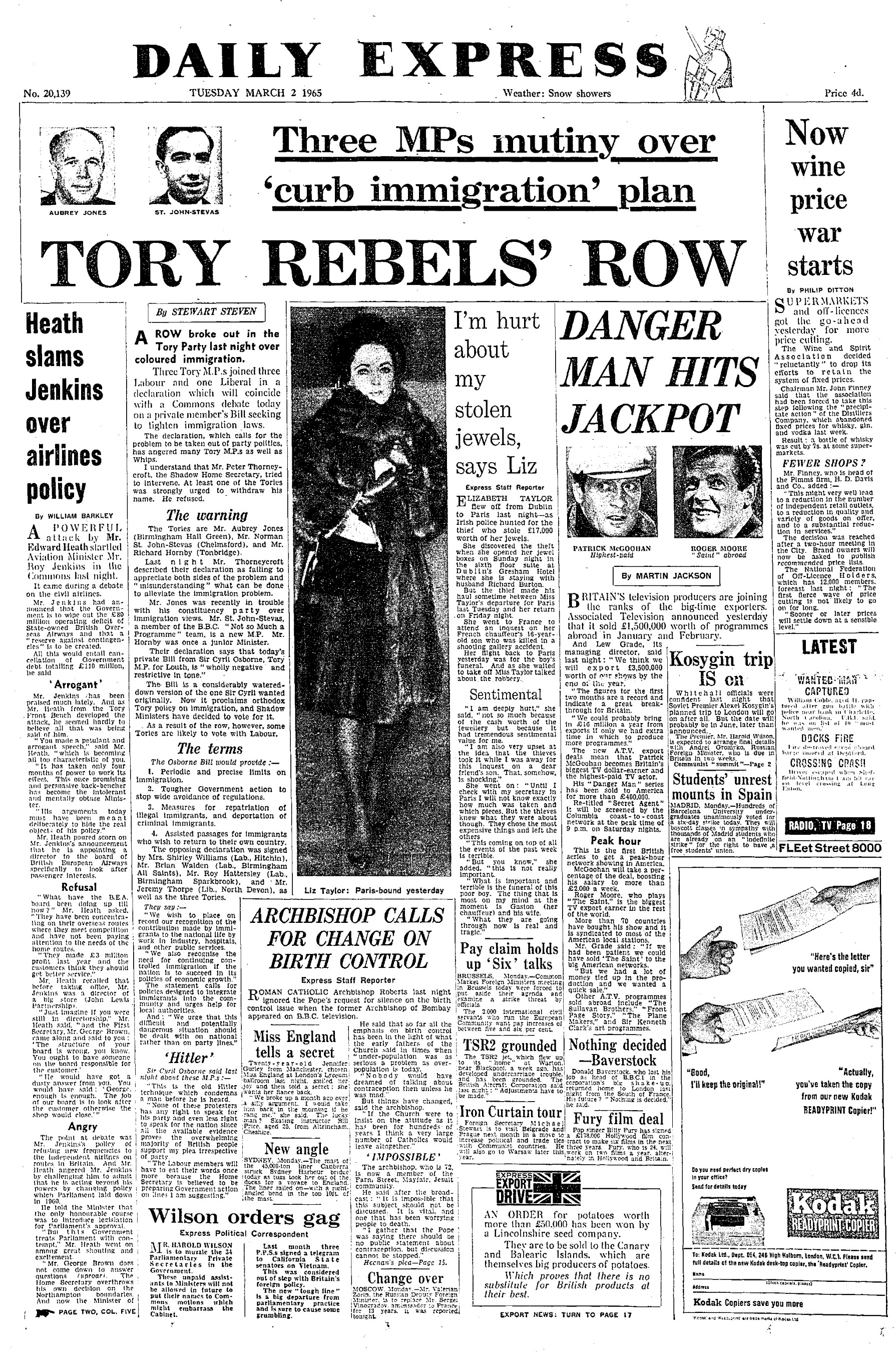
The real version of the Daily Express, with the headline now reading TORY REBELS' ROW. The date is Tuesday March 2nd 1965.

Nah, they just grabbed one from when the film was in production, of course. Lazy bastards.

Yes, this was all just an excuse to do one of those articles again. Sorry.


  1. Yes, I know Percival is in Carry on Cruising, but that was his only Carry On – you don’t really associate him much with the series. 

Read more about...

,

SWTV

Film / Other TV

What is the single most arousing image during the climax of Carry on Girls, at the beauty contest?

Carry on Girls: Margaret Nolan in a very revealing green swimsuit

No, not you, Margaret Nolan, put ’em away. We’re far more interested in the following:

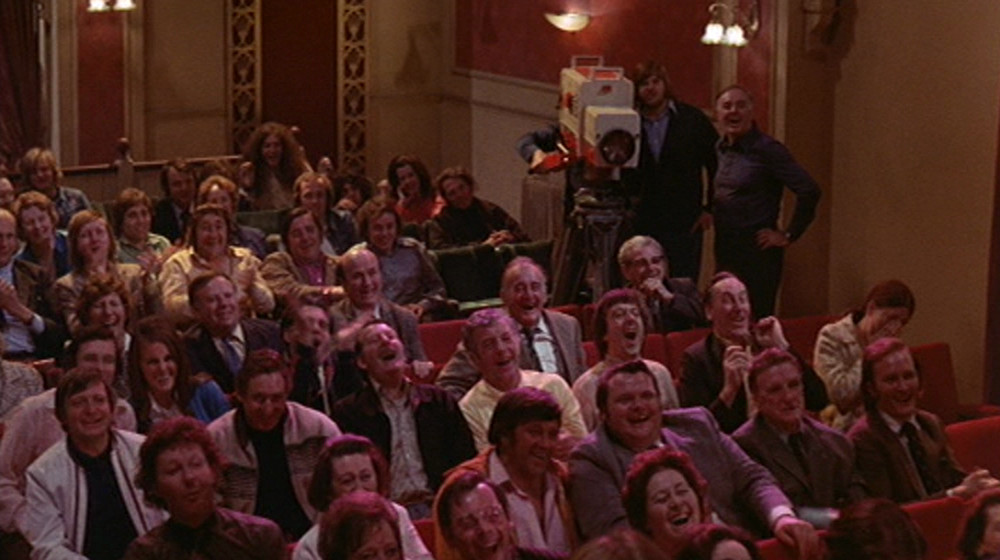
Carry on Girls: The audience of the beauty contest, with a red and cream camera on the right

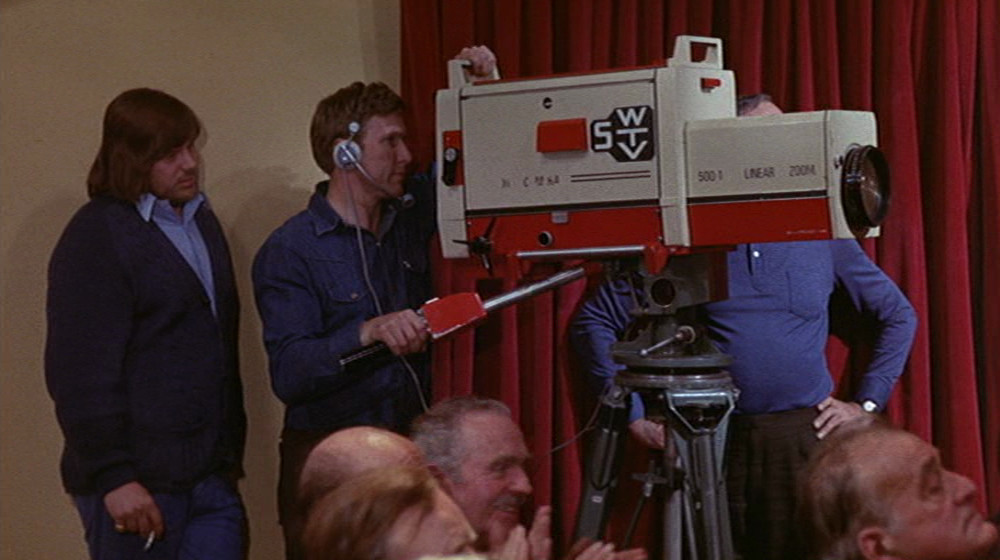
That’s a very interesting looking television camera there. If only we could get a better view.

Carry on Girls: A detailed shot of the red and cream camera

Blimey, I didn’t realise Carry On Girls strayed that far into hardcore pornography.

You will note the large SWTV letters on the side of the camera. This is the only mention of the TV company covering the beauty contest in the film; there’s no reference to them in the dialogue.1 But the name seems clearly chosen in order to avoid bringing to mind any specific ITV franchise. If it had been STV, you might have been tempted to think of Scottish or Southern Television; WTV would have brought to mind Westward. SWTV is safely unlike any existing company in terms of name, while still fitting the idea that they serve an area which contains a seaside resort.

But enough about fantasy ITV franchises. The real question for today is: does this scene in Carry on Girls use a real camera of some description, or is it a custom-made prop?

[Read more →]


  1. We only get a mention of the “fellow from the television studios”, which is slightly awkward. 

Read more about...

Not In My Paper

Film

MAYOR BUMBLE: I do feel that Councillor Fiddler has a point there, considering our very high seasonal rainfall figure.
PRODWORTHY: Oooh really, Mr Mayor? Personally, I think it is quite an average one.
FIDDLER: If you think nine inches is an average one, you’ve been spoilt.

I’ve always had rather an, erm, soft spot for Carry On Girls. When I was younger, it was because I fancied Margaret Nolan. Now I’m older, it’s because I really fancy Margaret Nolan.

Nonetheless, one thing which struck me on my recent watch is how successfully the film manages to have its cake and eat it. Sure, Sidney Fiddler and Hope Springs make a successful getaway, and their grinning faces are the final thing we see in the film, but don’t forget that Operation Spoilsport was also a success; the feminists get their own victory too. Even Connie Philpotts manages to get her money. Everybody wins, in some form or another, and that’s one of the things which gives the film its charm.1

But as ever, we’re not here to discuss the film properly in any sensible way. What interests me today is the following sequence of newspaper headlines, after the filming of the news report descends into chaos:

You know where this is going. Which real newspapers did the production use in order to make the three props for the above scene?

[Read more →]


  1. Thought experiment: imagine a version of the film where Sid foils the feminists, in the same way that he does with the hippies at the end of Carry on Camping. It would add a deeply unpleasant note to the film, and render it almost unwatchable. 

Read more about...

,

“Some Cheap American Science Fiction Movie”

Film / TV Comedy

20 years ago this month, I interviewed John Pomphrey, the lighting director for the first six series of Red Dwarf. I was going to tidy that interview up and republish it here for its little anniversary, but for various reasons, I’m struggling to get round to it. Maybe that’s for the best. That interview should probably be left in its own time and place.

Rereading it though, there’s a few things in there which I don’t think have come up anywhere else. Not least, the following anecdote about a cheap film which ripped off Red Dwarf‘s sets:

“Some of it did appear in a movie, because me and Mel sat down and looked at it. We came across a cheap American video, a very cheap science thing, and Mel said ‘It’s the control room!’ Someone in America had copied it, and we spoke to Doug and Rob at the time, but there was nothing we could do about it, but it was absolutely identical. Same lighting; it was evident that somebody had got hold of a copy and thought ‘That’s good’ and built it, and it featured in some cheap American science fiction movie. We said “Who do you sue?” and you’d never track them down, you’d never sue them… so we just sat and looked at it. He said ‘Look at that! It’s the octagonal control room!’, and they were all standing round, and we said ‘Bloomin’ ‘eck!'”

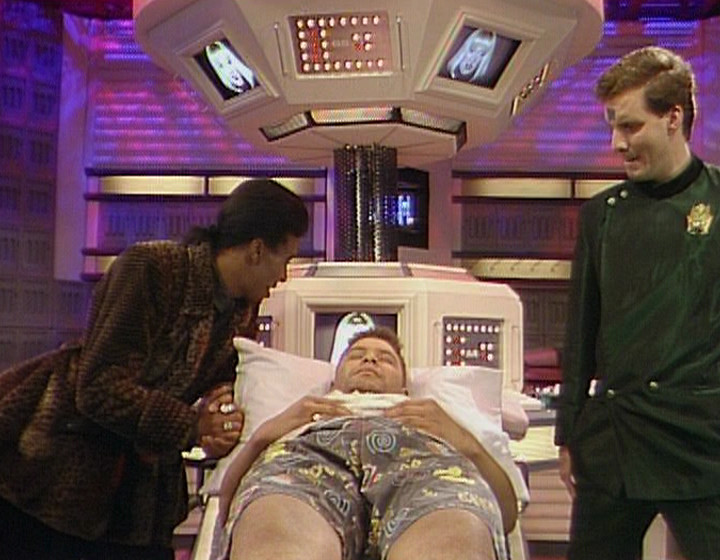
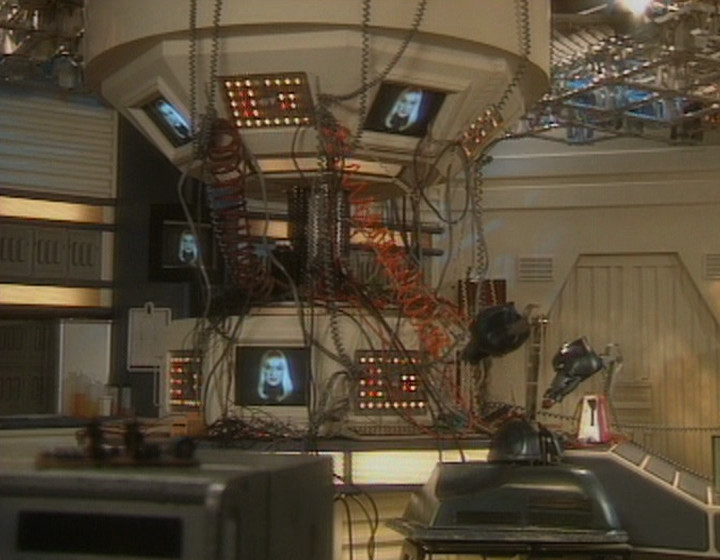
This would have been the control room from Series III through to V:

Red Dwarf control room/drive room, with Cat, Lister and Rimmer

Red Dwarf control room/drive room, with Holly and skutters

It perhaps seems a little odd that John and Mel were so outraged at the rip. Mel Bibby has often gone on record as saying that his work on Red Dwarf was inspired by Alien; frankly, it’s difficult to overstate exactly how inspired it actually is. But I guess there’s “inspired by”, and “absolutely identical”.

Regardless of all that, question is: exactly which cheap science fiction movie ripped off the Red Dwarf control room above? John Pomphrey sadly couldn’t remember. Anyone have any ideas?

Read more about...

,

Downtown Toontown

Animation / Film

MAROON: Look, Valiant. His wife’s poison, but he thinks she’s Betty Crocker. I want you to follow her. Get me a couple of nice juicy pictures I can wise the rabbit up with.
VALIANT: Forget it. I don’t work Toontown.
MAROON: What’s wrong with Toontown? Every Joe loves Toontown.
VALIANT: Then get Joe to do the job, ’cause I ain’t going.
MAROON: Whoa, feller. You don’t wanna go to Toontown, you don’t have to go to Toontown. Nobody said you had to go to Toontown anyway.

Who Framed Roger Rabbit (1988)

It’s odd how some deleted scenes seem to take on a life of their own. Some are happily released on DVD and/or Blu-ray, but never end up being discussed much, no matter how interesting. The really obscure ones never even made the leap from LaserDisc. And yet other examples become… is “well-known” an exaggeration? Maybe. But if you’re the kind of person who does more than scrape the surface of a film, you’ll learn about them fairly quickly.

I fancy that Who Framed Roger Rabbit‘s “Pig Head” sequence is more well-known than the average deleted scene. Here’s the short version. After Valiant has hidden Roger at the Terminal Bar, the deleted section has him going back to the Ink and Paint Club to go snooping for Marvin Acme’s will. Here, he’s knocked out by Bongo the Gorilla (in a return appearance), and menaced by Judge Doom and the Weasels. They eventually dump him in Toontown, he gets a pig’s head tooned onto his own in a nasty bit of gang violence, and he ends up washing it off in the shower.1

Here we rejoin the theatrical cut, with Eddie back at his office, and Jessica’s famous “I’m not bad, I’m just drawn that way” scene. Originally, Eddie was meant to be stepping out the shower having just washed his toon head off; instead, the filmmakers dub the sound of a flushing toilet to hide the cut scene. It mostly works, although if you stop and think about it for a moment, you might wonder why Eddie takes his shirt off to go for a dump.

[Read more →]


  1. This, at least, is what was shot. As scripted, there was even more missing at this point, including the funeral of Marvin Acme, and a deleted scene with Eddie wearing the pig’s head on the Red Car. This stuff is interesting and well worthy of discussion, but outside the scope of this post. 

Read more about...

, ,

“The Most Disgusting Thing I’ve Ever Seen”

Film

“The finished movie we see on the screen is often far different from the director’s original conception. The Cutting Room Floor is the intriguing study of the wounds, bruises, Band-Aids, and sometimes miracle remedies that can often improve a film… or destroy it.”

— Back page blurb for The Cutting Room Floor

“Trust me!”

— Rudy Russo, Used Cars

Determining cause and effect when it comes to teenage reading is a tricky thing. Did Laurent Bouzereau’s The Cutting Room Floor (Citadel Press, 1994) inspire my interest in deleted and alternate scenes in film and television? Or was I obsessed with them before picking up the book, which is why I grabbed it from the shelf in the first place?

I think there is a healthy dose of the former in this case, which makes it a very special book for me. Regardless, it’s a wonderful piece of work, and one which I find myself returning to again and again every few years. These days, with a combination of DVD extras and the right websites, much of this information is easier to access than it used to be. But back in 1994, especially for poor sods like me who hadn’t got a hope of getting a LaserDisc player, books like this were how you found out about this stuff.

There are so many tales of cut material which I first read about in that book, and stuck in my head immediately. The different edits of Basic Instinct for one; the attempted rescue of Exorcist II: The Heretic for another. But for sheer childish fun, you can’t beat the following tale about Used Cars, Robert Zemeckis and Bob Gale’s satirical black comedy.1

Bob Gale: “The only thing that got cut out of Used Cars never got to preview. It was something that the studio insisted that we change in the scene when the car salesmen do a commercial at a football game wearing Groucho Marx glasses. The propman on the film had found these glasses that instead of having a fake nose had a penis for it. We thought that was one of the funniest things we’d ever seen, and we thought to ourselves, you know, these car salesmen, that’s exactly the kind of things they would do. So we shot the scene with these glasses. When we sent the dailies to Columbia Pictures, I got this call from the head of production just ripping me apart for putting these pornographic images in the movie. How could we possibly do this? Had we lost our minds? This has gone beyond the grounds of taste. I got my head handed to me on a platter about this.

Columbia was outraged about this scene. I kept telling them to wait until they saw the scene cut together. I got on an airplane [the movie was shot in Phoenix] and screened the scene for Columbia. Frank Price [the head of the studio at the time], who by the way I have absolute admiration and respect for, turned around and said, ‘It’s the most disgusting thing I’ve ever seen. You have to redo this.’ And so we reshot the scene with normal Groucho glasses. However, if you have access to the videotape or the laserdisc and you single-frame through the sequence, you’ll see there is still one shot in that sequence where one of the guys is wearing a set of dick-nose glasses. In fact, an actual image of that was in one of the TV spots. It was one of the laughs that we had on the TV censors! It was only a few frames, but it was on national television.”

This tale stuck in my head, long before I ever watched Used Cars. And when did I finally get round to watching Used Cars? Erm, last month. Hey, it only took nearly two decades. There are other films listed in that book that I still haven’t got round to yet.

[Read more →]


  1. Although with character names like “Roy L. Fuchs”, it’s as much Carry On as anything else. 

Read more about...

, ,

Creatures of Flesh and Blood

Animation / Film

I’d like to quote to you one of my favourite pieces of criticism about animation. Scrub that, it’s one of my favourite pieces of criticism full stop. It’s from Michael Barrier’s Hollywood Cartoons: American Animation in Its Golden Age (Oxford University Press, 1999), and is about Disney’s first feature length animation, Snow White and the Seven Dwarfs (1937).

The important thing you need to know about the following is what Barrier means by rotoscoping in this context. For a fair chunk of Snow White, live action versions of each scene were filmed; these were then used as reference for the animation, either as loose inspiration, or in the later stages of production, rather more directly. Rotoscoping is this latter technique: literally tracing over the live action footage of the actors, in order to create the animation.

As Barrier describes, this caused noticeable problems in the final film. But he describes it using an absolutely beautiful piece of writing. The kind of writing that inspires any critic to try and become better at their craft.

Snow White‘s failings do not count for much when weighed against its great central successes, and the film’s most obvious failing – the weak, rotoscope-derived animation of Snow White and the Prince in the opening and closing scenes – actually gives it a dimension that Disney himself surely did not intend. It is in those scenes that the film is most wholly “fairy tale,” artificial and removed from reality; the all-but-weightless animation in the opening scenes is of a piece with the operetta-like musical treatment. Snow White seems more substantial when the animals lead her through the woods and into the dwarfs’ cottage, and then as she cleans the cottage—the music here is a work song. By the time she meets the dwarfs, she is at last a solid figure. She is most real in the evening musicale, as she dances with the dwarfs; her graceful movements, although they originated with Marjorie Belcher, are wholly the character’s.

Disney decided as early as the fall of 1934 to fence off the final sequence from the rest of the film by using a highly artificial device, three title cards that represent the changing seasons. It is in that sequence that Snow White melts again into a reverie. When the Prince appears at her glass coffin, operetta returns with him—he is singing “One Song,” his serenade at the beginning of the film. The dwarfs are mere spectators as the Prince kisses Snow White and lifts her to carry her away. He pauses long enough for her to kiss the dwarfs; she addresses only Grumpy and Dopey by name. The boy and girl are like two wraiths, bidding farewell to creatures of flesh and blood. Only what comes in between the fairy-tale sequences seems altogether real: the homely particulars of housekeeping and cooking and amusing one another, and the girl’s death most of all. It is as if the dwarfs dreamed this lovely girl’s life before she joined them, ever so briefly, and now that she is dead, they dream of her resurrection.

That the film should admit of such an interpretation is owing not just to the weakness of the rotoscoping, but to the tremendous vitality of the best dwarf animation. Because that animation is so emotionally revealing, it is the dwarfs, and not the characters who look more nearly human, who are the most like us. And like us, they long for a world where kindness can vanquish cruelty, and love conquer death.”

Barrier isn’t exaggerating about the odd nature of the rotoscoped scenes which bookend Snow White; even a cursory watch reveals they have a markedly different nature to the central part of the film. But it’s his interpretation about why those scenes still work anyway which I find the most fascinating.

[Read more →]

Read more about...

92.

Film

As I kid, I never really got on with films. Oh, I watched a few, don’t get me wrong. Who Framed Roger Rabbit was formative for all the obvious reasons. But they were long. I found it very difficult to sit still for 90 minutes, let alone for more than that. A half hour sitcom, brilliant. A film? Sounds a bit tiring.

And over the years, things calcified. I still watched the odd film. I even went to the cinema occasionally. But I was never a “film person”. I was too busy throwing myself into as many half hour sitcoms as I could find. That was my thing. I didn’t need anything else.

The problem: you can very easily end up starting to become a bit of a parody of yourself. At some point, I wasn’t that into film, simply because that’s what I’d told myself for years.

[Read more →]