
I don’t let the old Acorn/RISC OS fanboy in me out very much any more. At least, not in polite company. But I have to admit, when reading a blog post recently from somebody around my age1, which was complaining about how unsafe they felt buying computers from the US due to the Trump administration, a little voice popped into my head, unbidden.
“YOU HAD THE CHANCE TO BUY BRITISH IN THE 90S AND YOU DIDN’T, IT’S TOO LATE NOW!”
Ahem. Slightly unfair, of course – Acorn’s machines had plenty of US involvement, not least with partners like VLSI – but I still think there’s a reasonable point there when it comes to the software stack. And anyway, being slightly unfair is the whole point of being a fanboy.
Still, I should dial this rather unpleasant part of me back to something useful. So let’s travel a little further back in time to my BBC Master days. Specifically the release Play It Again Sam 6.
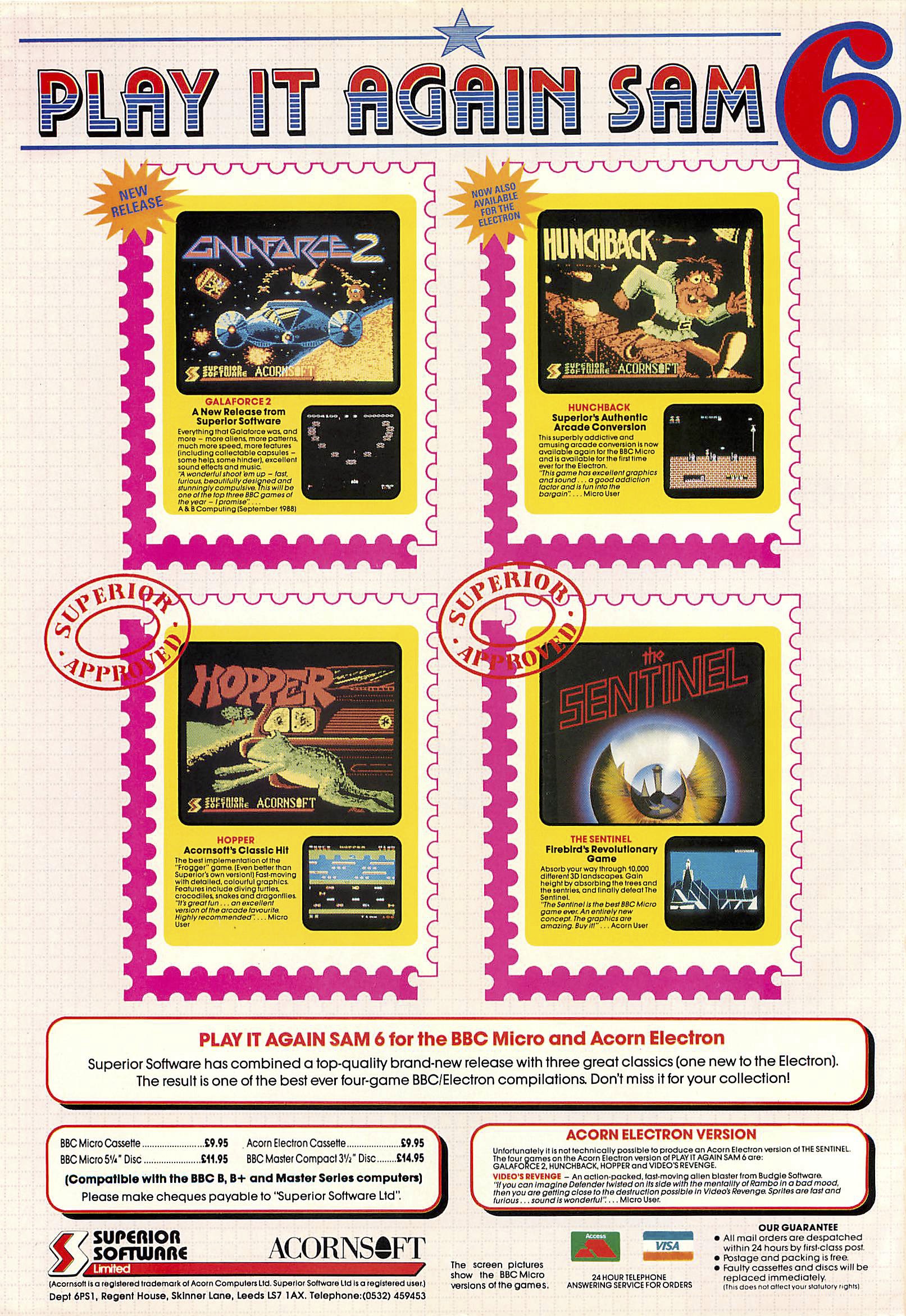
Play It Again Sam 6 advert, from the January 1989 issue of Acorn User
Play It Again Sam was that magic thing: a win for both company and consumer. Take four old games Superior Software had the rights to, package them up with minimal effort, charge the same amount as a single game would, and watch the money flow in. Crucially, if you already had two of the games, the releases were still a bargain. The 8-bit incarnation ended up running for 18 installments between and 1987 and 19932, and sometimes there was even a brand new game included.
So given that value for money, along with loving my BBC Master more than life itself, I owned every single release, yes? In fact, no. I think Play It Again Sam 6 was the only one I owned. And while I had a “healthy” collection of pirate games – including some games which appeared on various Play It Again Sam releases – I certainly didn’t own every game featured on them, legally or otherwise. Nowhere near.
I think maybe this is something that’s easy for us to forget as adults. (Or at least, the kind of adults who read this site.) Recently, I’ve been on a bit of a Jayne Mansfield kick, and have been tracking down as many films of hers as I can reasonably watch. This means obvious fare like The Girl Can’t Help It, through to less obvious films like The Challenge, and onto true obscurities like The Fat Spy.3 This has involved ordering some truly odd DVD releases. As my friend Darrell said: “When you’re onto the Spanish bootleg DVDs you know you’re in deep.”
But as a kid, I didn’t have the resources to do this kind of collecting. And no matter how much I might love any given thing, the very idea of owning every single release of something was just incomprehensible.4 Not only would I never own every single Play It Again Sam compilation, but of course I would never own every single Play It Again Sam compilation.
After all, I was never going to own every single Donald Duck VHS release either. I’d just wear out the single one I had.
* * *
These days, we’re all frankly spoilt. If I want to play every single game on the Play it Again Sam compilations, I can just toddle off to the Complete BBC Micro Games Archive, and play them for free in my browser.
Playing games like this is a very weird experience. I can flick from games which I endlessly played back in the 80s and 90s, to games I never played back then. This includes some very big hitters indeed. I never owned Exile, for instance, widely considered one of the very best games ever released for the 8-bit Acorn machines.
But the games of Play It Again Sam 6 I remember very well. My favourite was Galaforce 2, a shoot ’em up which was one of those aforementioned brand new games. I can still recall the enemy patterns, and can make a fair fist of playing the damn thing today from memory. It also had some beautiful chunky enemy sprites for the bosses, which were atypical for the Beeb, and some fantastic title music.
The other three games? Well, there was Hopper, a particularly good Frogger clone which I also sunk hours into. The least distinguished game was Hunchback, a fairly dull platformer. And then, written by Geoff Crammond and originally released by Firebird, there was The Sentinel.
I mean, how do you even describe The Sentinel? It feels virtually unlike any other game; almost its own genre. The original Firebird release of the game tried to explain it like this:
“Beyond your wildest dreams, in a world where the only force is pure energy, stands the Sentinel. Battle against him through 10000 lands, in the most original, compelling and addictive computer game ever devised. Firebird issues the challenge and the Sentinel awaits.
The object of the game is to absorb the Sentinel and replace him as the ruler of the landscape. Once achieved, you may hyperspace into a new world to begin the struggle afresh.
After a short delay you will be shown an aerial view of the selected landscape, which shows the relative positions of the Sentinel (the one standing on the tower) and the sentries, if any. Pressing any key will take you onto the landscape’s surface. The Sentinel and sentries will be inactive until you expend or absorb energy. This allows you to have a look around and plan your assault on the Sentinel.
Once activated, the Sentinel and sentries slowly rotate, scanning the landscape for squares which contain more than one unit of energy. If they can clearly see such a square, the Sentinel/sentry will reduce the energy to 1 unit by absorbing 1 unit at a time and creating a tree randomly on the landscape. Therefore a robot becomes a boulder, and a boulder becomes a tree.
You absorb things and create things by turning on your sights and centring them on the square surface below the object to be absorbed/created Boulders however, act as an extension of the square surface, and the sights should be aimed at the side of the boulder. Boulders can be stacked and have things placed on top of them.”
That is only a small section of the instructions; it gets more confusing from there. Truth be told, even now I just can’t really understand how to play The Sentinel. I had no chance when I was in my early teens. Mind you, I was crap at Elite too. Actually, I was also crap at Repton. I was just generally crap.
Still, it perhaps didn’t help that when the Sentinel spots you and tries to drain your energy, the game absolutely terrified me. It reached the same part of my brain as the life force symbol in Knightmare. Not in terms of the visuals; but in the terrifying sense of running out of time.5
* * *
Enough reminiscing. Let’s drag all this right back to 2026.
I’ve written before about Mark Moxon’s incredible software archaeology regarding Acorn games. And recently, he’s turned his eye to The Sentinel. And while the heart of the project is the reverse-engineered source code, my favourite things Mark writes are always the deep dive articles, which I find surprisingly accessible. (My level when it comes to these things: rudimentary BASIC programming as a kid, rudimentary C programming as an adult, and some rudimentary PHP right now, in order to get WordPress to spit out something interesting.)
So while I never really understood how to play The Sentinel, I was always interested in the 10000 landscapes in the game, and the secret codes used to unlock them; it all just seemed impossibly big for the Beeb’s meagre memory. Thanks to Mark, I now know everything there is to know about it all.
I love that there’s somebody out there, pulling a part of my childhood to bits, and seeing how it ticked. 40 years from its first release, we now know how The Sentinel works, something that before now only existed in Geoff Crammond’s head. It’s an utter joy. It feels like it rearranges part of my brain. In a pleasant way.
Because that weird, fun internet of the 2000s, that people constantly bemoan has been replaced with anger-inducing algorithms and trolling? It’s still out there. You just have to go searching for it.
And perhaps… make it, once in a while?
Deliberately left unlinked, I ain’t interested in a fight. ↩
Plenty of websites claim that Play It Again Sam 18 was released in 1992, but I don’t believe this is the case. The issue is blurred by the fact that Superior essentially stopped advertising its 8-bit range in the Acorn magazines the start of 1993; but until then, the latest compliation they were pushing was 17. Given that, the 1993 date feels most likely.
There was also a Play It Again Sam 19 released in 1997, released by ProAction, but this is distinct from the original Superior Software compilations, in my opinion. ↩
The Fat Spy currently holds the record for the worst film I have ever seen. ↩
The closest I ever came was Blue Peter annuals, and a) you could get them cheaply at boot sales, and b) that was as much pushed by my parents as much as anything else. ↩
Something I just discovered while researching this article: the original cover art for The Sentinel was designed by David Rowe… who also drew the dungeons for Knightmare. Everything’s linked somehow. ↩
2 comments
DocWallace on 15 March 2026 @ 2pm
David Rowe didn’t really leave gaming, as Broadsword tried their hands at game development as they embraced 3D and VR tech. Spirit of Speed, their racer looked great as it would with David’s artwork, but that was it. Acclaim ultimately published it, but using their long abandoned imprint of LJN, already a notorious label thanks to myriad angry reviewers.
As a fellow fanboy, I also had a lot of the PIAS collections as an easy way of getting into it all, given 65Host offered near native emulation of the Micro. Not a duff game in one, as I recall, which is exceedingly rare in these deals.
Paul Rhodes on 15 March 2026 @ 4pm
Just to confirm one: Acorn User for October 1993 has a review of PIAS18, and on the previous page an ad for Superior which mentions it as “Coming Soon”