Home AboutArchivesBest Of Subscribe

Northern Star

TV Comedy

Sometimes, finding out the true story about an old sitcom legend gets very complicated. But not always.

For instance, take this old Londonist article from 2008, as rumours swirled about the potential sale of a certain Television Centre. But don’t worry! They have an interesting “fact”.

Interesting Television Centre fact no. 1: Studio 1 is the biggest and most expensive studio in television centre. For the early series of Red Dwarf, there was no budget for any set after the production team hired it for filming so they had the hapless space team running around the exposed lighting rigs and gangways, which worked brilliantly (and cheaply) for convincing us they were on board a massive spaceship.

It’s difficult to know where to start with that paragraph. I mean, the idea that early Red Dwarf had “no budget for any set” is not even remotely true. It is also the case that the show was never recorded in Studio 1 at TV Centre. Or let’s get right to the point: Red Dwarf never recorded a single frame of material at TV Centre full stop.

To be fair to Londonist, I think I know where they got this particular misinformation from: the BBC itself. Back in 2013, I went on a tour of the soon-to-be-closed TV Centre, and sure enough, a version of this anecdote was told to me as well: the series was shot at TVC, and you could see the lighting gantries used in the finished episodes as part of the ship. Believe it or not, no, I didn’t start an argument with the tour guide. I just went back home and wrote a passive-aggressive article, obviously.

So, if Red Dwarf was never recorded at TV Centre, where was it recorded? For its first three series, the answer is: New Broadcasting House. Not the current NBH in London; this was Manchester’s New Broadcasting House, on Oxford Road.

Picture of New Broadcasting House in Manchester

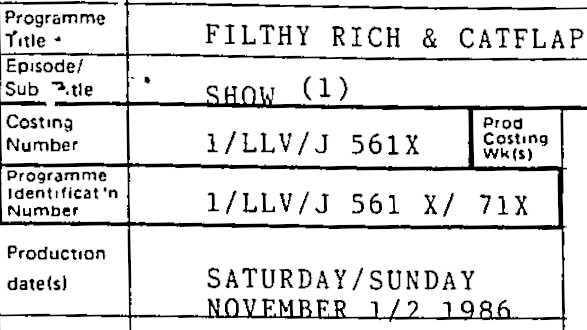
To be more specific: Red Dwarf was shot in Studio A at Oxford Road: the network production studio.1 Over the years, a great many nationally-broadcast programmes originated there; among others, the Oxford Road Show, A Question of Sport, Filthy Rich & Catflap, Cheggers Plays Pop, some editions of The Old Grey Whistle Test2, and a particular childhood favourite, The Satellite Show. And that’s only scraping the surface. Oxford Road Show aside, I expect plenty of viewers had no idea any of those series came from Manchester.

Still, for all the misinformation about Red Dwarf being shot at TV Centre, or having “no budget for any set”, the tales from the BBC tour guides were correct in one respect: certain scenes from the show really were shot on the lighting gantries in Studio A, standing in for the ship itself. Which is indeed an actual INTERESTING FACT.

Let’s take a look.

[Read more →]


  1. Studio B was the smaller regional production studio, although this was also used for some daytime network programming such as Open Air and Daytime UK

  2. I have to be honest, before researching this article, I thought that The Old Grey Whistle Test always came from TV Centre. But no. Here’s one of the first television performances by Dire Straits, transmitted live from Manchester’s Studio A. 

Read more about...

, ,

Between Fact… and Breakfast

TV Comedy

Recently, I have come across something rather disquieting. Every time I check out the accepted TX dates of a programme I’m researching, something turns out to be awry. Last time it was The Brittas Empire; this time, A Bit of Fry & Laurie comes under the microscope, if you’ll pardon the pun.1

The story behind Series 4 of A Bit of Fry & Laurie is oft-told; transferring back across to BBC1, with celebrity guests in all but one episode, it’s generally regarded as the weakest of the four series, with its reputation not helped by Fry’s disappearance and flight to Belgium near the beginning of the run. I personally love it, but now isn’t the time for my brilliantly iconoclastic and dangerous comedy opinions. Let’s stick to the facts.

And the facts, at first glance, seem to be clear. Plenty of websites seem to think that the series was transmitted in the most straightforward manner possible: seven episodes, weekly on Sunday nights, from the 12th February through to the 26th March 1995. For example, Wikipedia, the British Comedy Guide, and IMDB all state that this is the case.

Unfortunately, a bit more poking reveals some discrepancies. epguides.com still thinks the series started on the 12th February, but also that it skipped a week on the 5th March; meaning the final episode transmitted on the 2nd April. The BBC itself, meanwhile, also indicates the series skips a week; however, their missed week is the 12th March. The Beeb also unhelpfully list the series as six episodes long in the episode descriptions, rather than the correct seven.

Our mission is clear. Can we disentangle this load of old nonsense?

[Read more →]


  1. What pun? 

Read more about...

,

I Never Tossed Off

Film / TV Presentation

What is the best way for a teenager to watch John Hughes’ Weird Science?

I first saw it on a black and white portable TV in my bedroom. Maybe a black and white portable TV isn’t the ideal thing to watch Weird Science on. But the important thing here was that it was in my bedroom. Which means there is one scene absolutely seared into my mind, yes?

Lisa in the doorway

I mean, yes, that scene meant a great deal to me growing up. But my visceral memory watching Weird Science for the first time isn’t actually that shot. My memory is of the ridiculous hacking scene which precedes it, the big ACCESS DENIED sign, and then… this:

Skull from the hacking sequence

I can still remember the shiver that went through me as I glimpsed that horrific visage. The fact I was watching it in black and white made it even worse, if anything. I was absolutely terrified. And anyone who has hung around on Dirty Feed for any length of time knows exactly why. Clearly, my brain linked that skull with a certain life force symbol in Knightmare. Put into that context, I don’t even feel like I was being a wuss. Unexpected skulls which remind you of something you’re already scared of, when you were hoping for something naughty instead, would surely freak anybody out a bit.

Oh, OK, fine. I was also being a wuss.

*   *   *

When writing these pieces about my TV memories, I always try to nail down a date. Sadly, I’m not sure I can really do that here. I suspect the BBC network premiere on BBC2 in December 1989 is too early – I would have been eight years old. This BBC1 showing in November 1991 is possible, as is this August 1993 showing. It could even be later, I have no real idea.

But I can give you one date: Saturday 10th July 2021. That was the date I sat in NC1 – BBC One’s control room – and transmitted Weird Science to the nation myself. Three decades or so after watching it as a kid, I was on the other side of the TV screen, playing out exactly the same thing. Every time something like this happens, it completely blows my mind. It’s not something I ever could have conceived of happening, all those years ago. Two ends of my life, suddenly joining together unexpectedly.

The skull didn’t bother me this time round, mind. And as for Lisa… we’ll draw a veil over that one. Though I will admit I got excited at one point. Extremely excited.

Well, who wouldn’t? I got the end credit VO to fit perfectly over the instrumental section of the theme, so it didn’t crash any of the lyrics. That’s enough to get anyone tumescent.

Read more about...

You Rang, M’Lord: The Missing Seven Minutes

TV Comedy

8.00 – 9.00pm
You Rang, M’Lord?

By JIMMY PERRY, DAVID CROFT.
Starring Paul Shane as Alf
Jeffrey Holland as Jim
Su Pollard as Ivy
featuring Donald Hewlett as Lord George Meldrum
Michael Knowles as the Honourable Teddy
Bill Pertwee as PC Wilson
Brenda Cowling as Mrs Lipton.
A new hour-long comedy performed in front of an audience, in which Lord Meldrum takes on a new butler who in turn engages his daughter as a parlour-maid.

Radio Times, BBC1, Thursday 29th December 1988

What do Hi-de-Hi!, ‘Allo ‘Allo!, and You Rang, M’Lord? have in common?

Yes, they were all sitcoms produced and co-written by David Croft, and yes, they all have a penchant for punctuation marks in the title. Moving closer to the point, they all had proper pilot episodes that were shot separately from the rest of their first series. And they are all truly excellent pilots.

What’s more, all these pilots were also transmitted before their first series proper arrived. Hi-de-Hi!‘s pilot was broadcast in January 1980; the series arrived in February 1981. ‘Allo ‘Allo‘s pilot was shown in December 1982; the series didn’t arrive until September 1984. And the pilot for You Rang, M’Lord? was shown in December 1988, but the series didn’t arrive until January 1990.

You Rang, M’Lord? trail (for December 1988)

Today, you can easily see two of these pilots essentially as audiences saw them the first time round; the DVD releases for Hi-de-Hi! and ‘Allo ‘Allo contain the shows as they were initially broadcast.1 You Rang, M’Lord? is very much a different story. And it’s a story which has – with the odd honourable exception – gone virtually undocumented.

The clue is in the Radio Times listing above. One of the most notable things about You Rang, M’Lord? is the fact the show had a 50 minute duration, which allowed for – as David Croft put it – “a good opportunity to develop characters and scenes more thoroughly”2 And indeed, if you pop in the DVD, that pilot episode lasts for 49’07”.

In which case, why does that 1988 Radio Times capsule promise an “hour-long comedy”?

The answer: because when that pilot was first shown on the 29th December 1988, it wasn’t 49’07. It was 55’58”. But when the programme was repeated on the 7th January 1990 – the week before Series 1 of the show started properly – it magically fitted a 50 minute slot. What gives?

You Rang, M’Lord? trail (for January 1990)

The obvious explanation is that the show was edited down between its initial showing and its repeat. But what’s unusual for a Croft comedy is that this longer edit never had another outing. The show has – as far as I can tell – never been repeated or commercially released in its original longer version. Meaning that the way the British public first experienced You Rang, M’Lord? has been all but lost to history.3

I don’t like things being lost to history. For the first time, then, here is exactly what was edited out of the 1988 pilot of You Rang, M’Lord? for all subsequent repeats and DVD releases. A piece of David Croft that never usually sees the light of day. Many thanks to Elaine Musselwhite who dug out her copy of this very rarely seen part of Croft’s oeuvre, without which this piece would have been impossible to write.

All times included are for the 50 minute version released on DVD, so you can play along at home.

[Read more →]


  1. The occasional additional caption or so aside. 

  2. David Croft’s autobiography You Have Been Watching…, p. 231. 

  3. The only book I’ve found which even gives the broad strokes of this story of the longer edit is Rob Cope & Mike Fury’s Hi-de-Hi! Companion, from 2009. 

Read more about...

, ,

Seventh Heaven

TV Comedy

For years, we didn’t know the true story of how Red Dwarf‘s first episode was made. Not really.

I mean, we thought we did. Blah blah script rejected by the BBC for years, blah blah eventually accepted at BBC Manchester, blah blah electrician’s strike, blah blah remounted in late 1987, blah blah atom bomb. We also knew the rough pattern for the recordings: rehearse at Acton for four days, go up to Manchester for two days of recording – a pre-record day on the Saturday, then the audience record day for the Sunday. Then most people had Monday off, and then back to work rehearsing the next episode on Tuesday. Simple.

That is, until the big revelation. In 2007, a rather curious DVD set was released. Titled Red Dwarf: The Bodysnatcher Collection, this was a grab bag full of Dwarf stuff which – for various reasons – didn’t make it onto the original DVD releases. And one of these features was a proper, in-depth documentary about Series 1 of the show.

ROB GRANT: At the end of the recording of the first series, we had a spare recording day – including a day’s pre-VT – so we could do a whole other show.
PAUL JACKSON: I knew it was there. And I think I maybe even discussed with them [Rob Grant and Doug Naylor], you know, we might have to do a seventh script, and that wasn’t really very practical. So we devised this rather cunning plan of using that last week to go back and do pick-ups for the rest of the series. And again, because the BBC worked in these blocks and then didn’t really monitor it very carefully, nobody noticed, in effect. And we just delivered six.

“The Beginning”, Red Dwarf: The Bodysnatcher Collection

Most of those pick-ups were for that first episode, “The End”; in fact, well over half of the episode was reshot. And in an instant, this changed a vast chunk of what we thought we knew about the production of that first episode of Red Dwarf. From a programme recorded on the weekend of the 26th/27th September 1987, it now also became a programme where huge sections were re-recorded on the 7th/8th November 1987.

[Read more →]

Read more about...

A Short Discursion About Sets in You Rang, M’Lord

TV Comedy

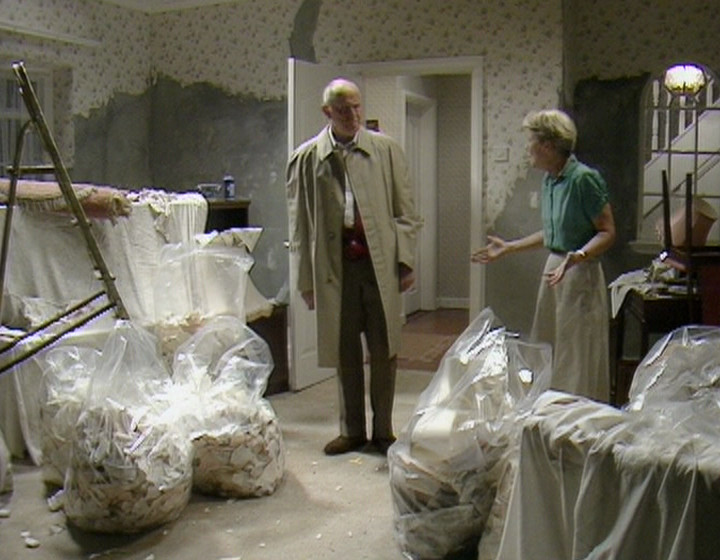
It is the 3rd December 1988 in studio TC6, and David Croft has a problem. The pilot of You Rang M’Lord? is about to start two days of recording, and things just aren’t ready.

As he recounts in his autobiography:

“We were due to record the pilot programme at Television Centre. Unfortunately, we hit a very bad period when the BBC was plagued by strikes, go-slows and walk-outs. When I arrived at the studio, the sets were barely standing. We rehearsed and recorded as they were completed. When we arrived on the second day for the public show, the audience seating had not been set and only the hall staircase was standing. The drawing room, dining room and kitchen had yet to be built and dressed. Nothing was to be gained by abandoning the recording, so I went ahead, determined to get all we could. It was far and away the most difficult day in the studio I have ever had. […]

When the audience arrived for the recording, Felix Bowness did the warm-up as if nothing had happened and the actors bravely played their parts. It was an excellent performance but, for instance, the walls of the dining room, which should have been festooned with oil paintings, were completely bare. There was no question of doing the show again so, in that condition, it went out over the air. The paucity of the set dressing didn’t affect the laughs, and Gareth1 went ahead and ordered the series.”

David Croft, “You Have Been Watching…”, p. 232

[Read more →]


  1. Gareth Gwenlan, then the head of BBC comedy. 

Read more about...

,

A Revised Schedule of Programmes

TV Comedy

One thing I’ve become vaguely obsessed with over the past year is how often the things that “everyone” knows about a TV show turn out to be incorrect. Of course, by “everyone”, I don’t actually mean everyone. The person on the street doesn’t mutter Brittas Empire TX dates as they go about their shopping. At least not in my local Tesco.

Somewhere which should know its Brittas Empire TX dates is epguides.com, mind you. Here is their page for the show, although I’ve screengrabbed the relevant section below, for reasons which will soon become apparent.

Series 1 Brittas Empire TX dates - don't worry, this is just for illustrative purposes, the actual information you need will be present in the body text

According to epguides.com, Series 1 of The Brittas Empire aired weekly from the 3rd January 1991, ending on the 14th February, skipping a week on the 31st. Wikipedia has the same details, as does The Brittas Empire Wiki. For complete transparency, seeing as I was writing for the site when it was published, Ganymede & Titan‘s guide has the same broad dates, but skips the 10th rather than the 31st; IMDB follows these latter dates too.

Every single guide mentioned above is wrong.

[Read more →]

Read more about...

, ,

40.

Life / TV Presentation

I was born on the 23rd May 1981, at Peel Street Hospital in Nottingham. Six months later, that hospital closed for good. I don’t think the two instances were linked.

Third child of the family, I weighed 3.73kg, and popped out at precisely 2:46pm. Which means we can ignore the rest of the gory details, and figure out the really interesting thing: what was on BBC television at precisely the moment I was born?

On BBC1 was Grandstand – specifically, the build-up to England v Scotland at Wembley. Meanwhile, over on BBC2, the afternoon film The Wonder Kid (1952) had just started. Make up your own jokes.

*   *   *

I am blessed with an absolutely fucking diabolical memory. My entire childhood exists as ever-disintegrating glimpses of quarter-remembered events.

But TV was always there. I distinctly remember running around the school playground with a camera, shooting the ongoing football match. I mean, I didn’t have a real camera. We couldn’t even afford Sky at that point, let alone have the money for something like that. I had to improvise. This improvisation consisted of a plastic ice cream tub, with stickers all over it for the buttons, and a toilet roll tube sticking out the side for the lens. This was placed on my head, so I could look through the tube. Sadly, this did not make Kerry Carter immediately fall in love with me.

I also distinctly remember watching Who Framed Roger Rabbit on Central… and then catching it again a year or so later, and noting that the shoe dip scene seemed to have been further cut. “Why would that happen?”, I wondered, not realising that it was the start of a lifelong obsession.

Then, there was Going Live! A show which got me out of bed early every Saturday morning – for half the year, at least. That show was mine, and Trev and Simon were the best thing in the world. I may never fall in love with a TV show in quite the same way again.

And one day, I noticed something interesting. A certain name showed up in those end credits. Erm, my name.1

Going Live! credits - Camera Supervisor John Hoare

Even at that age, it got me thinking. What would happen if I wrote into the show, told them that my name was the same as that guy who did the cameras, and that’s it’s what I wanted to do when I grew up? Surely they’d have me on the show, and I’d get to meet everyone? Wouldn’t that be amazing?

I never did it. I’m not exactly sure why. I mean, I can tell you that I was a lazy little shit. I also thought that thousands of letters would be sent into Going Live! each week. I suspect I didn’t think it was worth trying. These days, my gut feeling is that it was more likely something amazing might have happened than I expected at the time, but who knows, really.

So I never got to go anywhere near the Going Live! studio, unfortunately. I had to settle for lurking behind the camera at a Nottingham OB for one of the ITV Telethon programmes, and yelling out excitedly when I saw the Central logo on the camera. I distinctly remember the cameraman turning to me, and giving me an indulgent smile. To be fair, that was great too.

But none of this – not even the ice cream tub camera – meant I really thought I’d ever work in television. As much as it was a huge part of my life, working on the other side of the screen seemed somehow completely impossible. Anyway, I was obviously going to end up as a computer programmer or something. No, not a software developer. A computer programmer, that’s what it was called.

*   *   *

Six days after I was born, on the 29th May 1981, the Did You See…? team filmed a segment going behind-the-scenes in the BBC presentation department. Delightfully, somebody has uploaded this segment to YouTube. And at 5:49 into the video, we get to spend a bit of time in NC1, where BBC1 network originates. Warwick Cross is your network director, and the man in charge.

I find watching that video an incredibly weird experience. Because sitting in Warwick’s chair is where I find myself, 40 years later. Some of the job is different these days, and I could write a book about exactly what. But that’s all for another day. Instead, I want to draw your attention to the following.

The hunch forward. The hum to the theme tune. The tiniest hint of world-weariness. None of that is changed, 40 years on. I do all of them. The genetic memory of how to be a network director lives on.

And as for what I might be transmitting on any given day? Who knows. Maybe football on BBC1. Or an old film on BBC2.

Some things never change, 40 years later.


  1. With thanks to Mark Simpson for the screengrab. This particular edition was broadcast on the 4th February 1989. 

Read more about...

A Day in the Life of The Young Ones: 30th January 1984

TV Comedy

Oh, hello there. Now where were we?

Last time we investigated a day in the life of The Young Ones, we took a look at the pre-record studio day for the episode “Nasty”, which took place on the 6th February 1984. (Read that piece first if you haven’t already for the background information; I’m not going to repeat myself.) But that’s only half the story when it comes to the raw studio recordings sitting on YouTube. The other half of that video is the pre-record day for “Cash”. Oddly enough, despite being the second half of the video, this actually took place the week before, on the 30th January 1984.

Unlike “Nasty” which was in TC4, “Cash” was shot in TC3, and is still an extant studio at Television Centre; Good Morning Britain and This Morning now come from there live every weekday morning. Such is the odd life of a TV studio across the decades.

So, what can we glean from the above recording? As before, nothing can match just sitting and watching the video for yourself. But I thought a few notes about things I’ve spotted could be interesting. So join me as we leap back across the decades, and safely ensconce ourselves in a corner of Television Centre to spy upon proceedings.

[Read more →]

Read more about...

Nice To Be Here, Mr. Rimmer, You Son of a Gun

TV Comedy

This year has ended up being a rather odd one for Dirty Feed. I initially intended to write precisely nothing for the first half of this year at all. So what better time to accidentally publish one of the most popular things I’ve ever written, and end up deeper in the sitcom salt mines than ever before?

Well, today’s little fact isn’t as good as that one. Or as good as this one. It is, however, something brand new about early Red Dwarf, and clears up a little mystery that has dogged fandom for decades. And by “dogged fandom for decades”, I mean “five or so people wondered about it every so often”.

So let’s take a look at the Series 1 episode “Balance of Power”, broadcast on the 29th February 1988. Specifically, the start of the cinema scene with the skutters.

The question is: what exactly are they watching?

[Read more →]

Read more about...

,