Home AboutArchivesBest Of Subscribe

Tangents.

Internet

Working in the pop culture mines can be hard.

Take this article on the 1990 Lucasfilm Games release Loom, written by one of my favourite writers, Jimmy Maher. As part of the background to the piece, however, he has to write about a different game:

“Lucasfilm Games’s one adventure of 1989 was a similarly middling effort. A joint design by Gilbert, Falstein, and Fox, Indiana Jones and the Last Crusade: The Graphic Adventure — an Action Game was also made — marked the first time since Labyrinth that the games division had been entrusted with one of George Lucas’s cinematic properties. They don’t seem to have been all that excited at the prospect. The game dutifully walks you through the plot you’ve already watched unfold on the silver screen, without ever taking flight as a creative work in its own right.”

Maher is quickly picked up on this characterisation of the Indiana Jones game in the comments by Jason Dyer:

“I’m going to have to disagree with you here:

The game dutifully walks you through the plot you’ve already watched unfold on the silver screen, without ever taking flight as a creative work in its own right.

There is a *lot* of branching. There is so much branching I actually have a hard time thinking of a “classic-style” adventure game with more branching. (Fate of Atlantis, which is admittedly a better game, does a big branch into 3 routes at the beginning, but doesn’t really have any plot-driven branches in the middle.)

For example, you can play the scene entering the castle exactly like the movie (Indy punching the butler out) but it is quite possible to talk your way in. If you do so, it makes other things either.

If you recall the scene where they get the grail book from Berlin: it’s possible to not even lose the book and be able to skip the Berlin scene entirely.

There are quite a few endings as well; things don’t have to go anything like the movie.”

Maher takes the point gracefully:

“Hmm… maybe I just tried to do what Indy did in the movie, found it generally worked, and didn’t explore further. This in itself is of course another problematic aspect of adapting a linear story to an adventure game, but it seems I may have underestimated the game’s flexibility.”

The conversation then goes on to discuss plenty of the different scenarios and solutions the game offers, which is well worth reading in its own right, but I won’t quote any more from it here. My point here is not to dwell on the fact that Maher misjudged the game. Rather my point is to show how easy it was for him to accidentally do so.

Because Maher’s article wasn’t about Indiana Jones. He was specifically talking about Loom. But in order to do so, he had to give a bit of background. So he gave something a reasonable poke, thought he had the measure of it, and ended up misjudging it.

Now, if that happens with the main subject of your article, that’s on you. If the mistake had been about Loom itself, it would have been far less forgivable. But here, Maher runs into the problem we all do when writing about pop culture online. Which is, of course, the same problem that everybody has when researching anything.

Because there is a sheer combinational problem with research. It is unreasonable to expect that in order for someone to write about Loom, they also have to have deeply researched Indiana Jones, and learn about all the different routes through the game. Maher did the most anybody could expect here: he played the game, and formed an opinion based on that. You can’t expect anybody to do more, when you are trying to publish to some kind of regular, sensible schedule.

Sometimes, with tangents, you need to take a slight leap of faith. And sometimes, that leap will be misjudged. If you misjudge the central topic of your article, that’s on you. If you misjudge a tangent, you might feel a bit silly… but it’s an error which is virtually impossible to avoid completely.

Of course, there are ways to try and avoid the worst of these. Getting people you trust to proofread your work is of course one. But there is a limit to how much you can expect others to do when they’re not part of a strict, paid editorial structure. When you’re striking out on your own, such things are inevitable.

So have pity on your local pop culture writer, when we inevitably fall into these mistakes. We try our best, or at least those of us worth reading do. And please, correct us if you see something wrong. We can’t know everything.

And any decent writer will accept a correction with good grace.

Read more about...

Remembering.

Internet

Every generation discovers the same thing. As you get older, you have to deal with more and more people you know getting ill, or dying. Over the last few years, I’ve very much started to experience this.

So it was the other day, when I learnt the sad news of the death of Phil Reed. Phil was someone I’d mostly lost contact with over the last few years, though we did share some DMs a few months back about the possibility of him moving over to the UK. (A melancholic conversation all in itself, now.) But in the late 2000s, we got to know each other quite well, initially through Red Dwarf fandom, and then a little more broadly. And when I mooted the idea for a site which eventually became Noise to Signal back in 2005, he was an obvious person to get involved.

I’ve written about Noise to Signal on here before. A group blog where a bunch of friends all talked about media stuff we loved (and occasionally hated), it never quite took off, despite being published for a total of four full years until the end of 2009. In the end, we were all talking about slightly different things, and the site never quite coalesced into something that truly worked.

But that wasn’t through a lack of effort from Phil Reed, who was one of the most prolific contributors to the site, writing far more than I ever did. Phil clearly viewed the site and his work on it with some fondness; the name of his own site, Noiseless Chatter, was partly a reference to the old Noise to Signal. (Warning: his last post on that site is him saying goodbye; don’t click on that link without being prepared for it.)
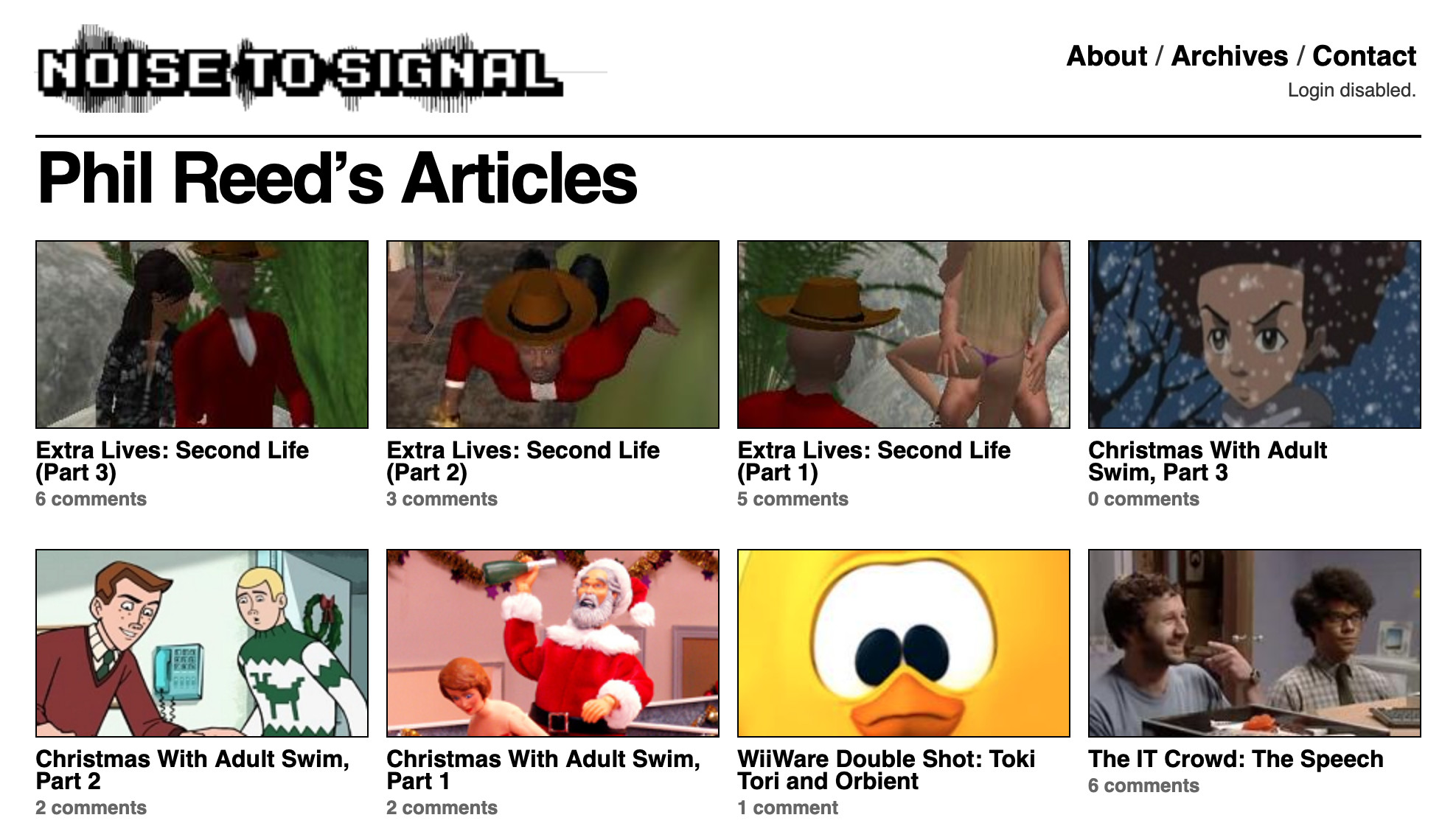
Screenshot of Phil Reed's work on Noise to Signal

Which is one reason that I felt especially bad that in the aftermath of Phil’s death, Noise to Signal was actually offline. When the site closed back in 2009, I made a point of saying the archives would remain available, and indeed they did for many years. Unfortunately, I was right in the middle of changing web hosts for all my old, legacy sites, and it took rather longer than I was planning. The result: a large chunk of his work from the late noughties wasn’t available for people to read.

Luckily, I’ve managed to bodge Noise to Signal back online. It really didn’t seem like an appropriate time for any of Phil’s work to be unavailable. And the reason for that is obvious: when someone who is known for their writing dies, one way people like to remember them is by revisiting their old work. I suspect a great many of us have gone back and read some of Phil’s writing over the past week. Sure, you can coax the Wayback Machine into giving you a version of the site, but it’s inevitably a less smooth experience, and it’s also not as easy to access. I couldn’t bear the idea of people wanting to read some of Phil’s old work for the site, and not being able to do so.

Family and close friends have photos, or other, more intangible memories. But if you’ve just read someone from afar – like a great many of people did with Phil Reed’s work – your relationship with them might not be with a photo, or with a personal memory of them in real life. It might be with a slice of their brain that they put online, which you responded to… and don’t want to lose.

And all this goes beyond people wanting to read Phil’s work right now, and speaks to a wider kind of responsibility. I’ve spoken many times about how I think people should keep their own writing online, but as I’ve always admitted, that is surely a discussion you have to have in your own head. But if you’re the custodian of an archive of someone else’s work, as I have ended up being with Noise to Signal, then things surely get a lot more complex.

There is, to be clear, no legal responsibility. But surely there has to be a question of a moral responsibility to keep a dead author’s work available for people to read and remember them by. And this is a particular issue for people like me and my friends, where we have done that weird thing: write for free on the internet. A commercial book can go out of print; that has its own issues, but is a different kind of problem. Closer, perhaps, is the idea of print fanzines in decades past: but there was surely no expectation for people to keep paper copies of an old author’s work, available to send out at all times.

With the web, keeping people’s memories of someone alive through their work is easier. To be sure, there are still costs and technical issues to consider, and I’m not thrilled with the idea that in 20 years, I might still have to spend time figuring out how to keep the archives of Noise to Signal online. But it’s far more possible to do so than it was in decades past. And the idea of letting someone’s work slip offline just doesn’t feel right, when that work is one of the ways that person lives on in people’s memories. And if that sounds overblown, well, I suspect that Phil of all people knew damn well the power that words could have on somebody.

So yes: every generation discovers the power of loss as they get older. But the brand new thing for my generation is being the custodian of public things which help people deal with that loss. It’s a responsibility that none of us signed up for… but is impossible to ignore.

After all, Noise to Signal contains the writing of more than one deceased person that people might like to remember.

Read more about...

Still Not Writing

Internet

Over the last few months, I’ve spent far too long slagging other people off for pretending to write. I worry that some people have misunderstood my point on this, and that I think everybody should be writing shit for free on the internet. Needless to say, this is very much not the case. Most people have better things to do.

My argument has always been a little more subtle: it’s about people who seem to want to write, but put needless barriers in their way. It could be because they’re worried that their chosen topic isn’t “important” enough. It could be a bad site design which looks cool, but makes actually publishing your thoughts difficult. It could be the idea that you can “reclaim the open spirit of the web” simply by publishing a manifesto, rather than actually writing something interesting. If people who want to write could break past their own self-imposed obstacles to writing, then the net as a whole would be a lot better off.

But it’s amazing the excuses people will find not to do so. For instance, I saw this on Twitter just recently:

“I do sometimes miss my blogging days. But for it to come back, I’d really need some kind of directory like Technorati used to be. I want to follow who I know but also have some kind of awareness of the landscape as well.”

Now, would I like to see a brand new, modern blog directory? Of course I would. It would be a bloody great thing to have. I’m not the person to make it, but I wish someone would.

But here’s the thing: if the only reason you’re not writing is because you can’t find a decent blogging directory, you don’t really want to write. That’s fine: nobody is obliged to. But it’s not the lack of good directory that’s the problem. You can fill in the blanks it would provide in other ways: RSS feeds, social media, and the like. I let people know about my posts through Twitter, and learn about other people’s blogs and personal sites there too.

Is that perfect? Of course not. But what is?

If we want a lively, open, independent web, the one thing we can’t do is to sit and wait for somebody to provide it. And if you want to write, you have to write first. The act of writing and publishing is the important part. And that writing will inspire other things to slot into place. To fold our arms and say we won’t write until the blogosphere is thriving is simply an admission of defeat.

Nobody will provide your preferred way of linking blogs together, without having the blogs to link together in the first place. And the first step to improving the independent web isn’t to put together anything complicated. It’s to write something interesting, and hit publish.

We’ll sort out the rest later.

Read more about...

Dear Diary

Internet / Meta

Some things I write would be better left unread, buried at the bottom of a drawer, thrown into the sea, and then blown up by an naval mine. This is one of them. If you’re really interested in my thoughts about where Dirty Feed might be going over the next year or so, by all means grab a cup of tea and settle down.

If you’re not, then don’t worry: something fun about The Young Ones will be along before you know it.1

[Read more →]


  1. Seriously. An off-air of something from 1984 which has been lost for years popped through my letterbox the other day. 

Design for Creation

Internet

A shade over two years ago, someone’s personal website had a very high profile redesign. Well, high profile among a certain kind of Very Online web design crowd, anyway. And that gang were falling over themselves to praise it. A “lovingly hand-carved redesign”, one person called it. “New, gorgeous, funky-fresh”, said another. It caused a stir for good reason: it really was was an interesting, bold piece of work. In a world where so many have abandoned their own little place on the web, it really did stand out a mile.

A year ago, it stopped updating. The person who designed it is still around, and still regularly posts on Twitter. But their site – launched in a blaze of glory – is essentially dead.

*   *   *

No, I’m not going to name the person, or their website. The specific example isn’t important. Let’s talk about me instead.

Earlier this year, I launched the current design of Dirty Feed. Throughout the design process, I had plenty of ideas which I considered, and then rejected. Many of these involved grids of pictures, much like the current design of Anil Dash’s site. Other ideas involved splitting my writing into two types: longer “Articles”, and shorter “Notes”, much like the old Noise to Signal that I designed over a decade ago. The idea being: give more prominence to the really big pieces on here, without them being shoved aside too easily by the smaller blog posts.

In the end, I abandoned both ideas, for very similar reasons. In terms of just going with one huge picture grid for the front page, I just don’t think they really work when you have shorter posts too. A clickthrough picture for a tiny blog post feels over-egged and wrong, selling it as something bigger and more important than it actually is.

As for splitting my writing into two types, that superficially feels like a much better idea. But then I thought a little more about how I write. Something like this is clearly a long article, and something like this is clearly a short blog post. But what about this piece, which sits in a weird hinterland between the two: too short to be a full article, but too long for a tiny blog post?

In the end, I abandoned both ideas entirely, in favour of a more traditional front page layout. Maybe it’s not stunningly exciting, but I’m not forced to either shrink my writing to fit a blog post, or expand it to be a proper article. Each piece of writing can be exactly the length it needs to be, without forcing it into a shape that it doesn’t fit.

My point is obvious. That when designing your personal site, don’t design for how you wish you wrote. Design for how you actually write. A good design isn’t there for people to coo over for being bold and original; a good design helps you write and publish.1 And a bad design is one which gets in the way, and makes sharing your ideas difficult.

And why does this matter? Let’s go back to the “hand-carved redesign” which opened this piece. The overall reaction from the Very Online web designer crowd was: “How great that people are moving away from social networks and back to their own place on the web. It’s important to have ownership of your own work.” Which I 100% agree with.

But unless you keep your site updated with your thoughts and ideas, having your own place on the web doesn’t really mean that much. It doesn’t have to be updated every day, every week, or even every month, especially. But I don’t think it’s unfair to say that a site lying stagnant for a year isn’t going to be fresh and exciting, no matter how funky your design is.

If you do that, no wonder people will just stick to Twitter to keep up with what you’re doing.


  1. Or upload images and publish, or link to podcasts and publish. Whatever it is that you make. 

Read more about...

I Hope I Never Post Anything Which Mentions Elon Musk Ever Again

Internet

John Gruber, on the report that under Musk’s (potential) ownership, people on the left are leaving Twitter:

“Conservative-leaning users joining (or re-joining) Twitter in anticipation that under Musk’s ownership, Twitter will be more to their liking makes some sense. I don’t really get why liberal-leaning users are deleting or deactivating their accounts now, though. Nothing has changed. We don’t know what will change. It seems so defeatist, which, alas, is on-brand for the active-on-Twitter left.”

There are plenty of reasons I could give here why I think some people consider Elon Musk owning Twitter to be a tipping point. And I’m sure it would all be very justifiable, and that tipping points always look weird in isolation anyway, and all that jazz.

I do wonder whether we have something else here though, at least in part. A fair few people are sick of Twitter, for a million and one different reasons. I know I am. To take just one example of many: a steady stream of misery being pelted into my eyeballs on a daily basis – even from people who I agree with – doesn’t do me any good at all. I get enough exposure to misery elsewhere.

See also: shitbags popping up into my mentions and causing me trouble. Which has happened to me literally this evening. I don’t need it. I got enough of that in the playground three decades ago.

I think some people are seeing Elon Musk’s acquisition1 as a jumping off point. That it isn’t just about what the platform will or will not become. It’s just that they dislike Musk, and it’s a good excuse to cut something out of their lives which they no longer enjoy, but has become a habit.

Gruber again:

“I also don’t get deleting your account. Why not just stop using Twitter for now, but keep your account in case you change your mind down the road?”

I used to say this all the time. In fact, I used to make fun of people deleting their accounts – even temporarily – only to then reappear. “Just stop posting for a bit. Anything else looks attention-seeking.”

And then I realised that if I wanted to take a break from Twitter, but didn’t deactivate my account, it was much harder for me to do. Deactivating Twitter for a month put in that extra barrier which forced me to step away. The same will be true for people wanting to leave the service for good: it simply makes it less easy to pop back and get sucked in again.

It’s worth noting: I think the above makes me sound like a dickhead. The idea that I struggle to step away from Twitter for a bit without deactivating it seems completely ridiculous, when written down. What, am I really that addicted to the site, when it gives me so much misery sometimes?

Erm, it seems I am. And maybe that’s yet another reason to step away from it for good.


  1. Probable acquisition? Potential acquisition? Who the hell knows? 

Read more about...

Shame.

Internet

I’ve written many times in the past about how I think people should keep their website archives online. In fact I’ve talked about it to the point of obnoxiousness, and then far beyond that. About how old stuff can suddenly become found and loved, about the history of the web disappearing, about what remains of the public record, about accidentally destroying a web community, about losing memories… or simply about letting things live.

It’s all true. But today I want to talk about another reason I feel so strongly about this. A reason I haven’t really touched on before, but I think is one of the most important of all.

Take a look at this interview from 2013, with designer Frank Chimero. It’s actually worth reading in full; it touches on many interesting topics. For instance, I highly identify with this:

“I think I’m similar to a lot of other creative people in that I’m deeply uncomfortable with attention. It’s one of those things where if you gain any attention, you start to subconsciously — or maybe even consciously — make creative choices to have people stop paying attention to you. […]1

Attention creates expectations that feel like a saddle. And most horses buck the first time a saddle is put on them. It is a natural inclination. Maybe it’s immature behavior to want to shake off other people’s expectations? I don’t know. But, if I’m really honest about where I am creatively, that’s what I want to do — I just want to buck.”

This reminds me very much of when I decided I didn’t want to write about sitcoms for a while, because somebody mildly hinted that was all they enjoyed about my writing. It also reminds me that whenever this place gets attention for something beyond my usual audience – my Yes Minister piece last year, for instance – I feel a disconcerting mix of pleasure and uncomfortableness. Is my lack of a really popular article on Dirty Feed so far this year down to luck, people having less time for my nonsense as the world opens up again… or my choice?

But there’s another part of this interview which I can’t quite get on board with.

[Read more →]


  1. All the quotations in this article are edited a little to avoid the back-and-forth with the interviewers, which works brilliantly in the piece itself, but less well when quoting from it. I hope I’ve been fair with my edits, but it’s worth reading the full interview to capture the true flavour of the conversation. 

Read more about...

,

Corrections

Internet

Open Culture, “Revisit the Infamous Rolling Stones Free Festival at Altamont: The Ill-Fated Concert Took Place 50 Years Ago”, 9th December 2019:

“The stigma surrounding the Hells Angels greatly contributed the infamy, as news of their full involvement spread. Had accused killer Alan Passaro not been in a notoriously violent biker gang, Selvin believes, he would have been seen as a hero, since Hunter had rushed the stage with a gun after an earlier altercation with the gang. (Passaro was not charged.)”

Me, 21st February 2022, 5:41am:

Open Culture, “Revisit the Infamous Rolling Stones Free Festival at Altamont: The Ill-Fated Concert Took Place 50 Years Ago”, 21st February 2022, c. 5:55am:

“The stigma surrounding the Hells Angels greatly contributed the infamy, as news of their full involvement spread. Had accused killer Alan Passaro not been in a notoriously violent biker gang, Selvin believes, he would have been seen as a hero, since Hunter had rushed the stage with a gun after an earlier altercation with the gang. (Passaro was charged but not convicted.)”

*   *   *

So, y’know, the correction here is good. Slightly less good: no acknowledgement anywhere in the article that it’s had a whacking great error in it for over two years. (We’re not talking about a tiny mistake; reporting criminal proceedings correctly is kinda important.)

Oh, and I also didn’t get any kind of thank you for helping them correct the mistake. Not even a reply on Twitter, let alone in the article itself.

Let me make Dirty Feed’s editorial policy crystal clear on this one. If you spot an error on this site, please let me know. If the comments are open, you can use that; if they’re closed, grab me on Twitter or drop me an email. Not only will you get a thank you – because I think anyone who takes the time and trouble to help me make this site better deserves one – but I’ll put a note at the bottom of the article to tell the reader exactly what was corrected.

Silent corrections are death when it comes to trust with your readers. And not thanking the person who takes the time to help fix your crap is just rude.

The Open Web

Internet

The new, relaunched blog of a “web developer and designer”, somewhere near the start of 2020:

“The open web is a husk of its former self, conceded to the corporate ventures whose aim is to collect as much data as possible and leverage it in the most profitable manner possible. I want to reclaim my portion of it that dream of an open web of sharing ideas, culture, and imagination.”

Spoiler: they didn’t.

“I’m not happy with the result, but I will never be. Designing for oneself is an artistic act, and dissatisfaction for me in that sense is foundational. But again, that’s not the goal. The goal is to take back my part of the web.”

Spoiler: they didn’t.

“And with that, I will pledge to improve this site steadily and to contribute to the content regularly. To not let it die.”

Spoiler: they did.

*   *   *

I think caring about the open web is a good thing. I think sharing ideas, culture, and imagination is to be commended.

But you don’t do that by redesigning your blog, posting a manifesto, and then leaving it to rot. The design and manifesto are the least important thing. If you want to take back your part of the web, then you need to share your ideas and thoughts for real, on an ongoing basis.

It doesn’t have to be every day. Or even every week. And it certainly doesn’t have to be in blog posts stretching to thousands of words. There are so many different ways of doing it. It doesn’t matter.

But however we do it: if we truly want to take back control from those “corporate ventures”, then we need to actually say something. Not get trapped in that old redesign-languish-redesign cycle.

You want people to step outside Facebook? Have something which makes it worthwhile for people to step outside Facebook. Walled gardens are only worth leaving if there’s something nice on the other side of the wall. And your latest site redesign just isn’t going to be enough.

Contributing to the open web doesn’t need much. It doesn’t need 1337 design skillz. It doesn’t need hours of your time a day. And it most certainly doesn’t need any kind of manifesto.

It just needs you to start writing, and see what happens.

Read more about...

Worthy.

Internet

Sometimes, seeing how somebody else approaches writing clarifies how you approach your own. Or, rather, how not to approach it.

Take the following piece of advice, given to one blog writer who very much took it to heart.1

“Knowing when to stop is not exactly the same as knowing what to start. Determining what’s worthy is harder than simply finding something interesting.”

Different advice helps different people, and that’s fine. But speaking personally: I can’t think of anything more dreadful than having to decide what is worthy for me to write about. If something is interesting, that’s more than enough. Why put barriers in your way before you even start?

The person who was given this advice even struggles with it to some extent:

“Years later, as I emerge from what does indeed feel like an extended dormancy, I’m still seeking clarity on what’s worthy. But what I do know: time to start, it is. These handful of words mark an official commitment to an unofficial restart of writing.”

And I feel bad for them. Because to me, thinking about what’s “worthy” when writing on your own personal site is a recipe for treading water, and publishing nothing. And guess what: that’s exactly what happened.

We love to put barriers in the way of writing. Sometimes we want our backend to be perfect first. Sometimes we worry too much about being helpful. And sometimes we question whether what we’re doing is important at all.

It’s all nonsense. If you think something is interesting, it’s worth writing about, judgements about whether it’s “worthy” or not be damned. It might go nowhere. It might go somewhere. Just occasionally, it might really go somewhere. But the absolute worst thing that could happen?

You’ll have put something interesting into the world.


  1. I’m not linking to the source for this, deliberately. But you can easily find it yourself, if you know how to use Google and quote marks. 

Read more about...
