
In 2025, I watched all of The Dick Van Dyke Show (1961-65) and its spiritual successor The Mary Tyler Moore Show (1970-77), with a chaser of Rhoda (1974-78). That’s such a concentrated burst of greatness that I feel like anything I watch this year will be a disappointment.
So while I scrabble around for something to replace the giant hole in my life – and no, spin-off Phyllis (1975-77) doesn’t quite cut it – I can at least throw myself into the usual behind-the-scenes books and documentaries. Very quickly, you learn all the standard tales which have come up over the years. And with The Mary Tyler Moore Show, one tale looms above all: the disastrous preliminary filming of the opening episode, three days before the real one.
This is probably most succinctly expressed in the book Mary and Lou and Rhoda and Ted (Simon & Schuster, 2013):
“The day of The Mary Tyler Moore Show’s first chance to perform in front of a studio audience began with news of a bomb threat on the lot… The threat was determined to be unfounded, and audience members were herded in. But the folks in the stands couldn’t see the actors over the cameras, which were twice as bulky as the standard kind, so they were forced to try to catch the action on small monitors instead. The air-conditioning broke down, so the two-hundred-member audience and the actors were left to swelter in 90-degree July temperatures while watching a practice run of a series already being promoted to viewers as if it were a done deal. The microphones didn’t work properly.”
The problems continue from there. At times, the stories about this recording take on an almost absurd tinge; everything that could have gone wrong, seemingly did. Showrunners James L. Brooks and Allan Burns did a dreadful job with the warm-up; the actors weren’t quite ready; the director hadn’t had enough time with the camera crew… the excuses just keep piling up. The dodgy aircon and sound system would surely be enough to kill a recording, let alone anything else.
And then there was Rhoda, a character which seemingly made a few people nervous. To be fair, she is set up initially as an antagonist to Mary, and spends the entire episode trying to nab her apartment. But also: never underestimate some people’s unpleasant reactions to a gobby Jewish woman.
Either way, she certainly didn’t test well with the studio audience that particular night. What to do? Back to Mary and Lou and Rhoda and Ted:
“Script supervisor Marge Mullen, who’d held the same job at The Dick Van Dyke Show, stopped by the producers’ office. She had an idea – maybe not the biggest one, but it was something. “People don’t seem to like Rhoda,” they remember her saying. “There’s this little girl who’s Phyllis’s daughter, and if the little girl likes Rhoda, it’ll give the audience the opportunity to love her, too.”
It was the only substantive idea for an improvement Brooks and Burns had heard all evening. They decided to take Mullen’s suggestion, cut a few other lines, and call it a night, putting their faith in what they’d written and the cast they’d hired. Many things had gone wrong with that first taping, but the words and the talent, they believed, were there.”
Come the second recording, three days later?
“The only major change to the script was pigtailed twelve-year-old Lisa Gerritsen as Phyllis’s daughter, Bess, saying, “Aunt Rhoda’s really a lot of fun,” as Mary opened the curtains in her new apartment to see a harried Rhoda on her balcony in the opening scene. Gerritsen was the granddaughter of child actor and later screenwriter True Eames Boardman, as well as the great-granddaughter of silent film actors, but she had now made her own showbiz history.
This time, the audience roared. Gerritsen’s new line seemed to indeed be the magic bullet.”
Unlike all the other problems with the first recording, which was a smorgasbord of failure, this at least is a nice, neat anecdote. One single line changed how the audience felt about Rhoda, Marge Mullen and Lisa Gerritsen save the day, job done.
The problem is, it’s not quite the full story.
* * *
In a situation like this, what we really want is every single draft of the pilot script for The Mary Tyler Moore Show. We don’t have that. Damn it.
We do, however, have the next best thing: a very late draft. If we look at the cover:
PROD. #7001
Written – June 24, 1970
Revised – July 1, 1970
Filmed – July 3, 1970
It’s worth taking just a moment to work out the exact sequence of events here. We know from various reference sources that the disastrous first filming of the episode took place on a Tuesday; the successful filming took place on a Friday. July 3rd was indeed a Friday; this means that the first filming session took place on the Tuesday, 30th June 1970.
This script is noted has having been revised on the 1st July 1970, which makes total sense; this is the day after that first botched filming session. It will have been this draft which added the line given to Bess about Rhoda, and sure enough, at the bottom of Page 3:
FROM BEHIND THE DRAPES, RHODA STARTS BANGING ON THE WINDOW. BESS OPENS THE DRAPES A CRACK AND PEERS OUT AT HER.
BESS: Aunt Rhoda’s really a lot of fun. Mother hates her.
This script gives every impression of being the one taken into the second filming session on the 3rd July 1970, or certainly extremely close to it. Most of the changes in the broadcast episode are either material obviously filmed but taken out in the edit, or are because the actors found a different way of playing something. All fairly standard.
That is, apart from one scene. It’s the fourth scene in the show, just after the first ad break, and it features Mary and Rhoda beginning to get to know each other… and warm to each other. The entire scene is below, for your viewing pleasure.
This scene has multiple changes made to it between script and screen, which can’t just be easily explained away by the editing process. For instance, this is how the script goes:
RHODA: (EYEING MARY) Do you always look that good when you wake up?
MARY: I don’t know.
RHODA: I look like John Wayne.
MARY: (LAUGHS) Look, Rhoda, I’m starting a new job today and—
RHODA: (INTERRUPTING, INDICATING NIGHTGOWN) Who’d you get that nightie from – Tricia Nixon?
As broadcast, the exchange loses the John Wayne joke, and includes an additional line from Mary at the top which isn’t in the script:
MARY: Er, now that you see that I’ve moved in, would you leave?
RHODA: Where do you come off looking that good in the morning?
MARY: Look Rhoda, I’m starting a new job today, so—
RHODA: Who’d you get that nightie from – Tricia Nixon?
Here’s the crucial thing: there is no edit where the “John Wayne” line was removed in post-production – as Rhoda crosses the room to talk to Mary, it’s all one shot. The dialogue must have been deleted before the scene as it appears in the finished episode was filmed.
Exactly the same happens virtually straight afterwards – the entire exchange below appears in the script, but was removed from the final episode:
MARY: My mother sent it to me from my hometown. Wrenville, Minnesota.
RHODA: Why would anybody want to leave a swinging town like Wrenville, Minnesota? (MARY STARTS TO ANSWER) No, don’t tell me, let me guess. You knew all the boys… you weren’t particularly interested in them, so you just left.MARY STARTS TO SHAKE HER HEAD “NO” BUT SEQUES INTO A NOD “YES”.
MARY: That’s right. How’d you know?
RHODA: (SHRUGS) I left my hometown for the same reason. I’d gone out with every available man. (BEAT) I’m from New York City.MARY CAN’T HELP LAUGHING.
Again, this clearly wasn’t deleted in the edit – the surrounding material is all one continuous shot in the broadcast episode, and so was removed from the scene before it was filmed.
And then there’s the most interesting change of all. Towards the end of the scene is another line which was added to the final version of the scene, but doesn’t appear anywhere in the script at all:
RHODA: You know, I left New York City because I couldn’t find an apartment. I’m not going to leave Minneapolis for the same reason.
Put together, all of these changes make me extremely suspicious. Two brand new lines, one given to Mary, one to Rhoda? And two sections of dialogue clearly removed before the scene was filmed, rather than just removed in the edit?
Does anybody else smell a reshoot? I certainly do. But that’s gonna be difficult to prove, right?
* * *
You know me by now. At this point, the obvious thing to do is start scouring the background of the scene to look for changes in the set dressing. Obvious for me, that is. You may have different priorities.
There are a number of ways of proving the following point, most of which I shall leave as an exercise for the reader. But the most obvious way is to look at the paper butterflies on Mary’s wall. The following two pictures show the start of the the scene with Mary and Rhoda that we have been discussing in this article, and the final scene with Mary and Lou Grant. You may have to squint a little, but trust me, they are identical:
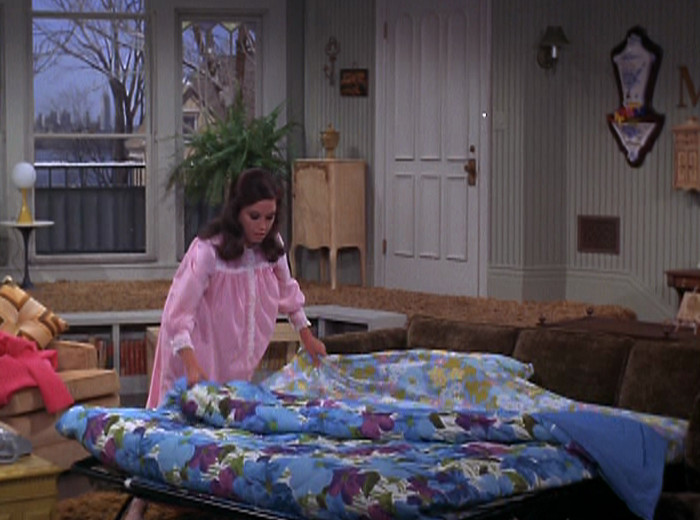

So why, halfway through the scene with Mary and Rhoda, do we get this shot, where the butterflies have suddenly turned into flowers?
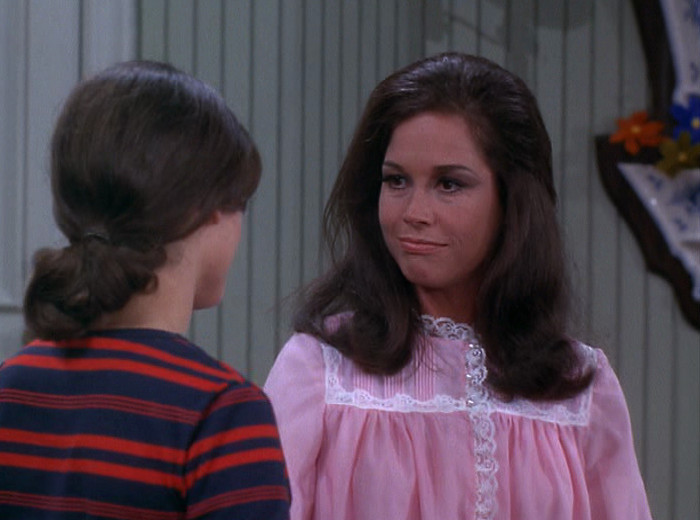
The answer: clearly, the middle section of the Mary and Rhoda scene – the one with all the dialogue changes – comes from a different filming session to the rest of the episode.
At which point, I’d love to be able to tell you that I’ve traced exactly which other episode those flowers appear in, and so we could find out when any reshoot took place. Sadly, nothing in that room quite seems to match with any other episode. The flowers do look similar to what we can see in the second broadcast episode, “Today I Am a Ma’am”, but the positions don’t quite match, and nor does the set dressing elsewhere in the room.
Still, one of the following two theories must be correct. Firstly, the middle section of the scene could be taken from the first recording of the episode. This would be a huge revelation in itself; the idea that something was salvaged from that terrible recording goes against everything we’ve been told anywhere. It would be thrilling if this was the case, but I just don’t think it’s that likely.
No, here’s the far more likely version: that this scene was reshot later on, either during another episode (and they changed the set dressing for some reason), or on a special pick-up day. And at this point, I want to remind you of one of the additional lines in the broadcast version of the episode, which is nowhere in the script:
RHODA: You know, I left New York City because I couldn’t find an apartment. I’m not going to leave Minneapolis for the same reason.
Here’s my best guess as to what happened. After the episode was recorded, the team were still concerned about Rhoda being unsympathetic, and they decided they needed a proper explanation as to why she was trying to take the apartment from Mary. So they reshot just that middle section of the Mary/Rhoda scene, adding the line about why she wants the apartment so badly – and taking out a few jokes which didn’t quite land into the bargain.1
In other words: this looks very much like a script fix… exactly in the same vein as the additional line given to Bess. If people were upset that Rhoda was trying to take the apartment away from Mary, giving her a really good reason why she’s so desperate to have it is another way of softening the character a tad.
To me, this feels just as much of a change as the line given to Bess about Rhoda; perhaps even more so. And yet nobody ever mentions it.
* * *
Which leaves us with just one final question. Wouldn’t it be nice to see a little of the scene in the version filmed with the rest of the episode? Surely it’s long since gone to the Home for Unwanted Celluloid?
Take a look at this brilliant 1970 CBS promo for the series. And when I say brilliant, I really mean it; I cannot rhapsodise enough how much I love this promo. It’s a great idea – Mary as princess – but crucially, follows through on the idea for the whole minute, rather than abandoning it halfway through. If only all comedies were lucky enough to have promotion this good.
The promo contains many clips from the opening episode, mostly how they appear in the final show.2 But 41 seconds in, we hit the jackpot:
Yes, dialogue which never made it into the final episode:
RHODA: Do you always look this good when you wake up in the morning? I look like Ed Sullivan.
A variant of the John Wayne joke, present in the script but cut from broadcast. Although in my opinion, a far funnier one. And if we compare what we can see in the background:
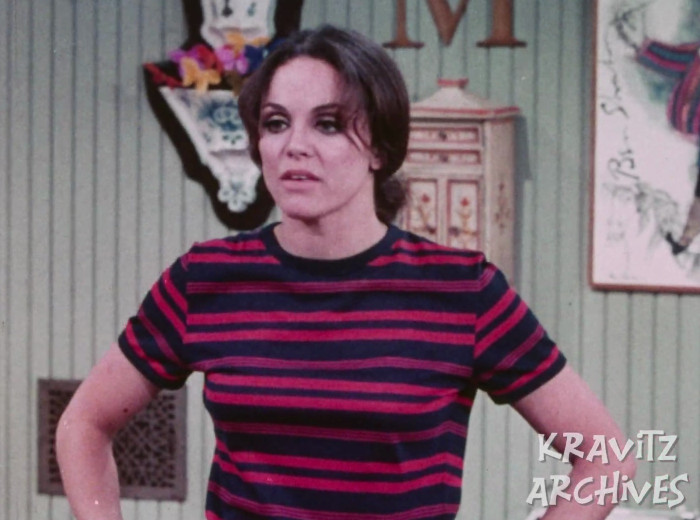
1970 Promo
First episode as broadcast
The scene has the butterflies on the wall rather than the flowers, matching the rest of the episode. The version of the scene as featured in the promo is clearly the one filmed in the second, main recording, and then – I believe – later reshot for the final broadcast episode.
And if nothing else, you’ve now seen Valerie Harper do her amazing Ed Sullivan impression. The kind of deleted material which makes all this nonsense worthwhile.
With thanks to Tanya Jones.
9 comments
Rob Keeley on 18 January 2026 @ 8am
Another fascinating article, John.
While we’re on the subject of flowers and reshoots, I spotted another one for you in Fawlty Towers: The Germans. When Polly is arranging the flowers on the reception desk while Basil is putting the moose’s head up, there’s a cutaway to her as she says: “They’re being ironed” and suddenly they are totally different flowers – different colours, and fresher. Another reshoot for some reason? The only time they could have done that would be during the studio for Gourmet Night, which I now know from you was recorded the following week. But why on Earth?
I also have a Yes, Prime Minister story sometime, which I bet no one has ever heard before!
Happy Sunday!
Rob
Richard Lyth on 18 January 2026 @ 10am
One more rewrite and they could have come up with that classic Police Squad joke – “Who are you, and how did you get in here?” “I’m a locksmith. And, I’m a locksmith.”
Billy Smart on 18 January 2026 @ 12pm
I was thinking when I read this that, “But the most obvious way is to look at the paper butterflies on Mary’s wall” is exactly the sort of sentence that only you would write. And this whole article is a characteristically excellent example of how explaining your methodology as you go along will make research more engaging to read.
David Wardrop on 18 January 2026 @ 3pm
Great work, John! The ‘eye logo’ on the CBS promotion is amazingly modern for 1970. It also begs the question – why didn’t The Mary Tyler Moore Show have more of an impact on UK screens? BBC1, a few ITV regions, C4 – not for want of trying…
FabianD83 on 19 January 2026 @ 10am
Re: Fawlty Towers. The flowers would need to be replaced constantly if the pick-up shots occurred after they got knocked over. Probably several bouquets backstage?
Rob Keeley on 20 January 2026 @ 6pm
Fabian ( of the Yard?) That’s a good thought. But surely if they had standby flowers they would have ensured they matched the originals? :)
John J. Hoare on 21 January 2026 @ 1am
Thanks for the kind words everyone – much appreciated. More to come in a similar vein soon with the rest of the script.
The Fawlty Towers flowers thing IS interesting, and definitely something I’ve never noticed before. I don’t think even Andrew Pixley mentions it anywhere in any of his TV Zone articles. My gut feeling is that it *is* a reshoot done during the Gourmet Night recording – Polly’s hair seems slightly different, and the picture texture seems different to a similar shot a few seconds later. I have no proof, though!
John J. Hoare on 25 January 2026 @ 8pm
Further to this article, I’ve just noticed the following from the book Mary and Lou and Rhoda and Ted:
It is, of course, extremely tempting to link this testing with the almost-certainly-reshot version of the scene – the additional dialogue clearly answers the question “Why was Rhoda so mean?” Impossible to prove, at least with the documentation I have, but I’d bet money on it.
James on 26 January 2026 @ 2pm
How can you do an Ed Sullivan impression and not say “Really Big Shoe”?
This turned out to be the same year as Ed’s final season as well, not that he knew it at the time… or even when the last episode was made. Part of the infamous “Rural Purge” that year where lots of popular long running shows were axed for attracting the “wrong” demographics.