

Researching a programme like The Golden Shot (1967-75) is a nightmare. As I pointed out last time, for a show which ran for hundreds of editions, vanishingly few of them actually survive. Even fewer are generally available to view. You’re left scrabbling for what you can find in old newspapers and magazines… and the odd autobiography.
Such as Bob Monkhouse’s incredible Crying With Laughter (Century, 1993), often regarded as the gold standard in celebrity memoirs. And one of the most arresting sequences in the whole book is the section where he details his thrilling takeover of The Golden Shot from first host, Jackie Rae.
“Having concluded that I was lucky not to be presenting this calamity and so suffering condemnation by press and public alike, I was puzzled when Peter1 phoned to say I was wanted as the guest star for the tenth week. The fee was insignificant and the inconvenience considerable as it meant travelling from Liverpool to Elstree and back again for my midnight jobs at Jack Murphy’s Cabaret Club in Duke Street. And who was watching ‘The Golden Shot’ now anyway? Its Saturday ratings had plunged. ‘I know, love, but it’s a chance for you to show ’em a thing or two on that set.’
I got the message.
Having made sure the set was standing, I drove out to the studio and looked it over. The guest had to fire the bow using a joystick in a glass booth. The booth looked like the one featured in a frequently seen soap commercial of the day where a man went into a phone kiosk which turned into a bathroom shower. I sought out my pals in special effects and had the booth rigged to do the same. Next, I consulted the props men and they agreed to build what I’d drawn.”
According to Bob, his guest performance went spectacularly well.
“Half an hour of the usual stuff, tedious as ever, with no audience reaction other than cued applause where required. Then I was announced and my first appearance brought a crack of laughter that registered on the Richter scale. I was dressed as a big target, the golden bullseye over my middle. The absurdity of anyone showing up at an archery contest in such an idiotic costume delighted the previously bored crowd. A fusillade of gags followed as I removed my outer costume to reveal a Tyrolean outfit in the style of William Tell, put an apple on my head and did some comic business with a curved crossbow that could shoot round corners. Then I announced that I had my own private armourer, ‘Heinz the dolt!’ A four-foot tin of Heinz Potted Shrimp was wheeled on and tiny Johnny Vyvyan climbed out, dressed as a stormtrooper with a spiked Prussian helmet and carrying a gigantic door bolt. We plunged into a fast and crazy routine in which I fired at various objects he was holding up, each of them rigged to explode when hit and shower the stone-faced little man with their contents. The laughter was just as explosive, roars of hysterical mirth and applause bursting from two hundred and fifty people who had been spending an evening starved of any semblance of fun.
When I started stuffing Johnny feet first into a large cannon, Jackie Rae must have been wondering what had hit him. Unrehearsed, he was rooted to the spot by his need to read his lines off idiot boards.
I ran into the glass booth to fire the cannon and rattled off a few funny lines while Johnny was secretly replaced by a dummy. On a signal that Johnny was out and clear, I pressed the firing button. There was a hell of a bang with confetti and red smoke, the dummy soared fifteen feet in the air and its spiked helmet stuck firmly in the bullseye.
The crowd went wild and Jack Parnell, watching the show on the screen of a TV monitor in the bandroom, waited for the din to diminish before giving his orchestra the downbeat. Precious seconds were ticking by.
Then the music from the then famous soap advert filled the air and, just as in the familiar commercial, the lighting changed to make a silhouette of me as my firing booth became a shower stall. A cascade of water hit me from above and I washed myself, working up a lather with the detergent already in my clothing.2 If an audience ever howled with laughter any longer and louder, it could only have been in comedy heaven.”
The inevitable then happened:
“On the Thursday of that week Lew [Grade] sent for Peter. ATV’s light entertainment booker Alec Fine joined the meeting and Lew told them to do a deal for me to take over as host on ‘The Golden Shot’ as soon as possible.”
All very nice. The question is: how much of it is true?
* * *
The first edition of The Golden Shot, hosted by Jackie Rae, aired on the 1st July 1967. This was a short ten minute programme, where Jackie talked to the great unwashed on the telephone, in order to get contestants for the full show the following week. For reasons which will become apparent, I’m going to call this short programme the first edition of the show.
In his autobiography, Bob states that he was originally wanted as the guest star “for the tenth week”. In fact, it was rather sooner than that. Bob was announced in the programme billings as the guest for the fifth show broadcast, on the 29th July 1967. This show is the first edition of The Golden Shot known to survive, and is sitting nicely on YouTube, as Challenge repeated it a few years back.
Sadly, Bob isn’t on it. Why? Jackie Rae explains:
JACKIE: If you’ve been reading this week’s Television Times you will have seen that our celebrity this week was to have been Bob Monkhouse. But at the last minute, he got a call to go to Aden to entertain the troops, and of course all we could say was good luck, and agree with him, indeed and hope he could be with us another time…
Bob’s replacement was John Junkin, who ended up working as a writer for Bob on many shows, including late-period programmes like Bob’s Full House and The $64,000 Question.
As for the reason why Bob missed his guest appearance: it wasn’t bullshit. On the same day as he failed to appear on The Golden Shot, the Liverpool Daily Post published a picture of Bob dancing with four lovely girls:
“Comedian Bob Monkhouse joins the beat girls3 in a dance route in Floral Street, London, yesterday, and it’s good news for British troops in troubled Aden.
The girls are in a show-business party headed by Bob Monkhouse who fly to Aden next Tuesday to entertain the Servicemen.”
There are numerous pictures from this Aden concert online, showing Bob Monkhouse and The Beat Girls. Here’s one of just Bob performing – while it would be wonderful to have a close-up, I’m amazed anything is available of this:
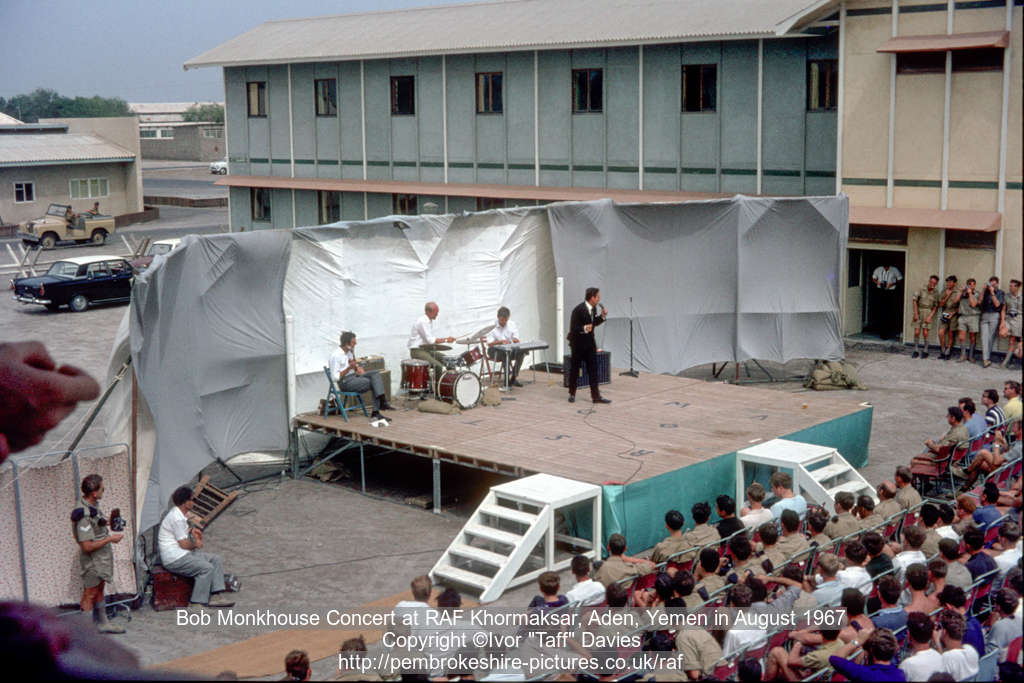
This trip is actually mentioned by Bob in his autobiography – “I flew out to Aden on 2 August to entertain the troops”4 – but he doesn’t link it to The Golden Shot, or indeed say that his planned appearance on the show was postponed in any way.
So when did Bob actually appear as a guest on the Shot? Well, he’s also billed in the TV Times and contemporary newspapers as being on the seventh edition of the series, broadcast on the 12th August 1967. Sadly, this edition does not survive. Bob does state at great length in his autobiography that his guest appearance was recorded at his request, in order for Lew Grade to judge how good he was, and hopefully give him a shot at hosting the show. Sadly, this recording wasn’t found as part of Bob Monkhouse’s famous archive. I guess it’s unlikely to show up anywhere at this point, but one can hope. It would certainly be one of my holy grails.5
However, we do have visual proof that this was almost certainly the edition which featured Monkhouse as guest. Hidden away in the archives of image library Shutterstock are lots of beautiful publicity photos from the show. And we’re interested in three in particular, one of which I will reproduce below.

This photo is labelled “‘The Golden Shot’ TV Show, Episode 7 UK – 17 Aug 1967”. Well, the date is wrong, but that’s not really surprising – the stated date is often inaccurate when looking at old publicity photos. But the episode number is correct, if you include the 10-minute pre-show at the start of July, as we have been doing. And the Shutterstock archives generally have these numbers right – this picture of Tom Jones performing is correctly labelled as Episode 5, from the show which is embedded at the start of this article.
So I’m happy to say that the date when Bob Monkhouse guested on The Golden Shot was indeed the 12th August 1967. Sadly, none of the pictures include any of Bob’s claimed comedy shenanigans, not even him dressed as a target; just him standing there looking funny in a suit. It doesn’t mean they didn’t happen. It also doesn’t prove they did, either.
* * *
Whatever the case, the reception to Bob’s guest appearance was clearly great, and it was decided that Monkhouse should indeed take over presenting The Golden Shot. This was reported on the 12th September 1967 in the Daily Record, exactly one month after Bob’s guest appearance almost certainly occurred. Interestingly, Jackie didn’t bother coming up with a face-saving cover story:
“Canadian Jackie Rae is to be replaced as compere of ITV’s Golden Shot programme by comedian Bob Monkhouse from October 14.
Jackie, who will then have completed a 13-week contract, said last night: ‘I am very disappointed. I had hoped to compere the show for its entire run.'”
In fact, Jackie’s last edition would be on the 7th October 1967… which was actually the fifteenth show. Bob took over as host from the 14th October.6 I’m sure everyone loved it, right?
The Sunday Sun‘s letters page on the 29th October 1967:
Being a reasonable sort of character I can tolerate almost anything which appears on television. But if they don’t get Bob Monkhouse and that other silly man7 off “The Golden Shot” I’ll put the poker right through the screen. Then I’ll be in real trouble because the set is rented. Please bring back Jackie Rae.
(Mrs.) M. CREIGHTON.
…What a shambles Bob Monkhouse has made of the show. The sooner Jackie Rae comes back the better. I, for one, would have been grateful to see that old, familiar sentence: “There is a fault, please do not adjust your set.”
(Mrs.) E.M. STEPHENSON.
…Bob Monkhouse has brought filth and smut to “The Golden Shot.”
T. PATTERSON.
Oh well. While Bob Monkhouse wasn’t always admired by everyone over the years, the above letters strike me as people complaining about change to a show they liked as much as anything else. Although to be fair, the last letter reads more like a recommendation to me than a warning.8
What about Bob’s account of his first show as host? Well, he talks about it in-depth in his autobiography, and it’s ludicrously exciting just reading about it, let alone watching it:
“My first show kicked off with a historic reunion of the RAF Skyrockets Dance Orchestra conducted by Paul Fenoulhet. Our detonating apples were located in barrage balloons over the skyline of London in the blitz. Anne Shelton sang a wartime medley and then the free-standing bows fired at models of Luftwaffe bombers diving through the sweeping beams of our searchlights, the flying bolts exploding the enemy aircraft seconds before they could drop their deadly cargo. Comedy guests from ‘Much Binding in the Marsh’ were Richard Murdoch, Kenneth Horne and Sam Costa. After a comedy routine, they fired on behalf of their charity, the RAF Association.
The target for the silver shootout was a marvellously accomplished model scene of the kind only the artisans at ATV could produce. Sitting in the booth operating the joystick, the contestants were given the point of view of a fighter pilot, homing in on a choice of three enemy planes of increasing difficulty and prize value. It was only just possible to shoot down all three in thirty seconds and our second player, a decorated and one-legged ex-RAF rear-gunner named Basil ‘Ginger’ Cody, did it. Then, in an atmosphere as tense as the thread he had to split, he fired a perfect bull and won the golden shot as well. As Anne Shelton presented him with the treasure chest and his other prizes, the official Band of the Royal Air Force played their stirring march anthem and cheered the winning hero. I promise you, there wasn’t a dry eye in the house.”
There’s only one problem: it doesn’t sound at all like the edition which actually aired on the 14th October 1967, which was billed as featuring Frankie Vaughan. However, it does sound remarkably like a show which aired six months later, on the 7th April 1968. This was billed in the TV Times as an “RAF 50th Anniversary Edition”, featuring Richard Murdoch, Sam Costa, and The Skyrockets, who were indeed conducted by Paul Fenoulhet.9
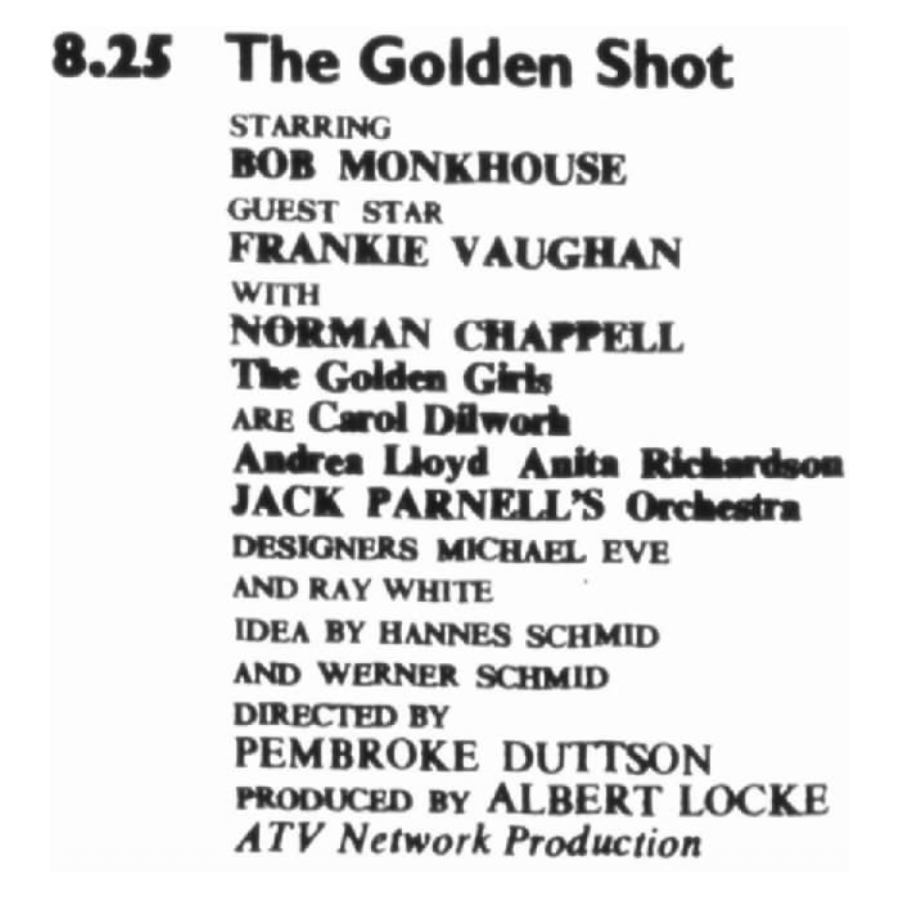
14th October 1967
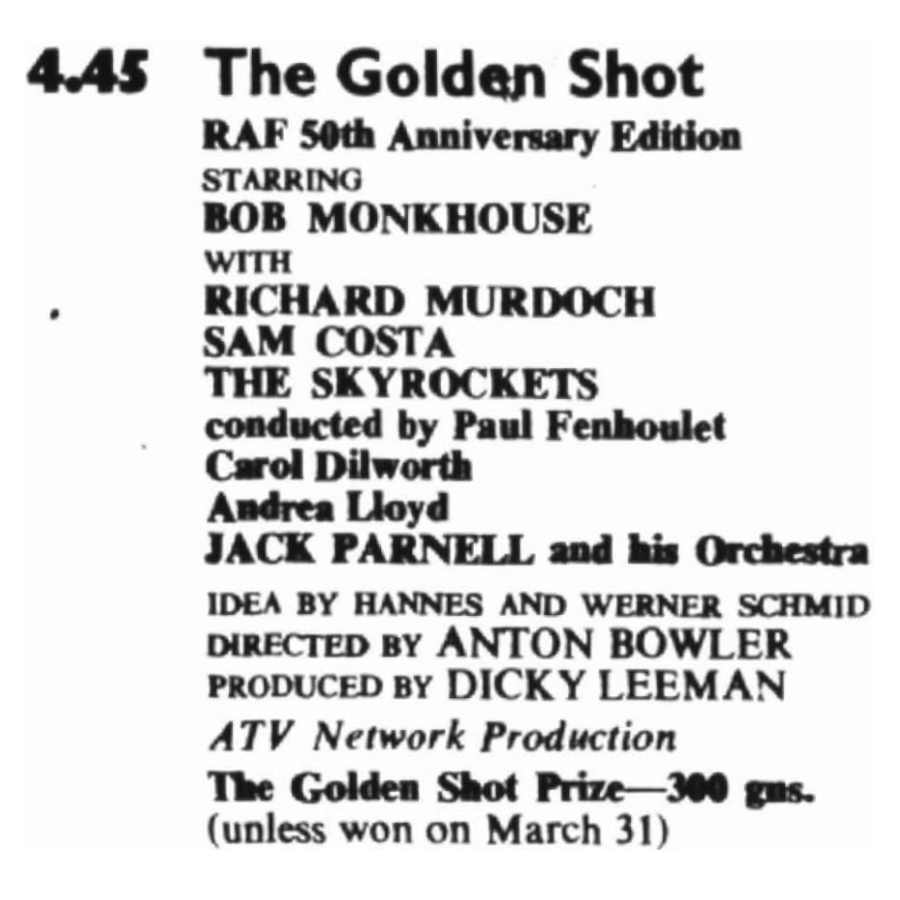
7th April 1968
As for Bob’s second show, broadcast on the 21st October 1967, he describes it like this:
“Though our switchboards were jammed for over two hours with congratulatory calls, the national press took no account of us until the second week. For this, Tony Hawes and I designed old time Music Hall targets, drawn in the style of Donald McGill’s vulgar seaside postcards and based on such songs as ‘My Old Man Said Follow the Van’ and ‘Any Old Iron’. The set resembled a typical variety stage of fifty years earlier and our two musical guest stars were eighty-nine-year-old Hetty King dressed in top hat and tails singing ‘Piccadilly’, her success of 1909, and seventy-eight-year-old Randolph Sutton recreating his beloved ‘On Mother Kelly’s Doorstep’ from 1925. Our comedy guest was dear old Sandy Powell, who gave us his hilariously inept ventriloquist sketch and then fired a winning bolt on behalf of the Variety Artistes’ Benevolent Fund. Once again the golden shot was won, this time by a sixty-eight-year-old ex-chorus girl. Luck was smiling on those early shows. This time the papers noticed us: ‘A Bolt Out of the Blue!’, ‘Golden Shot Bobs Up’ and ‘On Target at Last’ were three headlines that conveyed the new opinion of the series. A quarter of a century later, it’s difficult to communicate the extraordinary warmth with which these shows were greeted.”
Again, this doesn’t sound like the show which actually aired that week, which apparently featured the Dave Clark Five. But it sounds very like the edition broadcast on the 21st April 1968, which was billed as an “Old Time Music Hall” show, and specifically mentions Randolph Sutton, Hetty King, and Sandy Powell.
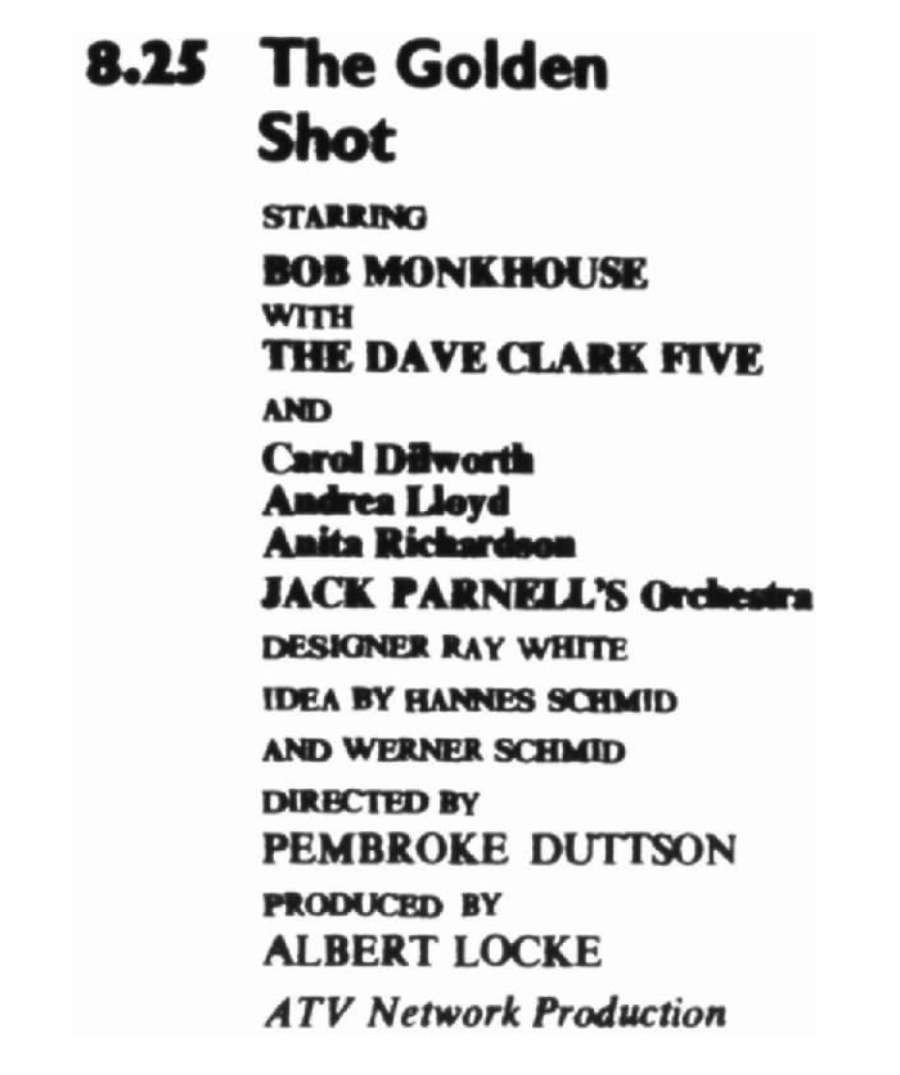
21st October 1967
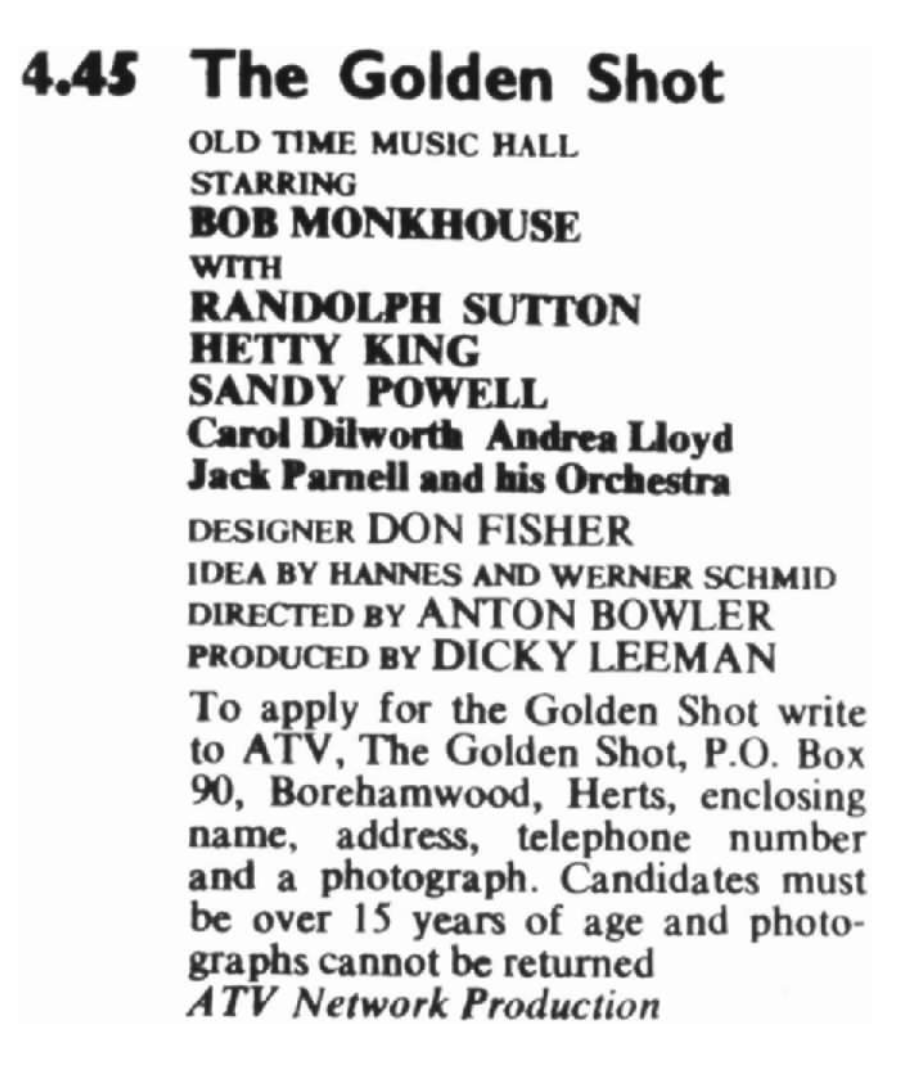
21st April 1968
What to make of this? Did Bob simply misremember here, or – as I suspect – was it a deliberate choice to give details of two really special shows, instead of his first two?
I have to be honest: for me, this is where Bob’s writing about the show becomes a little troublesome. I entirely understand why he didn’t want to complicate the story of his guest appearance by discussing how it was postponed; equally, getting the week of his guest appearance wrong doesn’t really seem that important. But here, it feels like a leap too far. It would have been absolutely fine to simply discuss the success of his “early shows” – a perfectly legitimate term to use for editions transmitted in his first six months – without portraying them as the very first shows he hosted.
There’s a similar issue with his memories about how he changed the format of The Golden Shot. To take just one example, when talking about how he came up with ideas on how to revitalise the programme, he remembers the following:
“The seven wearisome stages of the original game were simplified into only four: home contestants used their phones to aim the bow at the central detonator in each of four apples, thus blowing them to smithereens, the successful marksmen qualifying for a place in the studio next week. These four players then handled free-standing crossbows, aiming at a more difficult target to win a bronze prize. The two with the highest scores qualified for the silver stage, using the joystick to aim at an even tougher target. Finally, the week’s best archer tackled the ‘golden shot’ itself, trying to sever a thread.”
In fact, the above is largely the format of the Jackie Rae version of the show, as can be seen when you watch his single extant edition. Of course, Bob most certainly made changes to the programme, and if it were possible to compare the final Jackie Rae edition and the first Bob Monkhouse one10, I suspect I would much prefer the latter.
But the changes simply weren’t as major or as immediate as his autobiography indicates.
* * *
To which you might reasonably say: well, so what? Bob Monkhouse in preferring nice, neat anecdotes to the pure facts, what a shocker, right?
Well, maybe. It’s perfectly within your rights to just consider me naive. In my defence, however, I will quote one final part of Bob’s autobiography, regarding the show changing studios.
“Towards the end of 1968, ATV decided to move the production to the major city of the Midlands area the company was franchised to serve, Birmingham. […]
So by 12 January 1969, the ‘Shot’ had moved again, this time physically. Proved to be a success as a Sunday teatime fixture, we were now ensconced in our new but old home, the technically out-dated rabbit warren known as the Aston Studios in Birmingham.”
I will now point you towards the edition of the Sunday Mercury published on the 24th November 1968, and the article “Midlands gets (golden) shot in the arm”:
“The producer – yet to be appointed – who takes over “The Golden Shot” when it comes back to the screen in January is in line for a headache almost as big as the one William Tell’s son stood to get.
For the first time the show is to be mounted at A.T.V.’s studio in Aston, Birmingham, which is only half the size of the Elstree studio where the popular Sunday afternoon series was originally produced.
A high-powered crossbow, as lethal as a .303 rifle and aimed by twitchy-fingered contestants, poses serious problems in a confined space.”
The Golden Shot took a break after July 1968. And when it did return to the screen, from the Aston studios, it was indeed on 12th January 1969.11 A man who was purely interested in providing pleasant anecdotes would not have bothered to give a date here… let alone actually get that date correct.
So forgive me. If I poke a little at Bob’s writing while trying to come up with a timeline of events, it’s because I think it’s worth poking at. And because I want to know as much about that damn man, his amazing life, and his amazing shows as I can.
With many thanks to Paul Hayes and Tanya Jones for editorial help.
Peter Prichard, Bob’s agent. ↩
With many thanks to Simon McLean, the advert Bob is referencing here must be this one for Lifebuoy soap, or a similar one in the same series. ↩
“The Beat Girls” was the name of the group, and so should really be capitalised. They were the forerunner to Pan’s People. ↩
The 2nd August was a Wednesday, while the Liverpool Daily Post mentioned a Tuesday, but this doesn’t really matter. Surely the reason Bob missed The Golden Shot is because of rehearsals for the concert. ↩
Something interesting to ponder: the fifth show where Bob was meant to appear is the first edition of The Golden Shot to survive. Bob also indicates that the show was not routinely recorded at the time. Is the only reason that fifth edition exists because it was recorded as the show Monkhouse was meant to be on? If so, it’s grimly amusing that it survived… and Bob’s actual guest appearance does not. ↩
A word about transmission dates for The Golden Shot. At this point in the show’s life, the show aired on Saturdays, live from ATV’s studios in Elstree. Most ITV companies took this broadcast live, as did ABC in the Midlands initially. However, from the fourteenth full edition broadcast – live from ATV on the 30th September – ABC decided to shift the show to Sundays. After 27 editions, ATV decided to move the live show to Sundays, and everyone matched up again. I am only using TX dates for the initial live broadcasts from ATV, although some sources use the ABC dates.
Incidentally, this does mean that the 14 editions which were time-shifted on ABC must have been recorded… although almost certainly wiped immediately after the ABC transmission. ↩
Norman Chappell, Bob’s new sidekick. Here’s a lovely picture of them. ↩
What kind of “filth and smut” did Bob Monkhouse bring to The Golden Shot, I hear you ask? The answer can be found in the Sunday Mirror, also published on the 29th October, and James Pettigrew’s column:
“Bob Monkhouse… why tarnish the gilt on the gingerbread with tasteless gags? Like that one about consenting adults which you made during a film clip of wrestlers falling accidentally in an obscene heap on the canvas.”
Ah, “consenting adults”. The Sexual Offences Act 1967, which legalised homosexual acts in England and Wales between men aged 21, received royal assent on the 27th July – just three months earlier. ↩
Misspelt as “Fenhoulet” in the TV Times listing. ↩
Neither edition of the programme now exists. ↩
The amazing book Bob’s Full House (2009, Kaleidoscope Publishing) reveals there was an unbroadcast trial episode made the week before, to get used to the new digs. ↩
15 comments
Bruce Dessau on 24 November 2025 @ 2pm
I always thought it was a strange coincidence that Anne Aston had the same surname as the studio location but wikipedia tells me that she changed her name from Lloyd as there was already an Anne Lloyd in Equity and she intentionally chose Aston because of the location.
Paul Martin on 24 November 2025 @ 3pm
Much Kerning in the Marsh: Kenneth Home should be Kenneth Horne. Tiddle-im-pom-pom.
John J. Hoare on 24 November 2025 @ 3pm
Cheers Paul, corrected, thank you. The original error is in the Kindle version of the autobiography itself. Some of them really are filled with tons of OCR errors when it comes to older books.
Peter Counsell on 24 November 2025 @ 3pm
I recall watching Norman Vaughn do The Golden Shot when I was very very young, knew that Bob Monkhouse had done it, but was unaware of Jackie Rae. A couple of links and I find he was married to Janette Scott, who was delightful in School for Scoundrels and is Thora Hird’s daughter.
Gareth Randall on 24 November 2025 @ 4pm
As fantastic a book as Crying With Laughter is, the frustration of not being able to see things like That Edition of Golden Shot is very real, and I’ve long wondered about how accurate the anecdote is. I’m also intrigued by his references to the split-level set with staircase; I can’t really picture it, and I’m not sure if any editions that feature it have survived.
I’ve tried checking up on the accuracy of some of his radio anecdotes. Based on available sources, the Calling All Forces one about the Tondelayo sketch (which I’d love to hear) can’t be true.
He states it was the first edition to feature Diana Dors and the other guest was Max Wall. The first Dors was 21st Jan 1951, but according to the episode guide in Bob’s Full House the other guest was Terry-Thomas, not Max Wall; Dors and Wall don’t seem to ever have appeared on CAF together.
Then there’s the Show Time anecdote, where he flops trying to follow Max Bygraves but his failure is confined to the live theatre audience because the BBC switched to live cricket coverage from Australia of Don Bradman making a century.
The only edition of Show Time where both Bob and Max are billed is 3rd June 1948 and Bradman didn’t score a century on that day – he did on the 10th June, but in Nottingham. And I can’t find any evidence of the Press reaction to him being faded off air that he mentions, although I’ve only been able to check the Mail and Mirror archives.
John J. Hoare on 24 November 2025 @ 8pm
Brilliant stuff, Gareth. And yet also infuriating.
I can at least shed a bit of light on the setup for The Golden Shot at Aston, and it really was on two levels. These photos must be some of the only records of how the show looked at that point which survive:
https://www.shutterstock.com/editorial/image-editorial/golden-shot-tv-studio-including-targets-video-14350857w
https://www.shutterstock.com/editorial/image-editorial/golden-shot-tv-studio-including-targets-video-14350857ae
It looks to me like it really was a genuinely cramped space that was difficult to do the show in… and yet it also perhaps had the potential to look pretty good, if it was shot in the right way?
Gareth Randall on 25 November 2025 @ 1am
Thanks so much for the links to the photos – I get it now, and it’s not at all what I had in my head. It even looks like the control gallery is a sort of shed on the studio floor.
On the subject of autobiographical anecdotes that have been deliberately embellished to increase their entertainment value, David Niven is pretty much unbeatable. When he was doing the rounds of talk shows, and writing The Moon’s A Balloon, there was obviously no practical way of actually verifying the stories about his earliest film roles and what happened when he went up on stage to collect his Oscar, but these days it’s all too easy, and he really was talking (entertaining) bollocks.
Nicola on 25 November 2025 @ 5am
I response to Gareth Randall. Wager the error is in describing the the show as an edition of Show Time – which went out too late to be sidelined by the cricket anyway ..
On 10th June BBC Home Service North is airing a Summer Show excerpt from ‘ It’s Fun’ at the Coliseum Theatre, Douglas. Isle of Man.
Max would be a solid bet on the bill for this – was Bob?
Jeremy Rogers on 25 November 2025 @ 1pm
I remember watching shows with the bi-level set. As seen here the sections where the booth with the joystick control were used were done from the top level, as was the introduction & telephone round. The rest was from the floor. As is often the case the set & stairs didn’t look as shonky or for that matter as cramped on screen as they do in these photos, especially in 405-lines.
Martin Fenton on 26 November 2025 @ 5pm
If the footage of 89-year-old “male impersonator” Hetty King turns up, I’ll be first in the queue at the BFI.
Kieran Wilkinson on 29 November 2025 @ 7am
Is there another problem with Bob’s story insofar as he refers to having to travel from Liverpool? I cannot find any evidence of him having appeared that week at the Cabaret Club on Duke Street. Indeed, the Liverpool Echo of 8 August 1967 advertises that the star turn “Tonight and All This Week” was the future Ivy Tilsley, Lyn Perrie (and the Amazing Margos). Surely a residence by Bob would have been worthy of an advert?
And what of Johnny Vyvyan, the supposed cannon fodder? In August 1967, Vyvyan was in the play, The Bedsitting Room, alongside Spike Milligan (the Nottingham Guardian of 1 August 1967 confirms this, as does the Birmingham Mail of 29 August 1967, so I think we can assume that he was in it for the whole month). The play was on at the New Theatre, Oxford for all of the week commencing 7 August 1967. Whilst I’ve not found 100% proof that this included Saturday 12 August, it would be usual for a play to have a Satuday matinee and evening performance which would make Vyvyan’s appearance on the Golden Shot the same day problematical.
In general terms, the idea that Bob, a guest star, could dictate (and direct to a special effects team, at that) that complex (and presumably costly and dangerous) stunts were performed seems a bit of a stretch.
Ben on 29 November 2025 @ 1pm
It strikes me also that Monkhouse would be unusually aware, given his own archivist tendencies, of the series’ state of preservation when he was writing the book, and that bluntly, he would have known nobody would be able to check his word on the matter by referring to the tape.
Gareth Randall on 9 December 2025 @ 7pm
Just for the hell of it, I’ve been searching the Mail and Mirror archives for the articles quoted by Bob in Crying With Laughter. Sadly, none of them actually exist, not even the paraphrased review of Bob and Denis in Cinderella at the Manchester Palace in 1958-59.
It’s particularly disappointing since it’s so easy to believe that they must be genuine quotes, because you’d expect Bob to have kept the clippings… or are they actually genuine quotes, but from much less prominent papers, leading Bob to get creative with his attributions?
John J. Hoare on 11 December 2025 @ 1am
Yes, that’s the odd thing about a lot of this stuff, isn’t it? It really, really has the ring of truth, but it ends up at the very least not being quite correct.
For another example of this, in his subsequent book Over the Limit, he – correctly – talks about an absolutely abominable story that the Mirror did about his son Gary… but then says that a few weeks later, they published a front page apology. In fact, they didn’t – it was a few months later, and it was on the inside pages.
As you indicate, the worst thing about this is that it’s easy to suggest Monkhouse just went into “the facts don’t really matter” mode, but that seems very much at odds with other parts of his personality; the archival side. Nobody is expecting him to have been 100% accurate when doing comedy routines, and you can give chat shows a bit of a free pass too – but I kinda find books a slightly different matter. Especially when he explicitly says at the start of Crying With Laughter that he’s going for the full truth.
Gareth Randall on 18 December 2025 @ 9pm
Given that even a small amount of research suggests that a lot of his anecdotes are probably badly misremembered at best and flat-out made up at worst, it does rather take a fair bit of the shine off Crying With Laughter for me.
On the subject of “the full truth”, I’ve only just discovered that while still a teenager he set up a publishing company called Streamline with his schoolfriend Denis Gifford. This isn’t covered at all in CWL and Gifford himself is only mentioned once, very much in passing.
He does briefly mention earning money drawing comic strips and being asked to write books for the troops, but goes into very little detail; he claims authorship of “about thirty terrible pulp novels”, but apparently in reality he wrote nearly 100 “Harlem Hotspots” novelettes and it looks like one of them can be found here: https://www.worthpoint.com/worthopedia/harlem-hotspots-scarce-1948-utopian-1783312967
If that’s actually one of Bob’s, it’s potentially quite progressive for 1948 while also clearly being highly problematic and the sort of thing he’d have preferred to gloss over by 1993. What’s the betting Bob did the cover art too?