
The opening episode of the first series of I’m Alan Partridge, “A Room with an Alan”, was broadcast on the 3rd November 1997. What is the first thing we see Alan Partridge doing in his room at the Linton Travel Tavern?
Oh, the usual stuff. Some bad programme ideas. The first of many dream sequences. But the very first thing we see is him doing is reading a newspaper article about Tony Hayers… the person who is about to deny him his second series.
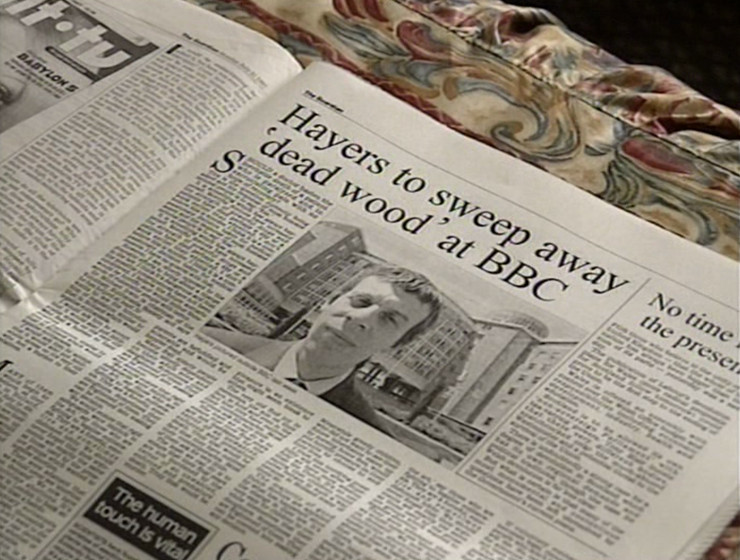
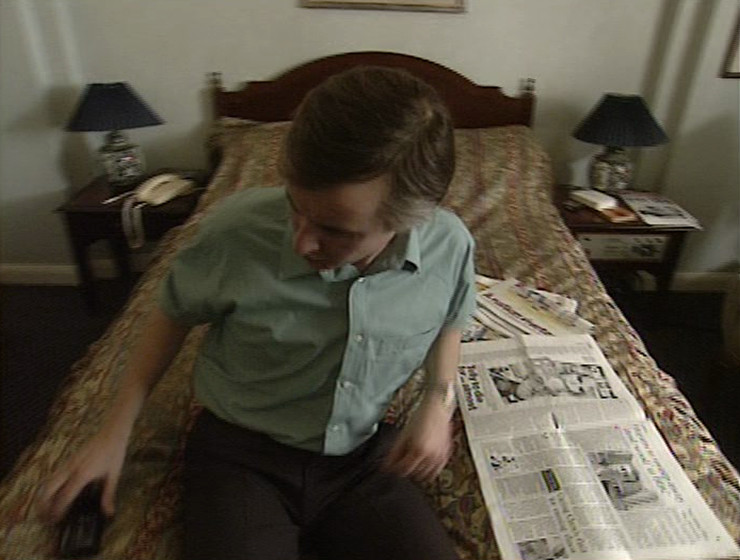
If you squint, the folio at the top of the first image identifies the paper as The Guardian. So let’s ask our usual question: which edition of the real paper did they modify, in order to create their prop with the fake Tony Hayers story?
As always for questions like this, it’s useful to know exactly when the episode was recorded. Despite looking remarkably like a real location, all of the scenes set in the Linton Travel Tavern were shot in Studio 1 at TV Centre; this first episode of the series was recorded on the 25th July 1997. It therefore seems likely that the original version of the newspaper was published around this time.
The next step: let’s search for the most obvious thing in that spread. On the left is a picture of the front cover of the short-lived Cult TV magazine; the corner of it is visible in the first image, and the full cover is shown in the second. Sure enough, if we search in The Guardian‘s archives in 1997 for “Cult TV”, the following was published in the 21st July 1997 edition:
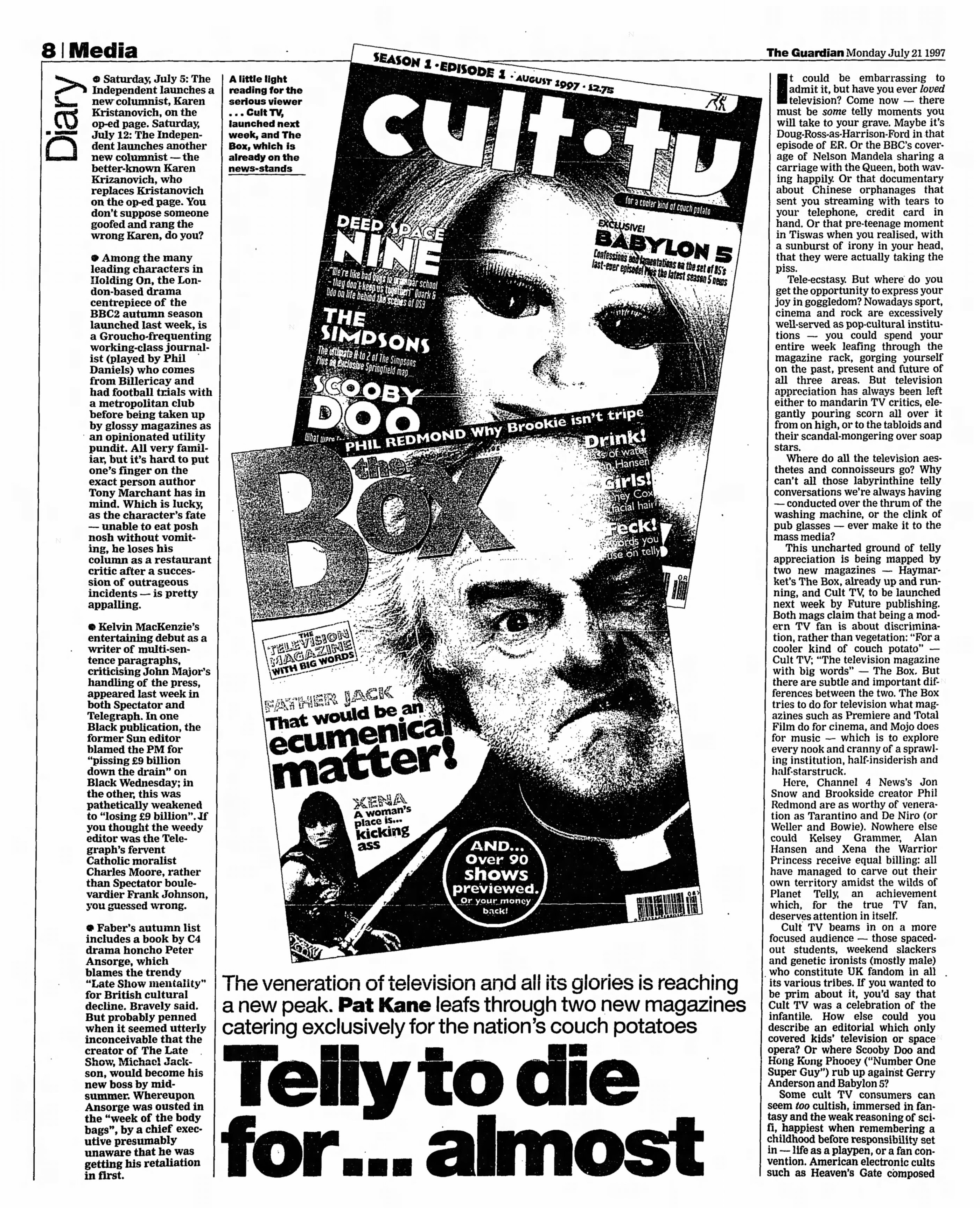
This is very clearly the left-hand page in the paper that Alan is perusing above.1 Which means that the right-hand side must be the one used as the basis for the made-up Tony Hayers story, right?
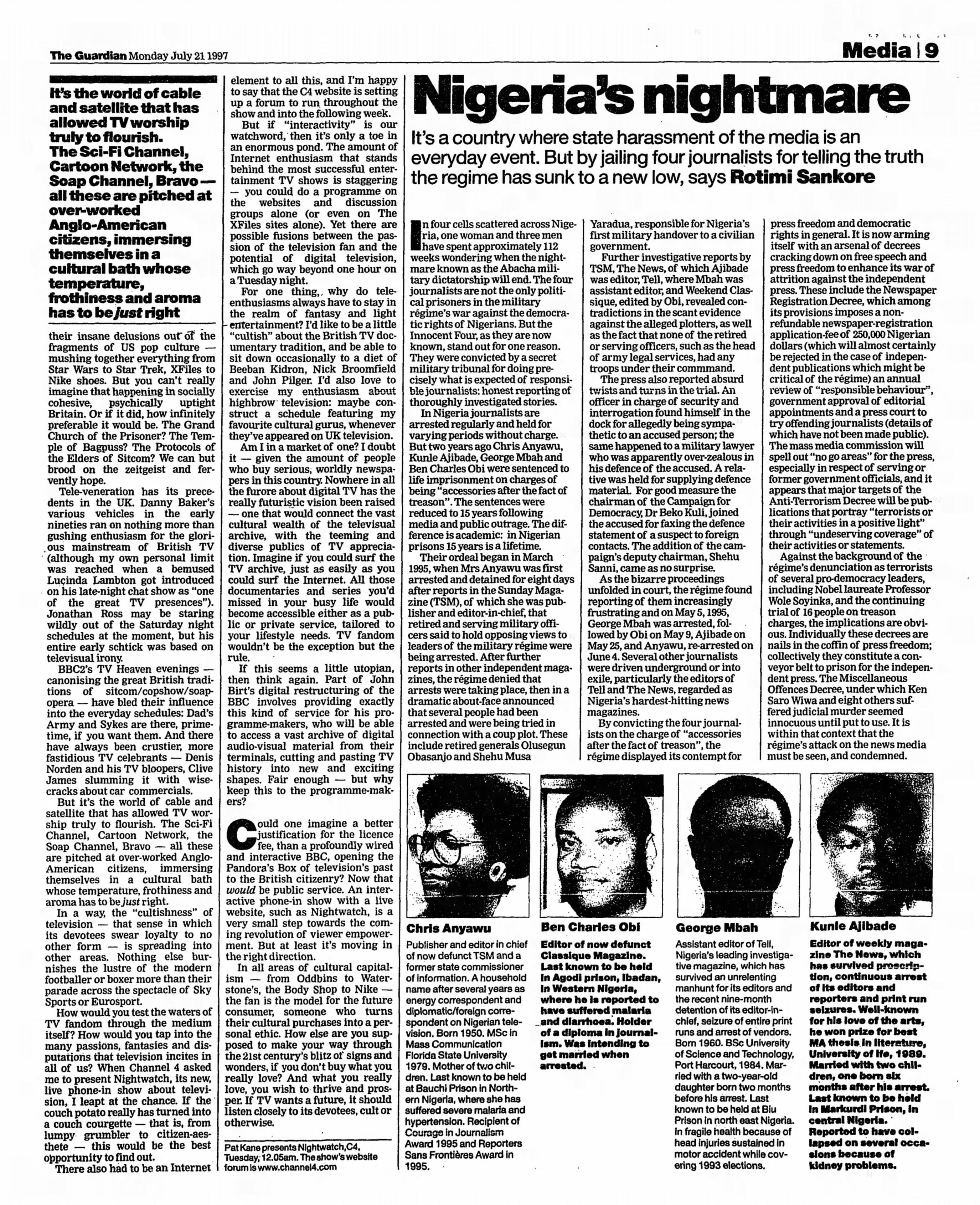
Hmmm. That is nothing like the page which features the Tony Hayers story:
I mean, even the fonts are wrong. The Guardian at this point had very distinctive look, which is not even slightly replicated in the mock-up we see in I’m Alan Partridge.
At this point, I was reduced to squinting at the screen, trying desperately to figure out some of the body text in the article. I eventually managed to scrape “there is undoubtedly a strong case for a degree of” from the text at the top right of the page. This – in a roundabout way – sent me to… erm, the Daily Mail.2
Specifically, the 23rd July 1997 edition:
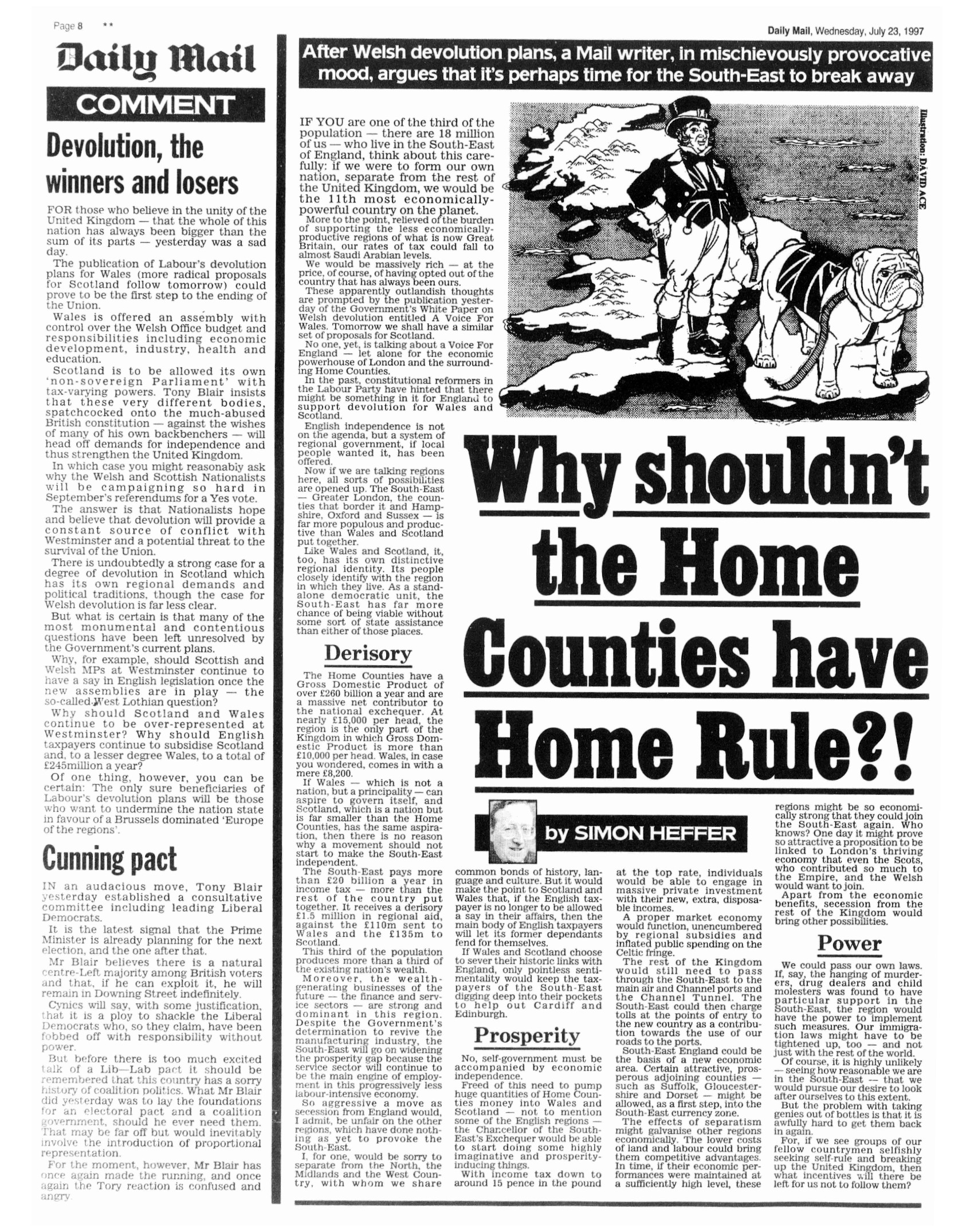
So the story in the top right of the mock-up featured in I’m Alan Partridge, under the headline “No time like the present”, is actually a Mail editorial on devolution. Brilliant.
Oh, and the very next page of that edition of the Mail? Turns out that it’s the page which was used for the rest of the mock-up. Look at the big S and M drop caps3 in the main bulk of the text – and crucially, the white-on-black headline “The human touch is vital”:
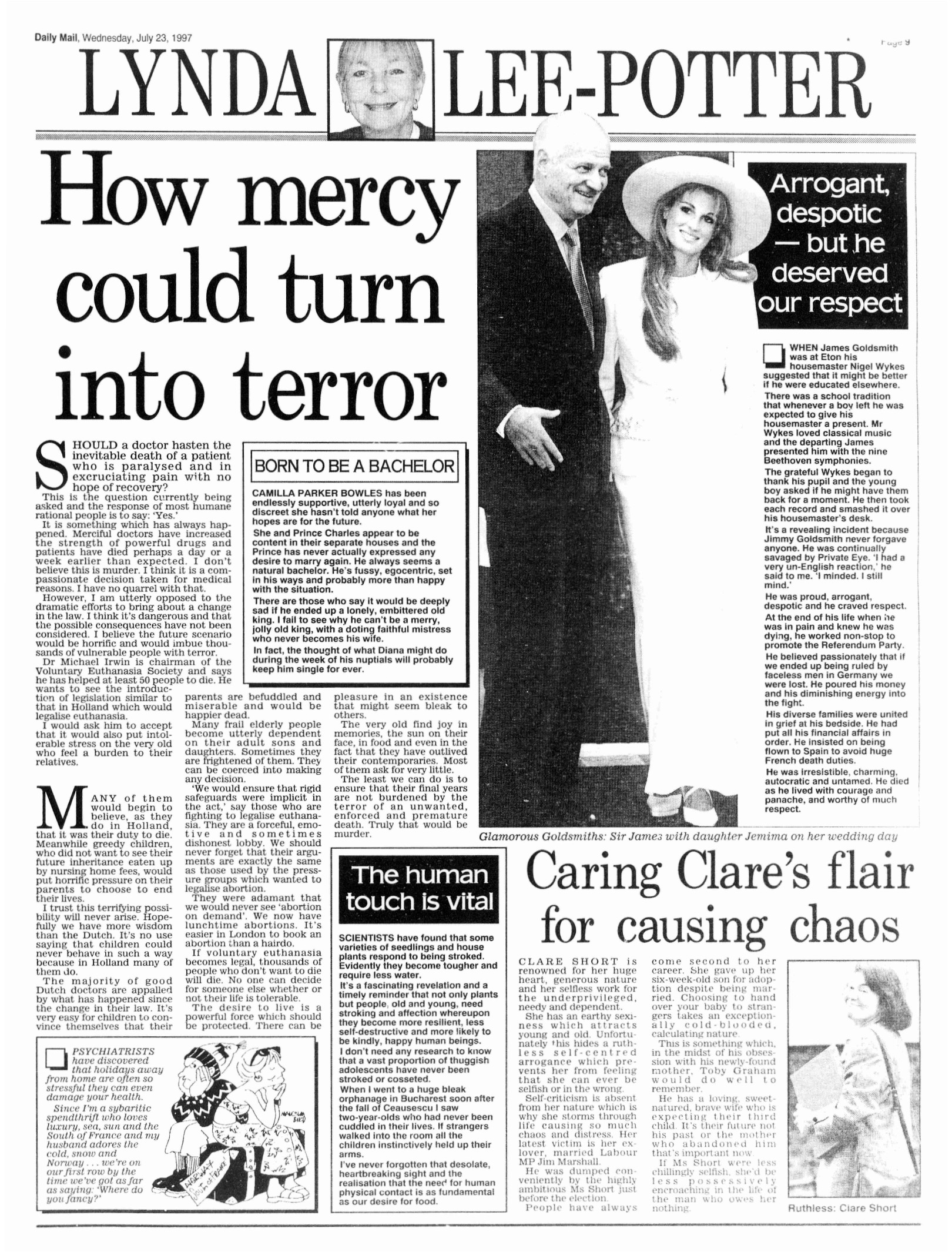
Which means that the main Tony Hayers article uses as its basis… a Lynda Lee-Potter column on assisted dying. Brilliant. The columnists may change, but the topics don’t.
As for why the team used the Daily Mail as the basis for a mock-up of a Guardian article? Who knows. I can’t imagine newspapers would cause any serious problems when it came to rules about due prominence. But I do find it very, very funny.
After all, you could hardly pick a less friendly amalgamation than The Guardian and the Daily Mail.
With thanks to John Williams for picture research, and Walter Dunlop for helping me with my shaky grasp of newspaper terminology.
A sample quote from the article: “It could be embarrassing to admit it, but have you ever loved television? Come now – there must be some telly moments you will take to your grave.”
Oh dear. To be fair, there are some good points buried in the article, but it’s cloaked in so much obnoxiousness that it’s not worth rooting through to get to the good bits. Parts of it read like a parody of what you might think The Guardian would publish about television in 1997. ↩
I originally found it through The Scotsman quoting the Mail secondhand. ↩
Yes, there is a hilarious S&M gag to be done here, please control yourselves. ↩
12 comments
Simon Simmons on 26 June 2025 @ 3pm
Weren’t The Guardian and the Mail different sizes back then?
John J. Hoare on 26 June 2025 @ 4pm
Ah, now, is it because the Media Guardian was a smaller size, which is where the left-hand page is from? In my attempt to make this as simple as possible, I may have over-simplified!
Peter Counsell on 26 June 2025 @ 7pm
Is the Pat Kane who wrote the article on Cult tv etc the Pat Kane of Hue and Cry?
Paul Rhodes on 26 June 2025 @ 8pm
Alan doesn’t strike me as a Media Guardian type, somehow… it looking like a Mail or Express page makes more sense. Perhaps the Media G was just the only paper of the right size they had knocking about to slot the mocked up page into?
The recording at Television Centre was an odd experience : the location feel meant Alan’s hotel room had four walls and a ceiling, so the audience were basically watching on screen what was happening in a plywood box in front of them.
Stephen on 26 June 2025 @ 11pm
At this time, the main part of the Guardian was a broadsheet but the G2 features section was tabloid. In the days when Media Guardian attracted a lot of advertising it was a separate section. It may also have been tabloid.
Despite their political differences, I think there was a point where the papers shared presses but I don’t suppose that’s relevant.
As you said, the Guardian of this era had a very distinctive look so the choices here are odd ones unless it was an intentional joke or easter egg.
I’d have imagined Partridge to be a Mail reader anyway.
John J. Hoare on 27 June 2025 @ 8am
Peter: I believe it is!
Paul: I do agree, but I also reckon that Alan is obsessed enough to buy every single paper just in case they have something on his nemesis.
Very jealous of you going to a recording, even if all you saw was a box.
Paul Rhodes on 27 June 2025 @ 8am
Unusually, there wasn’t really a warm-up as such, but Alan Partridge himself did come out to explain to us that this was going to be a faithful studio recreation of events from his actual life. The hotel lobby was open plan – including the lift – but behind the hotel room. Unless my memory fails me, the living room for the house was also a box in the studio – I think you can tell it’s not quite the right proportions for a real living room, but the ceiling and daylight lighting sell it well! The rest of the house (and obvs exteriors) was played in. And the BBC restaurant was stuck in the corner to the audience’s right.
John J. Hoare on 27 June 2025 @ 9am
This is why I have comments open on here!
I can confirm you’re remembering correctly, the living room was definitely studio – Iannucci mentions it on the commentary, along with the fact that the rest of the house was location. In many ways, I find that more impressive than the Travel Tavern set – no WAY would I have thought that was studio.
Paul Rhodes on 27 June 2025 @ 9am
I think the lighting – best I recall, rectangular arrays of bright ‘daylight’ lights outside each window – is a big part of it. A more traditional “out of focus background trees” diorama outside the hotel lobby.
John J. Hoare on 27 June 2025 @ 9am
The most impressive example of this is probably the path outside the caravan in IAP2, which I still can’t quite believe was studio.
Rob Keeley on 27 June 2025 @ 5pm
If you’ve still got an appetite for mocked-up newspapers, John, I saw a subject for you the other day in the Terry and June episode ‘The Raft Race’. The end credits play over a local newspaper from Ross-on-Wye, telling about Terry’s river antics, and there’s a photo, headline and two quite convincing paragraphs, then the article suddenly turns into the original one, about drink-driving! They obviously thought no one would read any further. I did.
John J. Hoare on 30 June 2025 @ 6am
You’ve just made me order the complete Terry and June on DVD.
Although I guess the more surprising thing is that I didn’t own it before now…
Comments on this post are now closed.