
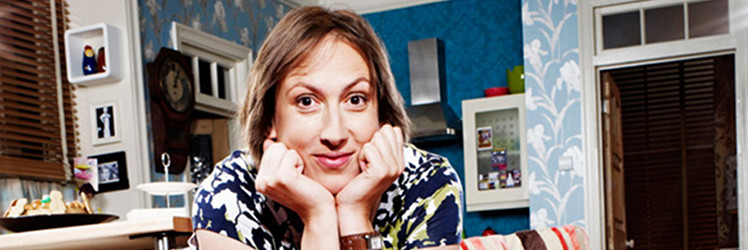
In a rare guest article here on Dirty Feed, script editor and writer Andrew Ellard takes issue with the poor quality of debate around the subject of studio audience sitcom…
This little piece in The Telegraph caused a minor kerfuffle just before Christmas. Catherine Gee gave her (negative) opinion on Miranda and Miranda’s fans, lent voice by Twitter and the ever-present ‘comment’ option, responded angrily.
While the pro/con article itself wasn’t really balanced by the inclusion of Chris Harvey’s rebuttal – which still described the show as having “terrible catchphrases”, “caricatures that make Little Britain look subtle” and “slapstick so obvious it wouldn’t confuse a small child” – the truth is that the ‘con’ half is what drew most ire.
I tweet about TV a lot. A bit of 140-character critique and analysis – why things work for me, or don’t. I like Miranda. I’ve liked its writer/star for a long time, and I like the show. I think it’s a flawed but deeply funny sitcom. I wouldn’t miss it.
However I’ve stopped discussing the ups and downs of this one, specific show due to the quick-tempered overprotectiveness of its fans. I fear pointing out that, say, Miranda’s supporting characters aren’t strong enough to hold down even a single scene without the leading lady present – because what follows are angry tweets of the “it’s funny, that’s all that matters, now stop being mean” variety.
But it’s in my nature to feel that such analysis is useful. Far from being Miranda security, protecting it from harsh words in case it shatters, fans should (and generally do) know that shows get better through robust and intelligent analysis and critique. (It’s also, obviously, how they’re made in the first place.)
And so I find myself in the curious position of being out of sorts both with Miranda fans and a fervent critic of the show. The flak Catherine Gee received online was often as ill-considered as the analysis she provided. While this internet of ours is often in the business of providing a platform for the uninformed, when you get paid to talk about something, you need to – should be required to – know your stuff.
So here, in bold, are the Gee comments that pressed my irk button… along with my rebuttage:
“Miranda is a flop, and here’s six reasons why – by Catherine Gee”
As a headline this may well be the sub-editor’s wording, but whoever wrote it doesn’t know what the word ‘flop’ means. And since their job includes using the word, that’s a problem.
A flop film is a financial failure, with fewer tickets sold than justify the initial expenditure. For a BBC TV series to be regarded as a flop it needs to have difficulty attracting an audience. Viewing figures would be poor in comparison to other shows in the time-slot, public demand would be low and, as the series went on, those figures would be diminishing.
Ultimately, ‘flop’ or ‘hit’ is a tangible achievement. Either extreme can be factually assessed by looking at hard data. Wanna take a guess which sitcom has been having a increasingly great time in the ratings in its unusual 8.30pm BBC Two slot? (Points deducted if you said The Persuasionists.)
“One: Canned laughter.”
Three words in and it’s regurgitate-a-myth time. Name for me, please, five sitcoms in the last 20 years that have regularly used ‘canned laughter’.
What’s that? Oh, no, no, no. Canned laughter isn’t simply a laughter track. Studio audiences come and watch sitcoms, laugh out loud and that laughter is recorded. That’s not canned. That’s free-range laughter you’re getting.
Canned laughter refers to a pre-recorded bank of laughs used on certain shows. Miranda, unsurprisingly, doesn’t use it. It’s massively rare in situation comedy these days. For a very, very long time it has been felt that people can spot a fake track and tell the difference.
There’s a Douglas Adams joke about the universe being unpopulated:
It is known that there are an infinite number of worlds, simply because there is an infinite amount of space for them to be in. However, not every one of them is inhabited. Therefore, there must be a finite number of inhabited worlds. Any finite number divided by infinity is as near to nothing as makes no odds, so the average population of all the planets in the Universe can be said to be zero. From this it follows that the population of the whole Universe is also zero, and that any people you may meet from time to time are merely the products of a deranged imagination.
There are a large number of modern situation comedies with laughter tracks. The number of modern situation comedies with canned laughter tracks is so minute, such a small percentage, that they might as well not exist at all, and any shows you claim use it…well, y’know.
If by ‘canned laughter’ Gee means ‘studio audience’ then…well, you simply cannot do that. They mean totally different things and using them interchangeably misleads the reader, (deliberately) creating an inaccurately negative impression. If your argument is solid do you need to resort to such a cheap technique?
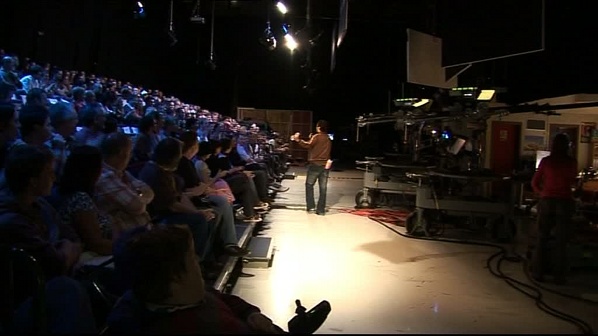
“Once upon a time, audience laughter was used to signal where the jokes were, when producers thought that viewers wouldn’t be able to figure it out for themselves.”
This is not what a laugh track is used for. It never has been. Are we really happy ascribing this kind of crass motivation to producing talents like John Lloyd, Paul Jackson and Geoffrey Perkins? They really thought so little of their viewers, and the scripts they were filming, that they added the aural equivalent of ‘laugh now’ captions?
I’ve heard show makers say that a live audience tells the makers to be funny. I like that. It guides performance, just as in good theatre, and lets you get a feel for what’s working. But let’s skip past even this – entirely reasonable – point because, I’m sure, the counter-argument would be the fabulously disingenuous “Why not just hire people who know how to be funny without the crutch of an audience?”
Here’s the thing: Saying a laugh track is there to tell you a joke is funny is like saying background music is there to tell you a scene is sad. Film and TV music, done right, conveys emotion and context – but it’s with you, alongside you, it’s not ‘signalling’ you. It’s not intended to point out so much as to underscore.
Nobody, least of all a musician by the name of Thomas Wanker*, needs to tell me that Buffy dying to save her sister is huge, dramatic and upsetting. His music wasn’t a signal, it was a relief. The show was with me. We were in it together.
Similarly, a laughter track is inclusive. It’s there to engage, to make the viewer part of a communal experience. Does seeing a comedy in the cinema require a large audience? No. Does a stand-up’s material get weaker in an unpopulated venue? Not intrinsically. But go see either in an auditorium of three people – you laugh less. You just do.
You enjoyed Friends and Men Behaving Badly right along with the rest of us. If you think you’ve since grown beyond audience sitcom, I think you’re nuts, but go ahead. Quit watching Big Bang Theory and The IT Crowd and feel for-some-reason superior for doing so. But don’t create a fake history of television, and fake motivations for its makers, to justify it.
“Now that comedies such as The Office and Peep Show have proved said viewers more than capable, it seems strange to still use it [a laugh track].”
The idea that The Office and Peep Show somehow reveal us ‘evolving’ past laugh-track sitcoms is a fundamental misunderstanding of the genre and its tools. The implication that I’m Alan Partridge, Father Ted, Seinfeld, Coupling and a thousand others were patronising their audiences at a time when they should have evolved past such prehistoric production techniques is… well, it’s not a clever thing to say.
Single-camera, no-laugh-track comedies existed long before the most recent iteration. They are not a modern discovery. They’re not the final proof we were all waiting for that we can chuck away the crutches of laughter and dance unaccompanied. And they are not the difference between ‘clever’ and ‘stupid’.
Those shows would have been better – less patronising? – if the audience had been taken away? You think a show puts its production schedule out – incurring the logistical costs of bringing 300 people to a studio – in order to provide instructions for the viewer? Are you kidding me?
“The role she’s written for herself is basically the socially inept sibling you’re embarrassed to introduce to people. Why voluntarily watch them at their most excruciating? Every week?”
We’ve stumbled on the true unspoken rule of comedy here: competent people are funny. That’s why you see so many comedies about people who are great at their jobs, are socially winning and romantically flawless. It’s that complete lack of fault that leads to really knockout –
Well no, obviously not. The Office is massively predicated on witnessing Brent at his most excruciating. His role is that of the socially inept boss you’re embarrassed to introduce to people. Why voluntarily watch him at his most excruciating? Every week?
Do I really have to list the number of great sitcoms that thrive on their characters failings and embarrassments? Or can I just assume at this point that we all – bar one – understand that this includes ‘all of them’ and move on?
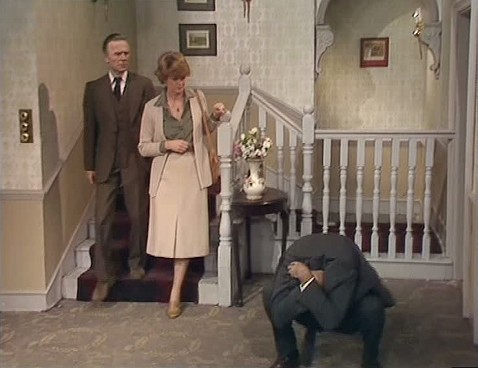
“It considers itself old-fashioned but seems to have only retained the worst aspects of the sitcoms of yesteryear – the cheap sets being just one. Vintage comedies such as Fawlty Towers and The Good Life may have been built out of reinforced cardboard, but at least they were backed up by likable (sic) characters and genuinely funny jokes.”
We presumably mean ‘cheap-looking’ rather than simply ‘inexpensive’ here, though I’ve never seen Miranda’s set wobble. Generally when people say this all it boils down to is ‘lit more brightly’, a genuine issue with studio sitcom that has to blanket light for around four cameras at once. A logistical problem worthy of debate.
But there’s no mention of multi-camera lighting here, just cheapness of design. And it begs the question: is the Miranda set really cheaper-looking than anyone else’s? When its designer, Harry Banks, was working on Jam & Jerusalem or The Smoking Room was he really thinking “Hey, these shows aren’t going to have a laugh track, I guess I’d better make them look good.”
The point actually diffuses itself, though. Boiled down it pretty much says ‘I only mention disliking the set because I don’t like the characters or the jokes.’ Which is another way of saying ‘I am unable to distinguish my appreciation between different aspects of production.’
A good script can be badly performed. A bad performance can be beautifully photographed. A collection of great shots can be badly edited. Nuance is your friend.
“Miranda’s asides to the camera are completely unnecessary… Miranda asks the therapist… if the fruit in his bowl was real. He responds by asking the old psychiatrist cliché: “How do you mean?” After she simply rephrases the question, she turns to camera and adds “I don’t know how to make it any clearer.” It’s a struggle to decide whether Hart considers her viewers to be so mentally challenged that they can’t see the joke implied, or if she genuinely thinks she’s being funny.”
See also that utter hack, Eric Morecambe. “This boy’s a fool.” Why say it? Wasn’t that opinion clear already from his place in the script?
The idea that there’s only one way to play a joke – under, darling, always under – again fundamentally misunderstands the nature of performed comedy. If nothing else, the asides to camera are just the stylistic equivalent of Peep Show’s interior monologues:
MIRANDA: Is that real fruit?
PSYCHIATRIST: How do you mean?
MIRANDA: I mean, is that fruit real? (to camera) I don’t know how to make it any clearer.
Handle this the Peep Show way:
MARK: Is that real fruit?
PSYCHIATRIST: How do you mean?
MARK: I mean, is that fruit real?
MARK VOICEOVER: I literally cannot think of another way to rephrase that question.
There’s common experience at the base of this – when someone asks you what you meant and you can’t conceive of a more simple way of explaining than the one you just used. We’ve all felt it. The joke isn’t ‘it’s hard to think of another way’, it’s in the familiar, exasperated sensation – and our being included in it. This is something Peep Show revels in… yet Miranda should, apparently, be chided for.
It’s a struggle to decide whether Gee considers her readers to be so mentally challenged that they can’t see the hypocrisy implied, or if she genuinely thinks she’s being funny. Don’t give me ‘unnecessary asides’. Asides are funny. We discover our characters through them, and we see ourselves reflected in them.
So there you have it.
When the Telegraph piece first appeared I tweeted a link to it, accompanied by harsh, throwaway disparagement. The level of inaccuracy, myth-making and contradiction seemed too vast to refute point-by-point. Like claiming the moon was made of ice cream. At some point a thing is just too ridiculous.
But, as the saying goes, you resort to name-calling, you get called names. It’s not a good saying, and people don’t actually say it, but it is what happened.
A ‘journalist’ claiming to be Gee’s friend responded thusly: “You’re a writer and the best counterargument you can come up with is ‘utter moron’? GOOD WORK.” Followed by “‘Moron’ isn’t exactly enlightening or insightful.” And then “You numb cunt. (See?)”
Ouch.
But yes, maybe what I assumed was obvious-to-anyone bad journalism was… well, not obvious. Maybe we don’t expect professional media commentators to know the difference between canned laughter and live audience, a flop and a personal dislike, an unnecessary writing technique and a simple matter of taste. Maybe even a bad argument deserves intelligent rebuttal.
This is the closest I’ve been able to manage.
Like what you like, dislike what you don’t, ignore the rest. Write about what’s not working for you, by all means. Explain the confusion of finding something you can’t stand becoming popular.
But please, know your topic before you start typing. No more canned opinions.
With thanks to John for lending me his webspace in which to deposit my brainpoo.
* CORRECTION: While Thomas Wanker composed the music for the fifth season of Buffy, in fact the final episode referred to here was scored by his predecessor, Christophe Beck.
34 comments
T on 8 January 2011 @ 8pm
“Like what you like, dislike what you don’t, ignore the rest. Write about what’s not working for you, by all means. Explain the confusion of finding something you can’t stand becoming popular.
But please, know your topic before you start typing. No more canned opinions.”
————————
Yes!
I really didn’t like the CG piece (and the “argument” from her colleague, below it). It seemed that she was just scratching around for content and as you say, didn’t really know what she was talking about.
Perhaps it was just meant as a throwaway, light-hearted piece, but when you’re negatively discussing people’s passion and work in a huge public arena, things can quickly become personal and hurtful.
I also found the attack on studio-audience comedy very upsetting and frustrating. You’ve rebutted and explained it excellently above.
As for the show being “flawed” I tend to agree that if people love it, that’s what matters. If it’s loved for what it is… it’s imperfectly perfect!
Great piece Andrew. As a huge fan of Miranda and a writer/performer myself (and someone in love with studio audience comedy) I think this needed to be said and I thank you.
(Incidentally I wish CG well and would never want her to feel cyber-ganged-up-on as she probably meant the piece in a quite tongue in cheek way and was just being journalisty. I expect she didn’t realise what an impact it would have. It just happens that she was wrong, ill-informed and overly harsh. We all make mistakes and the wise ones learn from them.)
Thiefree on 8 January 2011 @ 8pm
Couldn’t agree more. I’m not blind to miranda’s flaws, I can see the cheap-and-cheerful nature might rub some people up the wrong way, but I like it anyway. I don’t consider myself above laughing at silly gags and pratfalls. Even they can be done well (Del Boy falling through the counter, anyone?)
I anticipated the Morecambe comparison after seeing Miranda discussing his to-camera bits in the recent Eric & Ernie documentary. It’s a sound comparison.
If the characterisation improves, I could see Miranda becoming a classic. And the lady herself is priceless, I’m really very fond of her!
Rob Mitchell on 8 January 2011 @ 8pm
Thanks for taking he time and trouble to write such a detailed and insightful piece. Perfectly put throughout. ‘Miranda’ is fascinating show. After initially catching a few minutes here and there I filed it along with the rest of the BBC’s filler sitcoms, as I know many casual viewers do. As soon as I took the time to watch properly, I realised I couldn’t have been more wrong. It’s breezy, bright and joyful, with some pitch-perfect performances and a willingness to poke fun at its own limitations. ‘Miranda’ can trace its conceptual lineage back to ‘It’s Gary Shandling’s Show’ and ‘Sean’s Show’, but with some fine physical comedy chucked in for good measure. It may not be perfect but it is, to quote Patricia Hodge, such fun.
Paul McGlade on 9 January 2011 @ 10pm
Back further than Gary Shandling, the programmes which Miranda really reminds me of in terms of the overall style and feel are the old Frankie Howerd sitcoms like Up Pompeii.
And this may be part of the apparent divide in viewers/critics. If you like that arch style and the lead actor, you forgive any apparent wobbliness of plot, characterisation or presentation. If you don’t like that style, there is a lot to make you dislike it.
For me it is a bit of neither. Might not switch channel to watch it, but likewise might not turn it off if it’s on.
But to assert that being deliberately like something other than nervous, awkward, cringe docu-comedies is a bad thing is a very narrow view of the world.
Maria Dougan on 9 January 2011 @ 11pm
Love this article, but one small point, you say ‘Single-camera, no-laugh-track comedies existed long before the most recent iteration. They are not a modern discovery’ but you don’t give any examples, which is a shame as the rest of the article is so well illustrated. It’s not that I dont believe you, but…
Andrew on 10 January 2011 @ 12am
> you say ‘Single-camera, no-laugh-track comedies existed long before the
> most recent iteration. They are not a modern discovery’ but you don’t
> give any examples
Fair point!
My personal favourite single-camera, laugh-track free comedy would be Ben Elton’s Happy Families from 1985, wonderfully directed by Paul Jackson. Though it wasn’t the first by any means. And around the same time in the UK, you have comedies like A Very Peculiar Practice and Fairly Secret Army.
The earliest (1970s) example from my harried, late-night memory is M*A*S*H, where the (canned!) laughter was omitted during operation scenes, and laugh-track free versions of the entire series were used in syndication – including for many UK broadcasts.
(As an aside, the entire history of TV comedy-drama is filled with little *but* laugh-track free shows. I was careful with the wording ‘comedies’ rather than ‘sitcoms’ because this opens up a vast area – one I didn’t want to wade into in the piece for fear of getting bogged down. ‘What defines comedy-drama as different from sitcom’ was too vast a topic to only hint at. It requires an article of its own!)
SpeakerToAnimals on 10 January 2011 @ 12am
Excellent article. I’ve been making similar arguments – less eloquently – elsewhere. There’s a kind of triumphalism when people find something they don’t like and then start attributing all kind of aesthetic, moral or political fault with it then make sweeping generalisations about the fans.
I’ve yet to see a review that says ‘You know, this probably isn’t aimed at me.’
Its like a contest but the players don’t realise they’re actually competing to be the biggest dick.
One other bad criticism tactic is ‘concern’ for other people, always less smart than the critic. ‘Okay, I understand that Al Murray’s being ironic – but do his fans?’ Criticism like that simultaneously paints the writer as ‘smarter’ than other people and more ‘progressive’.
Alastair on 10 January 2011 @ 8am
Really enjoyed this article, detailed and insightful. People blinding criticising things to a really harsh extent just because they don’t like them is indeed a problem.
I would take issue with one or two things. I don’t find the term ‘canned laughter’ as used in this context particularly misleading. I’m speaking personally, but I feel the term can extend to laughter accompanying a show which feels innappropriate or over enthusiastic – out of place perhaps. Now I know I’m on shaky ground to argue this as, like you rightfully point out, the laughter on Miranda is absolutely genuine. If I’m understanding your implication with this correctly it seems to be that as people are laughing, and the laughter is no simply canned, then there must be some merit to the show.
I’m not so sure with this. Some of the worst examples of sitcoms have raucous studio audience laughter throughout. ITV’s Hardware with Tim Freeman anyone? The latter series of My Family (which were genuine ratings flops and the stars themselves declared rubbish)? The current show on BBC 3 with the swearing kids is another example.
I appreciate that the difference between canned laughter and a studio audience may be more than symantics – but to an extent the terms can be interchangeable. I don’t know whether the laughter on the BBC’s program (was it Big Top?) with Amanda Holden recently was real or not, but it was tremendously grating and really compounded the bad writing. When a lame or downright copied pun gets a huge laugh the result for me is really annoying.
There’s a wider point in your article about the nature of criticism though and it’s a really interesting debate. I work as a music critic and I find the process incredibly interesting. All criticism, to an extent, is an evocation of how one feels about something. With music this is more acute – people tend to like or dislike a song without ascribing anything deeper than like or dislike unless they are pressed to do so. Essentially the original reviewer has decided that she disliked Miranda only to explain her dislike in a slightly cackhanded way.
This is dissapointing, but an easy trap to fall into. To look into why we like or dislike something in too much detail can sometimes be a mistake. By this I mean that at the heart of the matter, something cannot really be objectively good or bad, objectively worthwhile or not. That’s why the best critics, for me, are happier to focus on their personal views (and back them up of course) and even happier to resort to saying that they simply liked something, or fell for something, or liked something despite themselves.
I didn’t like Miranda but I’m not sure I can argue in an objective sounding way to back up that claim. Something in the tone of the comedy or the personality of the characters I find offputting. I can’t attribute that to particular jokes or particular instances, but my overall impression is that I didn’t want to keep watching. Now this is no slight against the writer’s and doesn’t fundamentally say that the show is flawed. It just wasn’t for me – and in the end isn’t that often all we can really say to justify an opinion?
Thommck on 10 January 2011 @ 9am
Good points.
Unfortunately it doesn’t prevent “Miranda” being the worst sitcom I’ve seen since “Lab Rats”.
With regards to your comments about “laughter tracks” not being used I’m not 100% sure of your facts. I have been to the filming of a sitcom, as well as “Harry Hill’s TV Burp”, and the laughter on the TV show was a lot more than what was actually happening in the studio audience. I also would agree with this Gee person that I, personally, find it an insult to my intelligence when the “audience” on the show is laughing at something that I don’t find funny. In your example of the “IT Crowd”, including the audience’s laugh can highlight a subtle joke and end up killing it.
I actually agreed with all of Gee’s points that you highlighted. So what does that mean? The fact my opinion is based on an uninformed prejudice means that I’m wrong and “Miranda” is funny? Or maybe comedy is relative?
Andrew on 10 January 2011 @ 10am
It should be clear – well, I’d hoped it was! – that taste is a whole other matter. I don’t mean to suggest that audience laughter automatically provides merit; merely that live audiences are, fact, not ‘canned’.
The ‘sweetening’ of a live audience recordings is, like anything, relative to each production. That’s a bigger debate than this one piece can take on, since its remit is mostly limited to correct use of terminology and accurate statement of show-maker motive.
Of course taste is relative. But facts are not. That you feel your intelligence insulted is what you bring to the experience; it doesn’t mean that the intent was to do so. I can say that watching Take Me Out makes me nauseous, what I cannot claim is that the makers used specific techniques to deliberately achieve that effect.
Larry C on 10 January 2011 @ 4pm
Good piece.
I don’t actually like Miranda, but that’s a matter of taste of course. I took offence at the article simply because it was terrible, far too much contradiction of her own points. Sometimes one sentence seemed to completely back-peddle over the previous ones point. But that’s typical of most reviews in the “mainstream”(if that has any meaning anymore) media now.
chris on 10 January 2011 @ 10pm
i don’t want to be seen as defending the telegraph, but maybe the journalist’s editor sprung this on her an hour before the deadline and demanded 300 words on why this sitcom (which she’d maybe never seen) isn’t very good for a cheap good-vs-bad article to fill up a page.
so off she want to youtube, watched a few clips, and slung together some copy.
but maybe the days of journalism for it’s own sake should be numbered. in the distant past when newspapers were just that, paper, this would’ve been read by a few people and thrown in the bin. now, in the internet age, it’s posted online where it will stay forever, and within easy reach of the fans, not just telegraph readers.
lewarcher on 11 January 2011 @ 12am
I haven’t seen ‘Miranda’, but enjoyed this article.
I’m Canadian, so I don’t know how this works in other countries, but I’ve observed a couple of examples of live audiences being superceded/sweetened by a laugh track.
First example: years ago, I went to a live studio taping of ‘Royal Canadian Air Farce’ (a sketch comedy show) in Toronto. I was part of the live studio audience, but when I watched the episode later in the week at home, the laughs I could hear on TV were not the same laughs from the original studio taping. In addition to that, there were different spots where I remembered the audience not laughing, but now on TV were apparently the funniest part of a sketch.
Second example: when I was watching the red carpet show from the MuchMusic Video Awards a few years ago, there were some fans gathered behind the barriers, cheering. Their cheering was much louder than the number of people gathered, but I didn’t notice this until I actually heard the cheer track loop.
I don’t mind hearing laughter on a show (‘Seinfeld’ and ‘Friends’ were good examples), but I do mind when it’s obvious an audience is replaced in editing by a canned track, or when there’s “sweetening” taking place to make an audience sound different than they actually are. And I feel like there’s a lot more of that going on than shows let on.
Stephen on 11 January 2011 @ 7am
This is extremely well constructed and truly answers all the points. I’m very fond of Miranda Hart’s work and ‘get’ all of the things that the telegraph journalist so objected to. For me the only weakness is in the long-term narrative of the series…the lack of growth both in stories and characters. So whilst I find the programme very funny, I find it a bit disconcerting that the characters seem locked in stasis. And I wonder if the desire for an entirely flawed main character precludes from her ‘getting the man’ or achieving, well, anything much?
The art of criticism has been steadily eroded in recent years. Often all that’s left is a simple love or hate statement with professional critics just using a greater number of words. Fingers crossed that people start using a greater number of thunks.
Canne news on 11 January 2011 @ 9am
Whew, that was exhausting. I’m in the uncomfortable position of finding Miranda irritating, but agreeing with every point you make.
I just wonder if having people like you around will take the fun out of reviewing. Do people have to actually back up what they are saying? Yikes!
Jane on 11 January 2011 @ 8pm
Thanks for a great piece, I found it really informative. I understand your reasons for not going into your criticisms of Miranda here – and having seen the rabid defenders in action I really don’t blame you – but I’d be really interested to hear what you think she could do better in future. Maybe you could post anonymously if the retribution scares you that much?!
JonnyB on 12 January 2011 @ 10am
Really interesting post. I also saw the original article, and being a bit of a Miranda fan it annoyed me. But, likewise, a lot of the responses to it were so eye-rollingly rabid that I moved on quickly.
The studio laughter is, I think, one reason why those people who don’t like the pratfalls (me included) tip into ‘irritated’ mode. Because they must be one thing that are a grillion times funnier seeing live in person than one step removed onscreen. Of course it’s arguable that comic lines are as well – but I’d say that the magnitude is different.
Watching YouTube footage of a man walking into a lamp post is sometimes amusing. Glancing out of your window to see it happen in real life is hilarious. So for me there’s a disconnect between the huge ‘this is the highlight of the ENTIRE SHOW’ guffaws that accompany those bits and my own ‘move on!’ reaction.
Just a thought. Love the rest of it.
Michael on 12 January 2011 @ 5pm
Phew. I’ve got nothing to add, other than that that was an utterly brilliant article, tremendously insightful.
JohnnyW on 13 January 2011 @ 2am
Great article. One thing: M*A*S*H, one of the longest running sitcoms of all time, did not rely on ineptitude from its two leads: Hawkeye and Trapper (later Hunnicutt).
Just a counterpoint to your statement that “all” comedies rely on their characters failings and embarrassments.
JohnnyW on 13 January 2011 @ 2am
Hmmm. Your response to her accusation about it being “old fashioned” was a bit weak. She was clearly making a joke, and her point was that she didn’t like the sets, characters or find the jokes in the show funny. There’s nothing wrong with that, or really how she said it.
Also, Harry Banks may have had a tighter schedule or smaller budget than on either of the other two shows you mention, so it’s a bit low to pull him into the debate, as if you have some insider information. It’s also a bit of a weak argument to suggest that the fact he’s involved in the show means the sets couldn’t possibly be cheap looking.
(Being so critical of others’ writing, is only likely to invite some onto your own. Apologies! You make superb and well-written points elsewhere.)
JohnnyW on 13 January 2011 @ 5pm
Please ignore my second comment, I was totally wrong. I went back and read the original article in question, and I see now that the paragraph you quoted was, in fact, intended to be a “point” by itself. I wasn’t aware of this, and so was completely incorrect in my criticism of your counterpoint. Sorry!
Andrew Bowden on 14 January 2011 @ 6am
I once went to a radio recording where they decided we were having too much fun and tried to get us to laugh a bit less loudly. And that’s why some people think it’s canned laughter – ultimately in a room of however many people are in there, you laugh a bit louder. So to someone who doesn’t find it funny at all, it really irks and therefore must be “false”.
What I don’t understand is why people seem to think that because they don’t like a comedy, that must automatically mean it’s bad (I’m guilty at this I guess as I’m one of the few people to hate, loathe and despise Friends). Miranda certainly doesn’t fall on my hate list – I, like many, many others, love it. And I think that’s the crux of the problem. If I was working at the Guardian whilst Friends was on, would I have written a terse article about how crap it was? Err… probably…
Romney on 14 January 2011 @ 12pm
JohnnyW – I’d argue that while Hawkeye and Trapper may not be inept, they certainly have failings. However, usually the central character of a comedy that you identify with is not the character with the greatest failings, because thats difficult to sustain over time. (e.g. Frasier was a flawed side character in Cheers. When they made him the central character of his own series they made him less flawed and made his brother Niles more like the original Frasier, so you still had the right balance).
I like this article and considered criticism. Can’t stand Miranda, but there is plenty to criticise about the series without getting inaccurate or into details that don’t really affect whether you like something or not. For me, creaky scenery is irrelevant against poor writing with predictable laboured jokes, cliched characters and situations. Mostly it reminds me of Sorry!, which I enjoyed as a child but wouldn’t touch now with a bargepole.
MorayJ on 14 January 2011 @ 12pm
I read the original piece from a Twitter link but it was clear it was just a fluffy opinion job pandering to the people who don’t like the show. Journalism as entertainment. Crap, yes, but that’s newspapers.
What annoyed me most that they couldn’t find a balance with someone totally in love with the show. The companion piece just damned it with faint praise. If the paper is going to try and be black & white, they need to try a bit harder.
And I hope this general affection for presenting an example for a case and adding ‘anybody?’ is a fad on the wane. Is it from Miranda, or just a general absorption of sitcom-land?
JD on 14 January 2011 @ 4pm
Very interesting article and I totally agree with your stance on laughter and how it completes the conversation…CG has missed the point that “tumbleweed” humour can live without this (even depends on its absence) while more punctuated or theatrical humour thrives on the warmth and momentum it provides. However – and it’s a very big however – I do think we’re overlooking one key point here, to wit Miranda Hart has no discernable talent whatsoever and should never be allowed within 50 feet of a TV camera, radio mic or webcam ever again.
Pob on 15 January 2011 @ 6pm
The Telegraph piece is a truly awful piece of journalism that should have never made it pass the editor. Plaudits to this for ripping it to shreds.
But Miranda is fucking awful. I mean, AWFUL.
JohnnyW on 15 January 2011 @ 11pm
@Romney Yes, excellent point, well made.
Graham on 17 February 2011 @ 8pm
I think you mean ‘flak’, not ‘flack’.
Andrew on 20 February 2011 @ 9pm
> I think you mean ‘flak’, not ‘flack’.
Corrected!
chris white on 14 May 2011 @ 12pm
“A ‘journalist’ claiming to be Gee’s friend responded thusly: “You’re a writer and the best counterargument you can come up with is ‘utter moron’? GOOD WORK.” Followed by “‘Moron’ isn’t exactly enlightening or insightful.” And then “You numb cunt. (See?)””
I did apologise for the latter, which was meant to be tongue-in-cheek and didn’t come across that way *at all*.
This is a far better response than “moron”, though probably took longer.
“But yes, maybe what I assumed was obvious-to-anyone bad journalism was… well, not obvious.”
Indeed. Most of us don’t watch television with inside knowledge.
T on 16 May 2011 @ 3pm
Hi Chris White,
Good to hear that your comment to AE was tongue in cheek. ’cause it seemed overly harsh.
Regarding the last sentence of your comment, I don’t really think you need inside knowledge to recognise needlessly cruel and hurtful journalism which seems unprofessional. Most readers could probably pick that out. If a piece feels like the author’s just clutching at straws because they can’t think of anything interesting to write about. Plus, if you don’t know about something (television knowledge) then surely, it’s better not to write about it, in a manner which suggests you do.
Also, I hope you (and CG) read the other comments above! And that neither of you feel “cyber-ganged-up on” (not a case of that) but realise a few things, maybe :S
Namely, if you’re mean, it usually bites you in the butt! There are far nicer ways of doing or saying things. And these ways are usually far more polished and professional.
I think that cruel writing is a pretty easy, cop-out way of creating a piece. It’s simple to string a few stinging sentences together, which may attract people to it’s slightly shocking nature. Like children gathering around a bully. Far more worthy to create a kind piece, which is well put together and gripping through it’s skill and merit.
Harp on 24 January 2014 @ 7am
I started watching Miranda on Netflix and it looked like it would have been funny. It had some decent material and although not the best show it wasn’t too bad. However I found the laugh track extremely grating and was forced to stop watching the show about 5 minutes in.
It annoyed me so much that I did an internet search on Miranda and laugh track and found the article that is the basis of this article. I was surprised to see that the laugh track was a live audience. The volume of laughter as well as the frequency and lack of spacing in between seemed very artificial. Perhaps the audience was prompted or sweetened in some way but it was very loud and inappropriate.
I don’t know why the audience was laughing so hard and often and maybe it was really to their taste but having watched other shows with similar characters I didn’t think it was natural. Nothing against the show but the laugh track absolutely ruined it for me. If it wasn’t so loud I might have been able to tolerate it.
Dave on 22 January 2015 @ 11am
This is superb. I have nothing more to add.
Tim on 22 January 2015 @ 12pm
I thoroughly dislike Miranda, despite finding Miranda Hart herself charming and funny. I think the main issue I have is the laughter. As Harp says, it seems to loud and frequent and that makes me think about it and question why are people laughing SO much. Am I missing something or is my sense of humour out of whack with the target audience?
Of course the moment you start thinking about the laughter track instead of the jokes themselves, you lose immersion and it’s hard to get back into it.
Of course, I accept that I am not the target audience. The laugher track perfectly reflects the laughter of those that are, since many of them were its very source.
Comments on this post are now closed.